

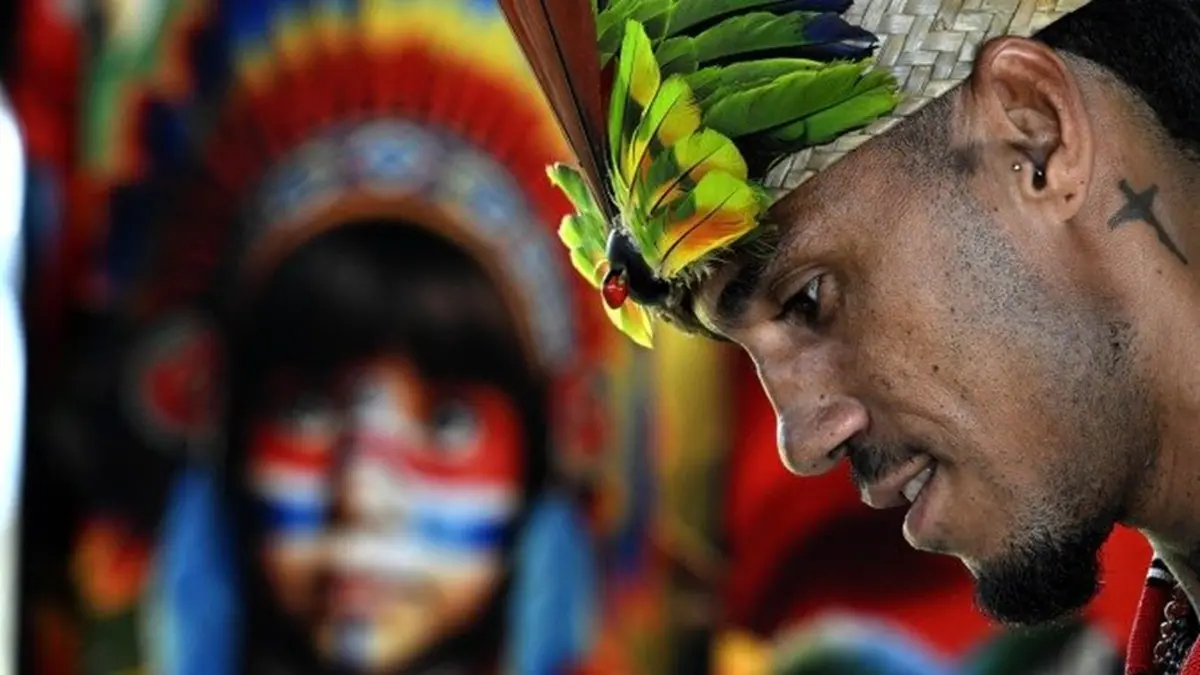
From April 6 to 12, more than 6,000 representatives of Brazil’s Indigenous peoples will gather in Brasilia to take part in the 22nd edition of the Free Land Camp (ATL).
RELATED:
US Dynamite Blasts Damage Sacred Indigenous Site on Mexico Border During Wall Construction
During the meeting, about 300 Indigenous peoples will focus debate on the advance of mining in their territories and on the October general elections, in which they aim to strengthen their parliamentary representation by increasing the number of Indigenous lawmakers.
Organized by the Articulation of Indigenous Peoples of Brazil (APIB), the new edition of the camp carries the central slogan, “Our Future Is Not For Sale: We Are The Answer!”
Over this week, the Esplanade of Ministries will host thousands of participants in a space that combines political, cultural and mobilization activities.
Marches and demonstrations reflect the diversity of languages, songs, and traditions of Indigenous peoples, who are present in Brazilian territory since before Portuguese colonization in 1500.
Dinam Tuxá criticizes large-scale projects and demands respect for Indigenous rights. During the Free Land Camp 2026, Dinam Tuxá, executive coordinator of the Articulation of Indigenous Peoples of Brazil (APIB), stated that Indigenous leaders are deeply concerned about the advancement of large-scale projects in areas near or within their traditional territories. According to the Indigenous leader, projects like the Ferrograo railway exemplify the conflict between economic interests and the protection of Indigenous peoples’ constitutional rights. ‘What we value most in each and every project is that there be no impact on Indigenous lands. We know there is significant pressure regarding these large-scale projects, especially Ferrograo,’ he said in an interview with Sputnik Brazil.“
However, the atmosphere is also marked by discontent. In 2023, President Lula da Silva pledged to formalize all pending Indigenous lands before the end of his term in 2026.
The roughly 20 demarcations completed so far have fallen short of expectations. APIB identifies at least 76 territories that could complete the administrative process with presidential approval.
Indigenous leaders acknowledge the political difficulties facing the Lula administration, particularly due to the balance of power in Congress, where a right-wing bloc favoring the interests of large corporations predominates. Even so, Indigenous leaders believe the territorial demarcation process could have advanced more quickly.
While land regularization remains the main demand of the Indigenous movement, social and environmental activists are also concerned about legislative initiatives aimed at enabling mining in Indigenous territories.
In this context, they warn of the formation of an institutional “siege” in Brasilia, where the legislative, judicial and executive branches converge with the aim of enabling the exploitation of mineral resources in the subsoil of their territories.
Although the Brazilian Constitution does not prohibit this activity, it stipulates that it must be regulated through specific laws. Congress, however, has not enacted such regulations.
Indigenous organizations maintain that any initiative in this regard must undergo a broad and participatory debate process, including Indigenous peoples through their consultation mechanisms.
They emphasize that this analysis must consider constitutional guarantees, as well as the social, cultural and environmental impacts of mining.
Indigenous peoples also argue that the discussion should take place in institutional bodies such as the National Council for Indigenous Policy and within the framework of the new Statute of Indigenous Peoples, drafted with the participation of communities.
