

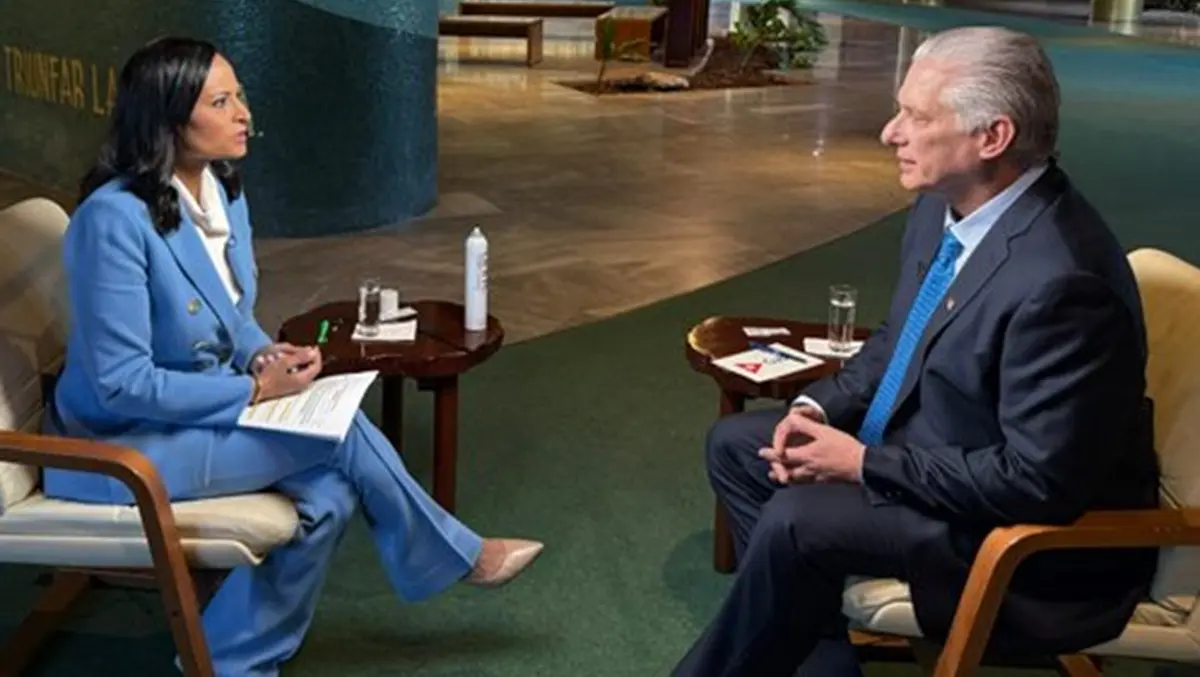
Surrender is ‘not part of the revolutionary vocabulary,’ he stressed.
On Thursday, Cuban President Miguel Diaz-Canel said he will not resign from his post, during an interview with NBC News’ “Meet the Press.”
RELATED:
Cuban President Meets Russian Deputy Foreign Minister in Havana
Asked by journalist Kristen Welker whether he would step down to “save his country,” he responded that surrender is not part of the revolutionary vocabulary. Diaz-Canel stressed that his mandate comes from the Cuban people, not from external designs.
“In Cuba, those who hold leadership positions are not elected by the U.S. government nor do they have a mandate from that government,” he said, adding that he would only leave the presidency if citizens considered him incapable of representing them.
“We have a free and sovereign state… We enjoy self-determination and independence,” the Cuban president stressed.
During the interview, he questioned whether the question about his resignation was the journalist’s idea or a directive from the U.S. State Department.
Diaz-Canel also mentioned that the Cuban government reiterated its willingness to negotiate with the United States. “We can negotiate, but at the table without pressure or attempts at U.S. intervention.”
The Cuban president’s remarks come amid a scenario of pressure, marked by the intensified and prolonged U.S. blockade against the island and constant U.S. threats of intervention in Cuba.
This week, during the International Conference on Coercive Measures organized by the United Nations, Diaz-Canel denounced that the U.S. oil blockade has caused critical situations in the health system, affecting surgeries and vital treatments due to a lack of electricity.
He also said that fuel shortages have caused an almost total paralysis of public and private transportation, simultaneously affecting businesses and food production, which negatively impacts the supply of basic goods.
These circumstances are a direct result of the executive order signed by U.S. President Donald Trump on Jan. 29. That executive order authorizes Washington to sanction countries that supply oil to Cuba, which generated a fuel shortage in the island nation.
In response to Trump’s offensive — who declared Cuba an unusual and extraordinary threat to U.S. security — international solidarity has manifested through statements, demonstrations, and the sending of aid.
At the end of March, for example, the Russian tanker Anatoly Kolodkin arrived in Havana carrying 740,000 barrels of crude oil to ease the Cuban energy crisis.
[ SOURCE: teleSUR ]
