

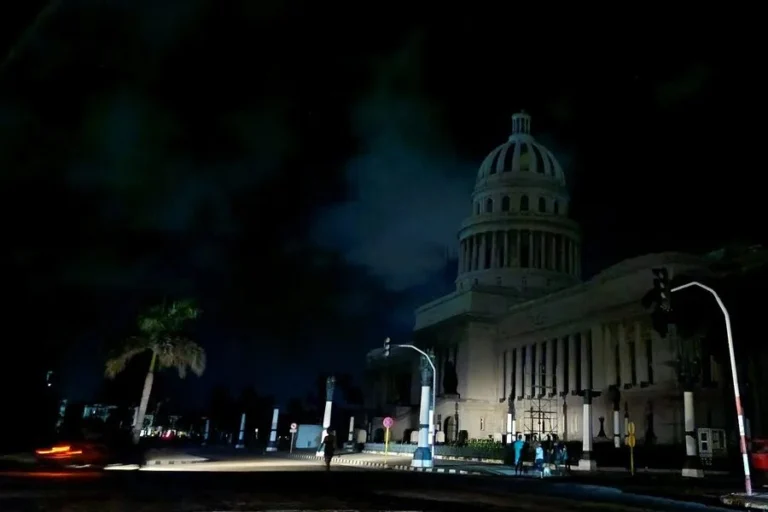
Cuban President Miguel Díaz-Canel reported on the tense situation facing the National Electric System (SEN) in recent days, projecting a deficit of over 2,000 megawatts (MW) during peak demand hours on Wednesday, May 13th.
The president attributed this “dramatic worsening” directly to the “genocidal energy blockade” imposed by the United States against Cuba for more than six decades, stating that the lack of fuel is responsible for the unavailability of 1,100 MW of generation capacity in the country on Wednesday.
According to the presidential statement, the U.S. government has intensified its measures through threats of tariffs and coercive measures against any nation or entity that supplies hydrocarbons to the island.
The situation of the National Electrical System has been particularly tense in recent days.
A deficit of more than 2,000 MW is forecast for today during peak demand hours. This dramatic worsening has a single cause: the genocidal regime.
Díaz-Canel emphasized that the system’s operation depends on the arrival of supplies, citing as an example the improvement experienced in April after the arrival of a single (Russian) ship, although he stressed that the nation requires at least eight shipments per month to stabilize the service.
The head of state rejected the narratives that characterize Cuba as a failed state or that attribute the crisis to government mismanagement, calling such claims part of a disinformation agenda.
Instead, he described the current situation as the result of a plan designed to stifle the economy and inflict suffering on the population through 243 tightening measures and executive orders that penalize trade and foreign investment.
The president recalled that the partial easing of sanctions years ago demonstrated mutual benefits for both peoples, contrasting this with the current policy which, in his opinion, is being hijacked by far-right sectors.
Faced with this complex scenario, Díaz-Canel reaffirmed his government’s commitment to maintaining a dialogue on equal terms, adding, “We will continue to resist and build, increasingly convinced that it is up to us to overcome these enormous difficulties through our own efforts, united as a nation, and resolute in facing the toughest challenges.”
On April 26, the Minister of Energy and Mines, Vicente de la O Levy, stated that stabilizing the National Electrical System is a government priority in the face of the crisis stemming from the imperial blockade.
During the Round Table program Wednesday evening on Cuban radio and TV, a special address by the Minister of Energy and Mines on the electricity situation was broadcast.
On the Mesa Redonda program, the official explained that the strategy is based on utilizing the island’s own resources and strengthening existing infrastructure to find internal solutions.
Cuba is implementing a strategy to recover its national electrical system, optimizing the country’s energy capacity. The measures include fuel production, maintenance of power units, and prioritize solar energy.
Within the recovery plan, de la O Levy highlighted the maintenance work being carried out on generating units and the processing of fuels from domestically produced crude oil and gas. She also emphasized the promotion of renewable energy sources, with a particular focus on storage systems that allow for the management of solar energy to support supply during nighttime hours and peak demand.
IMAGE CREDIT: Stabilizing the National Power System is a government priority in the face of the crisis stemming from the imperial blockade, stated Minister of Energy and Mines Vicente de la O Levy Photo: EFE
[ SOURCE: teleSUR ]
