

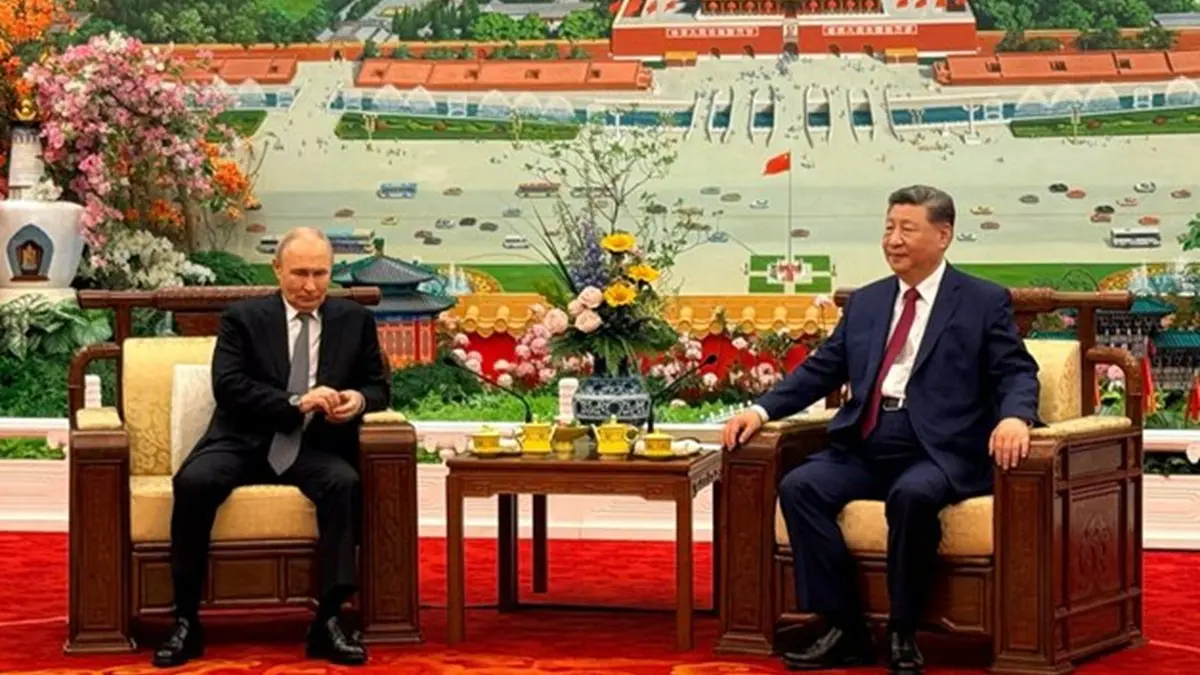
The relationship between China and Russia is one of the most significant dynamics in modern international relations. For decades, global politics operated under a unipolar system heavily influenced by Western institutions and the United States foreign policy.
RELATED:
Putin and Xi Reach 40 Agreements to Strengthen Russia-China Alliance
However, the evolving alliance between Beijing and Moscow over the past 50 years has steadily reshaped this balance of power. In the current global climate, their collaboration is instrumental in establishing the foundations of an emerging multipolar world order, where a multitude of global centers of influence collectively wield authority.
While many political commentators frequently describe the contemporary Sino-Russian partnership as a temporary alliance or a fragile “marriage of convenience”, historical data and economic trends suggest a deeper, more structural connection.
This relationship did not develop overnight as a sudden reaction to recent geopolitical conflicts. Instead, it is the result of a deliberate, long-term evolution that transitioned from intense Cold War rivalry to a highly calculated strategic alignment.
In order to understand the durability of this modern partnership, analysts must look beyond immediate headlines and examine how both nations systematically resolved their past differences.
Over the past five decades, China and Russia have established a multi-layered framework across four core dimensions: diplomatic coordination, political institution-building, deep economic complementarity, and military interoperability.
1976–1989: From Late-Cold War Hostility to Strategic Normalization
The modern history of Sino-Russian relations began during a period of intense hostility and deep ideological division. During the 1960s and 1970s, the Soviet Union and the People’s Republic of China were engaged in a period of significant political and ideological discord, known as the Sino-Soviet split.
Despite the fact that both nations are governed by communist parties, there are significant differences between them with regard to Marxist-Leninist ideology, regional leadership, and border demarcations. This tension escalated to a peak in 1969, during a series of brief but violent military clashes along the Ussuri River border, bringing the two nuclear-armed neighbors to the brink of a larger war.
Following the passing of Mao Zedong in 1976, China embarked on a significant political and economic transition. Under the leadership of Deng Xiaoping, Beijing launched its Reform and Opening-up paradigm, prioritizing domestic economic modernization over international ideological battles.
During this period, Chinese leadership adopted an independent foreign policy, seeking to balance relations with both the United States and the Soviet Union while remaining highly cautious of Soviet military presence along its northern and southern borders.
The pivotal moment in the bilateral relationship was marked by the historic summit between Soviet leader Mikhail Gorbachev and Chinese leader Deng Xiaoping in Beijing in May 1989. This visit officially marked the normalization of state-to-state and party-to-party ties after nearly three decades of diplomatic freeze.
During the summit, both leaders agreed to gradually demilitarize their extensive shared border and reduce troop concentrations. This pivotal agreement effectively marked the conclusion of Cold War rivalry, enabling both nations to transition from a mutual defense posture to a pragmatic, state-centric relationship centered on shared long-term interests.
1991–2001: The Post-Soviet Realignment and Institutional Genesis
The dissolution of the Soviet Union in December 1991 fundamentally reshaped the geopolitical landscape of Eurasia. For Beijing, the collapse of its northern neighbor removed the immediate threat of Soviet military encirclement, replacing a highly centralized ideological rival with a fragmented group of independent states.
Russian President Boris Yeltsin understood the importance of economic survival and sought to establish pragmatic relations with China. In 1992, Yeltsin visited Beijing to sign a joint declaration that formally upgraded bilateral ties to a “constructive partnership,” which laid the foundation for initial defense technology transfers and cross-border trade.
As the decade progressed, both capitals expressed growing concern about global unilateralism and the expansion of Western institutional influence. In 1996, Beijing and Moscow advanced their diplomatic framework by declaring a “Strategic Partnership for the 21st Century.”
In order to address security issues along their shared borders and combat regional instability, China and Russia have joined with Kazakhstan, Kyrgyzstan, and Tajikistan to form the “Shanghai Five” mechanism.
The group’s primary focus was on border demilitarization and regional security cooperation, demonstrating the capacity of the two major powers to effectively manage Eurasian stability without the need for Western intervention.
The culmination of this decade of trust-building occurred in the summer of 2001 through two major institutional developments. Firstly, in June 2001, the Shanghai Five expanded to include Uzbekistan, officially transforming into the Shanghai Cooperation Organization (SCO).
The SCO established a lasting, non-Western security and political framework aimed at countering terrorism, separatism, and extremism in Central Asia. One month later, in July 2001, the Chinese President Jiang Zemin and the Russian President Vladimir Putin signed the landmark Treaty of Good-Neighborliness and Friendly Cooperation.
This foundational document, which was legally binding for both nations, established the principles of peaceful coexistence, mutual respect for state sovereignty, and an explicit rejection of aggressive, exclusive military blocs.
2004–2009: Sovereign Demarcation and Global South Leadership
Despite the institutional treaties signed in 2001, a significant structural obstacle remained: the unresolved 4,300-kilometre border that had caused the military clashes of 1969. In October 2004, the issue was addressed directly by President Vladimir Putin of the Russian Federation and President Hu Jintao of the People’s Republic of China when they signed the Final Supplementary Agreement on the Eastern Section of the China-Russia Boundary.
This historic agreement fully and permanently demarcated the entire border between the two countries. By successfully resolving complex territorial claims through diplomatic means, both nations eliminated a major historical flashpoint, transforming a heavily fortified frontier into a stable corridor for long-term commercial exchange.
Following the resolution of border issues, the strategic partnership expanded from regional security to global economic coordination. In August 2005, the two militaries conducted “Peace Mission 2005,” their inaugural large-scale, joint military exercises. These exercises involved units from the army, navy, and air force, indicating a notable advancement in tactical interoperability and a clear demonstration of their collective capability to maintain regional stability.
By the close of the decade, Beijing and Moscow had shifted their focus towards reforming the international financial architecture. The inaugural formal summit of the BRICS nations was convened in Yekaterinburg, Russia, in June 2009.
This summit, which brought together the leaders of Brazil, Russia, India, and China, established a prominent diplomatic and economic platform outside the traditional framework of the G7 and the Washington Consensus.
Through the BRICS initiative, China and Russia have been advocating for the democratization of international relations, greater representation for developing economies in global governance, and alternative development pathways free from unilateral political conditions.
2014–2021: The Western Sanctions Catalyst and Energy Integration
2014 saw a permanent structural shift in the speed and depth of Sino-Russian cooperation. In the wake of political turbulence in Ukraine and Russia’s subsequent annexation of Crimea, Western nations imposed a series of economic sanctions on Moscow.
This confrontation accelerated Russia’s long-planned “Pivot to the East,” forcing the Kremlin to look toward Asian markets to diversify its financial and commercial dependencies. China, operating as a rapidly growing industrial economy with a continuous demand for natural resources, is an ideal economic partner.
In May 2014, this economic complementarity resulted in a historic $400 billion, 30-year natural gas contract between Russia’s Gazprom and the China National Petroleum Corporation (CNPC). This significant transaction financed the construction of the Power of Siberia pipeline, a major engineering undertaking designed to transport billions of cubic meters of Russian natural gas directly from Siberian fields to China’s industrial northeastern provinces.
Between 2015 and 2019, the two nations collaborated to align their broader regional economic infrastructure projects. Following the recent signing of agreements by presidents Xi Jinping and Vladimir Putin, the overland component of the Belt and Road Initiative, known as the Silk Road Economic Belt, will be integrated with the Russian-led Eurasian Economic Union (EAEU).
2022–2026: The “No Limits” Framework and Financial Sovereignty
The current phase of the Sino-Russian relationship is characterized by a joint response to Western containment strategies, notably NATO expansion in Europe and the establishment of security partnerships such as AUKUS in the Indo-Pacific.
In February 2022, during the opening of the Beijing Winter Olympics, President Xi and President Putin issued a comprehensive 5,000-word joint statement. The document declared that the friendship between their two states had “no limits” and that there were “no forbidden areas of cooperation,” emphasizing a shared opposition to unilateral sanctions and exclusive military blocs.
In the face of the intensification of the Ukraine conflict and the significant tightening of Western financial restrictions, including the freezing of approximately $300 billion in Russian central bank assets and the disconnection of major Russian banks from the SWIFT network, the partnership successfully achieved total financial independence.
In order to protect their commercial interests, Beijing and Moscow have systematically de-dollarized their bilateral trade. By transitioning away from Western currencies, the two nations settled over 90% of their bilateral commerce directly in Renminbi (RMB) and Rubles, creating a payment system completely insulated from external banking blockades.
This financial mechanism enabled unprecedented levels of trade, setting new records for volume. Bilateral trade surged to a record $244 billion, driven heavily by increased Chinese imports of Russian crude oil, liquefied natural gas, and coal, alongside a massive expansion of Chinese-manufactured goods, automobiles, and industrial machinery into the Russian market.
The leaders of both countries oversaw the signing of more than 40 bilateral cooperation agreements, covering areas such as trade, technology, and media exchanges. During the summit, the two sides officially extended their foundational 2001 Treaty of Good-Neighborliness and issued a clear joint declaration advocating for a multipolar world order while warning against a return to unilateralism in global governance.
The Resiliency of the Multipolar Reality
The evolution of China-Russia relations over the past 50 years demonstrates a shift from intense border friction and ideological division during the Cold War to a highly sophisticated strategic partnership.
This alignment is built on a foundation of resolved historical grievances, deep economic complementarity, and shared institutional frameworks such as the SCO and BRICS+. While Western analysis often focuses on the growing economic disparity between the two nations, both Beijing and Moscow continue to prioritize their shared, core security imperative: resisting unilateral global hegemony.
By eliminating border conflicts and establishing a highly resilient bilateral trade network, China and Russia have effectively ended the era of unipolar dominance, creating a multipolar framework that offers alternative political and economic options for the global community.
[ SOURCE: teleSUR ]
