

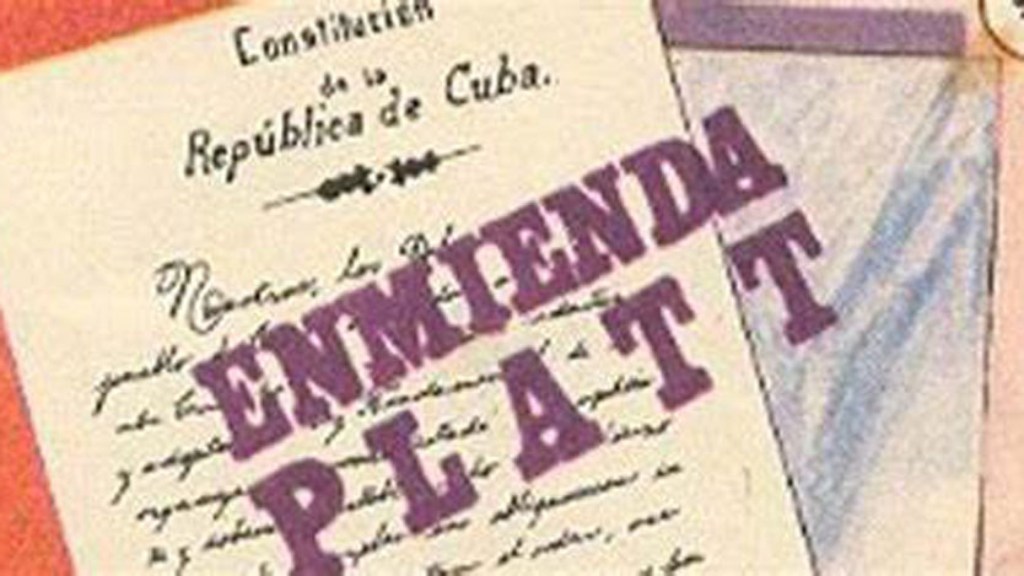
The Platt Amendment, a significant and controversial episode in Cuban history, symbolizes the limitations imposed on national sovereignty at the beginning of the 20th century and remains part of the country’s historical and political debate today.
Approved by the United States Congress in 1901 and incorporated into the Cuban Constitution as a condition for ending the U.S. military occupation, it established restrictions that conditioned the full exercise of the independence won after decades of struggle against Spanish colonialism.
Among its relevant provisions was the right of the United States to intervene in the affairs of the Caribbean nation when it considered political stability or certain strategic interests threatened.
It also prevented the island from entering into treaties with other nations that would compromise its independence and established the basis for the cession of territories designated for naval and coaling stations.
The imposition of that legislation generated intense debates among political leaders and patriots of the time, who adopted, primarily, two opposing positions.
For some, it was an inevitable concession given the circumstances of the moment, while for others, it represented a violation of the ideals of sovereignty for which generations of Cubans fought in the 19th-century wars of independence.
Its entry into force coincided with the birth of the Republic in 1902 and conditioned a significant part of national political life for more than three decades, as its application served as the basis for several US interventions on the island and consolidated an asymmetrical relationship between the two countries that influenced Cuban economics, politics, and society.
The repeal of the Amendment, formalized in 1934, represented an important step in the recovery of the sovereign powers of the Cuban state, but it left a heavy shadow.
Numerous historians believe that the consequences of that period continued to resonate on the nation long after its formal elimination, and that only after 1959 did a near-unanimous and outright opposition to the Platt Amendment emerge.
More than a century after its ratification, it remains a subject of study in universities, research centers, and public forums, particularly for understanding the complexities of the Republic’s formation and the challenges the nation faced in defending its self-determination.
Currently, references to this historical chapter frequently appear in debates related to sovereignty, independence, and Cuba’s international relations.
Experts agree that the experience of the first half of the 20th century contributed to forging a national consciousness particularly sensitive to any form of external interference in the country’s internal affairs.
Cuba-United States relations have gone through various stages since then, marked by periods of rapprochement and estrangement. Nevertheless, the Platt Amendment remains a recurring reference point when analyzing bilateral relations and the historical aspirations of Cubans to fully and unconditionally exercise their right to self-determination.
More than a century later, that legal instrument remains a symbol of a complex period in national history and a reminder of the importance that the defense of sovereignty has had — and continues to have — in shaping Cuba’s political identity.
[ SOURCE: PRENSA LATINA ]
