

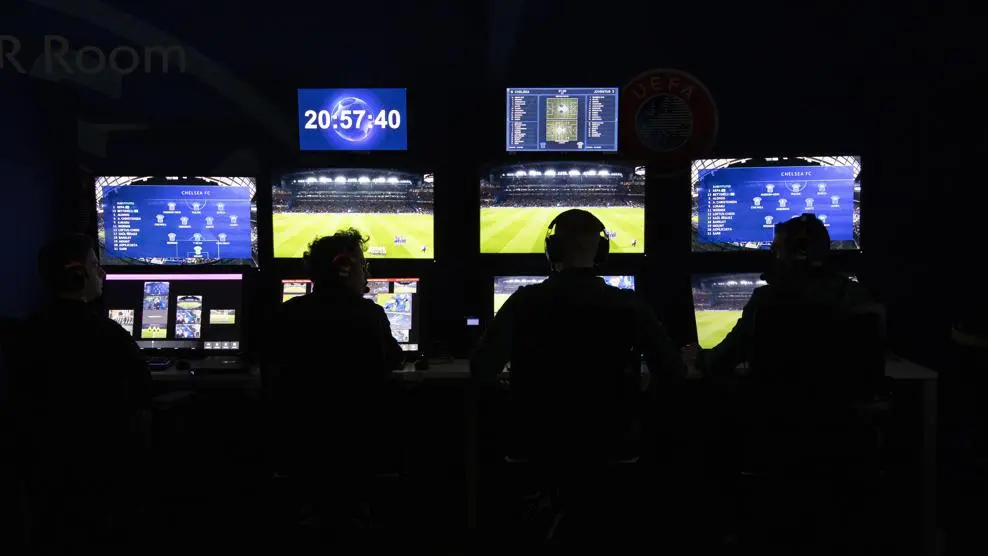
UEFA and the 55 national associations of the European continent reached a series of common guidelines for the 2026/27 season during a meeting held in Nyon, Switzerland.
The gathering, which included participation from the International Football Association Board (IFAB) Board of Directors, sought to unify the interpretation of the rules, increase effective match time, and ensure a more limited use of video refereeing.
RELATED: CONMEBOL Confirms FIFA World Cup 2030 Centenary Matches in South America
The measure comes after the refereeing controversies recorded during the FIFA World Cup 2026, marked by prolonged reviews of offside plays and penalty situations. In response, UEFA insisted that VAR will only intervene in the event of a “clear and obvious” error or a manifestly missed action, avoiding the re-refereeing of matches from the video room.
“The popularity of football requires eliminating any doubt from the game and ensuring that the rules are applied with clarity,” said Roberto Rosetti, UEFA’s chief refereeing officer, highlighting the importance of the agreement.
Stricter Time Management
The new guidelines also include reducing extensive reviews at the monitor and strictly applying IFAB provisions to combat time-wasting during goal kicks, throw-ins, substitutions and injury interruptions.
UEFA aims to recover minutes of effective play that have been progressively lost in recent seasons due to frequent VAR stoppages. Statistics from major European leagues have shown that video reviews can add between two and five minutes of additional stoppage time per match, with some decisions taking over three minutes to resolve at the pitchside monitor.
The agreement also reinforces the exclusive communication protocol between team captains and the main referees, a formula successfully tested during Euro 2024 with the goal of reducing protests and promoting respect on the field. This measure proved effective in decreasing the number of players surrounding officials and has been praised by match officials across the continent.
UEFA will announce in the coming weeks new initiatives to facilitate the uniform implementation of these rules across all its competitions, including the UEFA Champions League, Europa League, Europa Conference League, and national team tournaments such as the European qualifiers for the 2028 FIFA World Cup. The objective is to ensure consistency in refereeing across different leagues and competitions, addressing a long-standing complaint from clubs and managers about varying interpretations of the same rules.
The decision represents a significant shift in the approach to video technology in football. Since its introduction in top-level competitions, VAR has been both praised for correcting clear injustices and criticized for disrupting the flow of the game and undermining the authority of the on-field referee. UEFA’s new framework seeks to strike a balance, preserving the corrective function of technology while preventing it from dominating the match experience for players, coaches and fans alike.
The IFAB, which sets the global rules of football, backed the UEFA initiative, signaling that a broader international consensus may be on the horizon for the 2027/28 season. For now, European football leads the way toward a more streamlined and efficient use of video technology -one that prioritizes the game itself over the review screen.
Author: Laura V. Mor
Source: Agencies
Source: teleSUR English
