

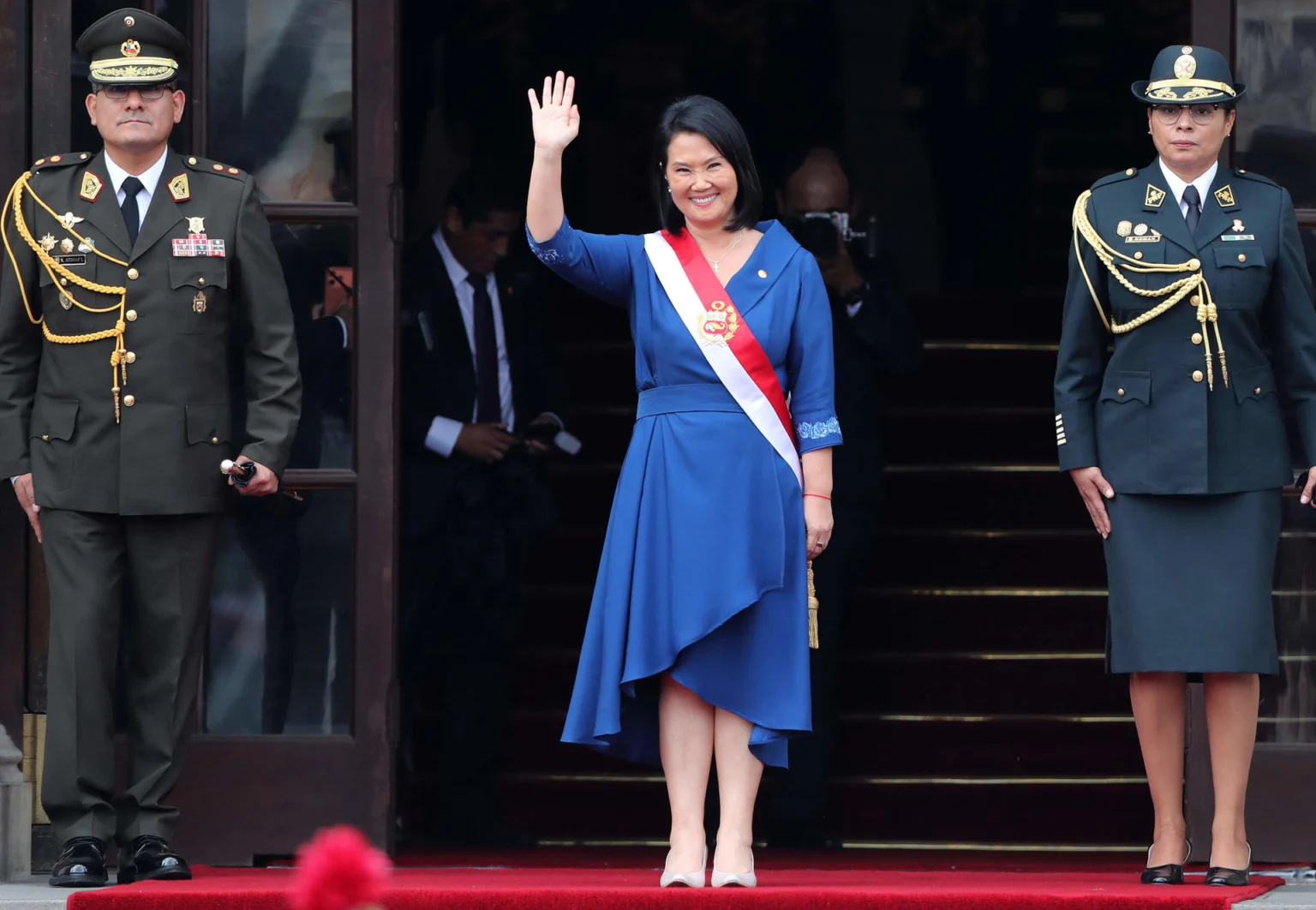
The leader of the conservative Popular Force party (Fuerza Popular, in Spanish) took the oath of office before Congress, her hand placed on a Bible and facing a crucifix.
“I swear before you, by God and the homeland, upon these holy gospels, that I will faithfully exercise the office of President of the Republic,” declared the daughter of the former president Alberto Fujimori (1990-2000), who rose to power after losing three consecutive runoffs.
RELATED: Keiko Fujimori Becomes Peru’s Ninth President in 10 Years
Already wearing the presidential sash, Fujimori announced that her administration will focus on two national emergencies: the El Niño weather phenomenon and public security, alongside a “profound” prison reform.
However, the arithmetic behind her victory reveals a fragile mandate. Out of 27 million eligible Peruvians, only 2.8 million voted for her in the first round -roughly one-tenth of the electorate.
In the runoff, she gathered 9.2 million votes, one-third of registered voters. Her advantage over Roberto Sánchez, the candidate of Together for Peru party (Juntos por el Perú, in Spanish), stood at just 49,641 ballots -less than 0.3% of the votes cast.
Legislative and Climate Challenges
The promise of order that sustained Fujimori’s campaign collides with the legislative inheritance of her own caucus. The outgoing Congress, dominated by Popular Force party and its allies, approved norms that loosened the prosecution of crime. One redefined the crime of criminal organization by demanding more sophisticated structures, leaving entire criminal gangs beyond the reach of complex judicial tools. Another requires the Prosecutor’s Office to wait for the suspect and their lawyer before raiding a property. A third cut the statute of limitations for serious crimes, risking impunity in corruption and money laundering cases.
The second emergency is equally uncomfortable. El Niño will strike the northern coast between late this year and early next. Further south weigh the deaths of civilians during protests against Dina Boluarte, whose rise was read in the Andean region as a maneuver by Fujimorism from Parliament. Fujimori becomes the nineth Peruvian ruler in ten years, a statistic that underscores the chronic political instability that has plagued the Andean nation.
Regional Outreach
With that internal map on her shoulders, the inaugural speech sought external room for maneuver. Fujimori promised to prioritize regional integration, boost the Pacific Alliance, reactivate the Andean Community, and expand cooperation with Asia-Pacific and the Middle East.
The Fujimori administration thus begins its term walking a tightrope: governing with a slim mandate for a nation deeply divided, facing natural disasters on the horizon, a security crisis that her own party’s legislative record may have exacerbated, and the task of rebuilding trust in democratic institutions after a decade of revolving-door presidencies. Her first test will come not from the opposition, but from the very Congress that supports her -and from the streets of a country where half the voters chose someone else.
Author: Laura V. Mor
Source: Agencies
Source: teleSUR English
