

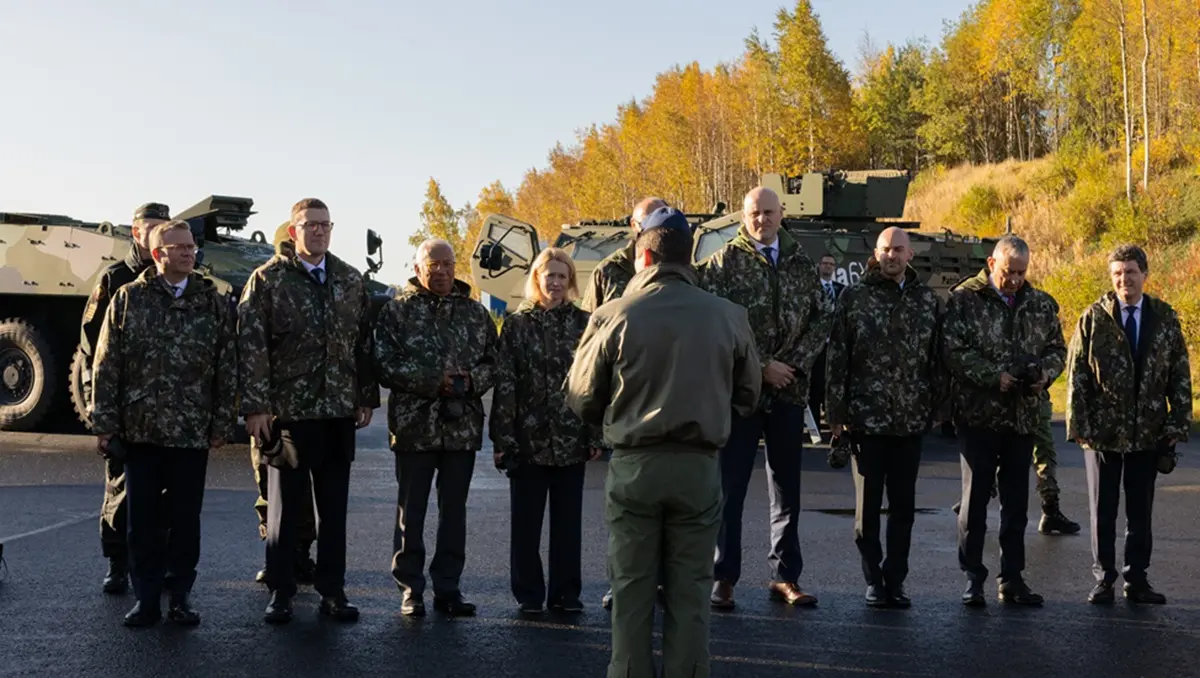
On Monday, European leaders called for stronger, coordinated European Union (EU) action in the Arctic, highlighting the region’s growing importance for European security and economic development.
RELATED:
NATO’s Arctic Buildup Threatens Regional Stability: Russia
Finnish Prime Minister Petteri Orpo, who hosted the two-day European Arctic Summit in Rovaniemi, said its main message was that there was “a high demand for concrete action by the EU in the Arctic.”
Speaking at a press conference following the summit, Orpo said participants agreed on the need to strengthen their shared assessment of threats and risks and their understanding of the Arctic’s strategic importance.”We need strong and coordinated EU leadership,” he said.
German Chancellor Friedrich Merz called for greater EU attention to the Arctic, citing its security significance and substantial economic opportunities in raw materials, energy and shipping. He also highlighted the region’s importance for space capabilities, referring to a recent rocket launch from Norway.
Merz stressed the importance of involving partners outside the EU in Arctic discussions, naming Iceland, Norway, Britain and Canada.
European Council President Antonio Costa said the EU would remain a reliable, long-term partner to all Arctic allies, European and non-European alike.
While climate protection, sustainable development and peaceful cooperation remained valid priorities, the EU needed to adapt its approach to Arctic security to the new geopolitical reality, he said.
Costa also pointed out that the European Commission and the European External Action Service are updating the EU’s Arctic strategy to address changing geopolitical, economic and environmental challenges.
The European Arctic Summit in Rovaniemi Concluded.
The European Arctic Summit took place in Rovaniemi, Finland, on September 13 and 14. At the conclusion of the event, Finland, Denmark, Estonia, France, Greece, Germany, Latvia, Lithuania, the Netherlands, Poland, Romania, and Sweden issued the following statement:
“The Arctic is undergoing rapid and far-reaching transformation, with growing implications for European security and stability. Intensified great power competition, the consequences of Russia’s war of aggression against Ukraine, China’s increased security policy interest, and the accelerating and severe impacts of climate change are reshaping the region’s strategic environment.
We, as leaders of the European Union and our respective countries, acknowledge the strategic importance of the Arctic region for European and global security. We underline that the European Arctic areas are an integral part of the European Union, encompassing both land and maritime areas, and including a long external EU border with Russia.
Security in the Arctic must be achieved collectively. We express our shared commitment to preserving the Arctic as a region of peace, stability and constructive cooperation, grounded in international law, including inviolability of borders and respect for territorial integrity, multilateral governance as well as Law of the Sea.
We stress the importance of strengthening resilience, through a whole-of-society security approach, and ensuring that growing strategic competition does not undermine the stability in the region.
We note with serious concern the significant and long-term threat Russia poses to Euro-Atlantic security. Russia’s ambitions to increase its influence in the Arctic, combined with its hostility towards Europe, including the increase in hybrid activities highlight the need to strengthen the EU’s Arctic policy.
We look forward to the upcoming Joint Communication by the European Commission and the High Representative on a Resilient, Secure and Peaceful Arctic.
We call for the European Union to take on a more strategic and proactive role in the European Arctic and commit to strengthening the Union’s Arctic engagement in a coherent and forward-looking manner with adequate resources and in line with evolving geopolitical realities.
We agree that the EU needs to step up its action to promote stability, sustainable development and prosperity while safeguarding its interests. Through its policies, programmes and Member States, the Union contributes significantly to security, economic development, research and innovation as well as environmental protection in the region. In this context, we welcome the recently announced EUR 200 million EU-Greenland Partnership Package.
The European Union should reinforce its position in the Arctic, including through enhanced preparedness. This is done, inter alia, by strengthening Member States’ monitoring and analysis capacities, as well as by increasing maritime domain awareness, using the EU Member States’ space-based capabilities and improving information-sharing for an integrated picture within the EU.
The EU and its Member States should promote and pursue the economic opportunities, benefitting notably those who live in the region, as the Arctic region offers potential for sustainable growth and competitiveness in areas such as critical raw materials, space technologies, Arctic and intercontinental shipping, connectivity, and tourism.
We emphasise the need to increase investment in military mobility, cross-border connectivity and the necessary infrastructure in the northernmost regions of the EU. Addressing critical and urgent needs, such as transport connections, digital connectivity and satellite technologies and services, and boosting Member States’ capabilities to respond to hybrid threats is vital for European security and defence, also along the Eastern Flank.
As the Arctic is opening, the EU and its Member States should also pay attention to the ability to operate in the area, including safe and secure shipping capabilities in Arctic conditions. The development of dual use infrastructure and the protection of critical infrastructures at land and at sea should be important cross-cutting priorities in the Arctic regions.
We emphasise that sustainable development and protection of the fragile Arctic environment and ecosystems must remain at the heart of Arctic policies. The transition to clean energy, responsible and sustainable management of natural resources, engagement of Arctic Indigenous Peoples and local communities and investment in sustainable economic activities are essential for ensuring long-term stability and prosperity in the region. Sustainable and responsibly sourced Arctic resources can strengthen critical material supply security.
We underline the value of Arctic scientific research and international academic and scientific cooperation, including with non-Arctic States, as a foundation for knowledge-based and responsible governance of the region as well as its importance for understanding the changes to the global climate.
We reaffirm our commitment to safeguarding the rights, livelihoods and cultures of the Indigenous Peoples and ensuring their effective participation in decision-making processes affecting the Arctic, as set out in the United Nations Declaration on the Rights of Indigenous Peoples.
We underline the importance of close coordination and cooperation between the EU, Member States and like-minded partners. Cooperation and complementarity in particular with NATO’s deterrence and defence, as well as with other international organisations and partners will remain essential to ensure coherent security efforts and strengthen resilience.
We underline that the Arctic is of strategic importance to Euro-Atlantic security and prosperity and thus, we call for stronger EU engagement and investments as well as concrete and comprehensive action to protect our interests and values, safeguard stability, resilience and rules-based governance in the region.”
teleSUR/ JF
Source: Xinhua – European Artic Summit
Source: teleSUR
