

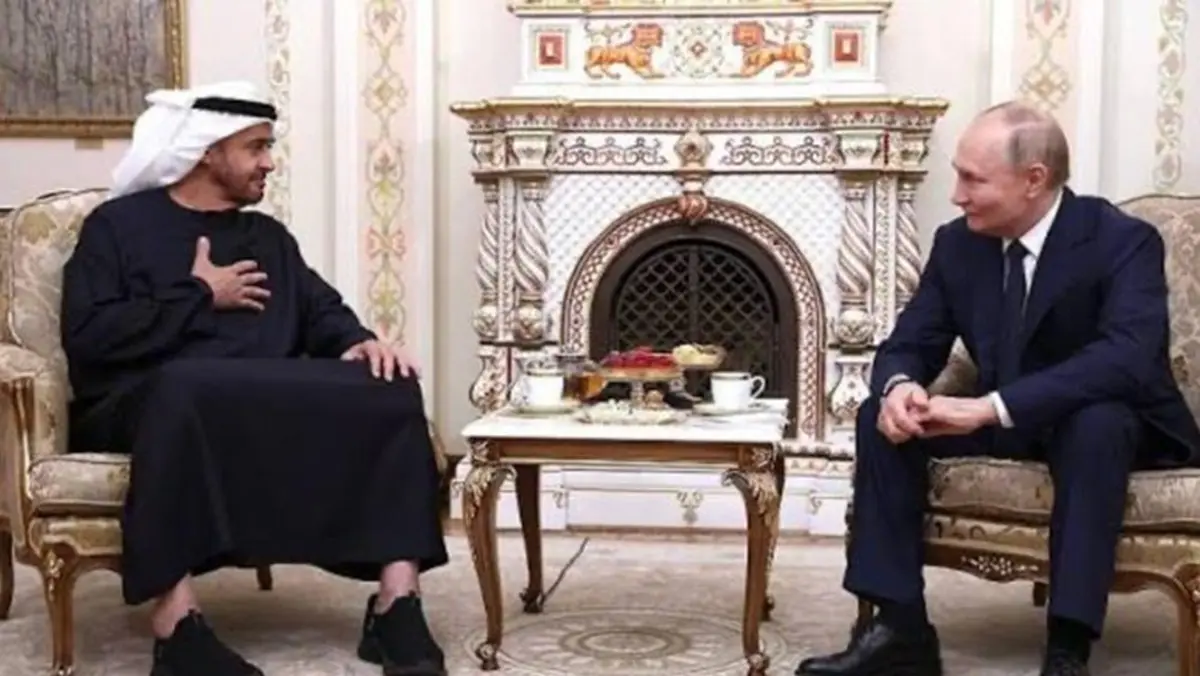
On Tuesday, Russian President Vladimir Putin held a telephone conversation with United Arab Emirates President Mohamed bin Zayed Al Nahyan, during which they discussed the agreements reached between Moscow and Washington on the supply of diesel fuel to the United States.
RELATED:
Russia-U.S. Diesel Deal Is Unrelated to Ukraine Peace Plan: Peskov
“During the exchange of views on international issues, the agreements reached during Vladimir Putin’s telephone conversation with U.S. President Donald Trump regarding Russian diesel fuel supplies were discussed,” the Kremlin press service said, adding that the two leaders also discussed “prospects for resolving the crisis in the Persian Gulf region.”
“In the context of the 55th anniversary of the establishment of diplomatic relations between Russia and the United Arab Emirates, issues related to the future development of strategic and mutually beneficial bilateral cooperation were discussed,” it added.
On Friday, Putin and Trump agreed that Russia would supply diesel fuel to U.S. and global markets, a move that drew sharp criticism from Kyiv and Brussels.
According to the U.S. president, Russia will immediately send more than 300,000 tons of diesel fuel to U.S. and global markets, followed by another 500,000 tons in November and 1 million tons immediately afterward, Trump wrote on his Truth Social platform.
Trump added that “depending on the condition of its diesel refineries, Russia will subsequently deliver — within a short period — 3 million tons of diesel fuel.”
EU Sanctions Could Hinder Diesel Agreement
On Tuesday, Kremlin spokesman Dmitry Peskov said the recent sanctions imposed on Russia by the European Union (EU) could hinder the diesel agreement reached between Putin and Trump.
“Without a doubt, this could hinder” implementation of the agreement, Peskov said, noting that European cynicism, which was also observed by U.S. Treasury Secretary Scott Bessent, “is widely discussed in the international media.”
“The point is that European countries, naturally, like the rest of the countries around the world, are active buyers of Russian oil and hydrocarbons,” he explained.
On Monday, EU foreign ministers formally approved the largest package of targeted sanctions to date, which includes nearly 1,600 individuals and entities linked to Russia’s military-industrial complex.
The new European sanctions were approved just three days after Putin and Trump agreed that Russia would supply diesel fuel to U.S. and global markets.
teleSUR/ JF
Source: EFE
