

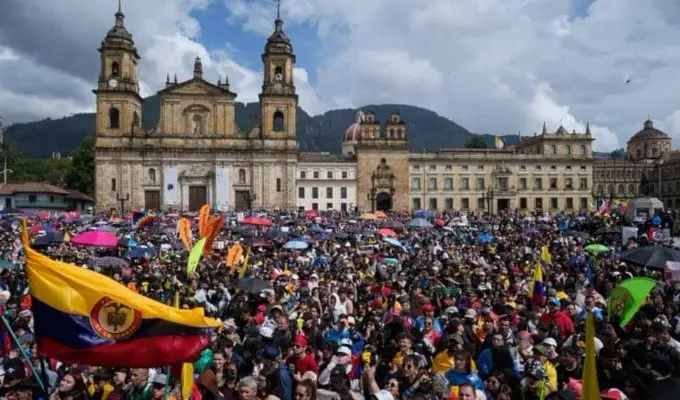
Thousands of people took to the streets across Colombia on Wednesday in the first national strike against President Abelardo de la Espriella’s administration, as police used tear gas, rubber bullets and armored vehicles to disperse demonstrators in several cities.
RELATED: Colombia Holds First National Strike Against De la Espriella
Protests spread across more than a dozen departmental capitals and municipalities, including Bogotá, Medellín, Cali, Barranquilla, Ibagué, Popayán and Bucaramanga. In Bogotá, four columns of demonstrators converged on Bolívar Square under a security operation monitored by a Unified Command Post.
In Medellín, demonstrations escalated into clashes between protesters and the Mobile Anti-Riot Squadron (ESMAD). Security forces deployed tear gas, rubber bullets and armored vehicles, leading to several arrests. Assaults on members of the press were also reported.
Clashes and serious public disturbances were also recorded in Ibagué and Popayán following police interventions. Human rights organizations, including the NGO Temblores, denounced the presence of armed men carrying rifles on the rooftops of government buildings in Bogotá, describing their deployment as a direct threat to protesters.
The demonstrations brought together trade unions, teachers, university students, Indigenous communities, LGBTQ+ groups and feminist organizations. Opposition figures, including former President Gustavo Petro and Senator Iván Cepeda, also took part.
Protesters called for labor, education and social protections, seeking to preserve measures introduced under the previous administration, including free access to public universities and increases in the minimum wage. They opposed what they described as a neoliberal shift under De la Espriella’s government, citing budget cuts and the administration’s initial economic reforms.
Demonstrators also rejected the restoration of diplomatic relations with Israel and what they described as U.S. interference in Colombia’s affairs.
Tensions mounted after the government signed a decree hours before the marches that changes the rules governing police conduct during public demonstrations. De la Espriella defended the measure as necessary to combat “urban terrorism,” while opposition politicians and social organizations condemned it as an attempt to intimidate protesters.
Senator Cepeda warned that the decree risked returning Colombia to a situation in which fear enabled arbitrary actions by security forces.
“They want to take us back to a time when fear becomes the means through which the security forces act arbitrarily,” Cepeda said.
Trade union sources said organizers were already drawing up a schedule of further mobilizations for the coming months following Wednesday’s mass protests. The campaign could culminate in a general strike in November.
teleSUR/ JF
