

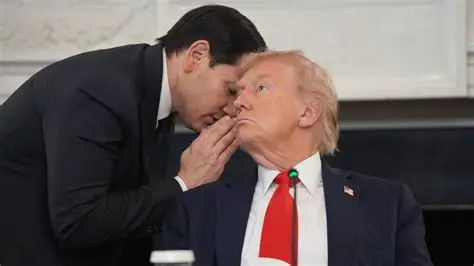
U.S. President Donald Trump and his Secretary of State, Marco Rubio, have once again placed Cuba at the center of their political and media offensive, making statements that anticipate the country’s collapse and hold the revolutionary government responsible for the economic hardships faced by the population. This narrative deliberately omits the decisive role played by the policy of economic, commercial, and financial strangulation—a policy applied by Washington for over six decades and intensified under the current administration.
On Monday, November 9, Trump declared that Cuba is a “failed nation” and predicted that it “will fall quite soon.” The U.S. president did not specify what concrete measures his administration might be considering to bring about such an outcome, though his remarks were made during an appearance in which he also alluded to Washington’s military operations and pressure tactics against other nations.
The U.S. president even went so far as to compare the Cuban ideology to that of the U.S. Democratic Party—an unsubstantiated association that appears aimed more at domestic political confrontation than at accurately describing the reality in Cuba.
These statements were echoed by Florida Republican Congressman Carlos A. Giménez, who asserted on the social media platform X that Trump had promised to “finish the job” in Cuba and that they were “closer than ever” to achieving that goal. This language makes it clear that this is not merely a rhetorical exchange regarding economic models, but rather a political strategy aimed at achieving regime change. For his part, Marco Rubio—Secretary of State and the primary architect of the “maximum pressure” policy against Havana—accused the Cuban government of permitting only enough economic activity to keep the country at a “third-world” level, all while maintaining firm control over the population.
According to Rubio, the Cuban authorities intend for the citizenry to be “100%” dependent on the State, and he asserts that the island’s economic model “does not work.” Furthermore, the head of U.S. diplomacy defended the continuation of the economic embargo, citing the lack of political freedoms in Cuba.
This argument is particularly significant: Washington acknowledges that it maintains a policy of sanctions—conditioning their removal on internal political changes—while simultaneously accusing the Cuban authorities of being solely responsible for the economic consequences endured by the population.
The embargo that does not exist in the discourse of Trump and Rubio
Neither Trump nor Rubio explains in their statements that the United States maintains a complex web of sanctions that limits Cuba’s ability to trade, access international financing, acquire technology, conduct banking transactions, and secure essential supplies.
They also fail to mention the tightening of measures targeting the island’s energy supply. The Trump administration has intensified its pursuit of maritime networks involved in transporting oil to Cuba and has expanded sanctions against companies and entities linked to strategic sectors of the economy. On November 5, Washington announced new measures targeting entities, individuals, and vessels connected to these activities, according to reports from Reuters and the Associated Press.
U.S. pressure regarding fuel supplies—including threats to impose tariffs on countries that provide oil to Cuba—has created severe energy challenges, leading to blackouts and operational issues for essential infrastructure. Reuters has reported that the oil embargo in place throughout 2026 has exacerbated fuel shortages and the deterioration of electrical services on the island.
Under these conditions, framing Cuba’s economic difficulties as an isolated piece of evidence for the failure of its economic model ignores a fundamental variable: the systematic intervention by a foreign power to restrict the commercial and financial relations of a sovereign nation.
The UN once again calls for the lifting of the embargo.
Washington’s narrative also obscures the international isolation of its policy toward Cuba.
On October 28, the United Nations General Assembly once again rejected the U.S. economic, commercial, and financial embargo—for the thirty-fourth time since 1992—and called for its removal. The resolution reflects sustained international opposition to a unilateral policy that hinders the island’s economic and social development.
The vote represents another diplomatic setback for Washington and reflects the fact that the policy of sanctions against Cuba continues to be widely questioned internationally. Many countries argue that these measures violate fundamental principles of the United Nations Charter, including the sovereign equality of states and the principle of non-interference in their internal affairs.
A psychological warfare operation aimed at securing Cuba’s political surrender
The statements by Trump and Rubio must also be analyzed within the context of a pressure strategy that combines economic sanctions, political threats, diplomatic isolation, and communication operations.
First, economic and energy-related restrictions are used to exacerbate the material hardships faced by the population. Then, these very hardships are presented as proof that the Cuban political system is unviable. Finally, it is claimed that the country is on the verge of collapse and that the United States could intervene to steer it toward a different future.
This narrative seeks to place the entire responsibility for economic hardship on the Cuban government, while obscuring the pressure exerted by Washington and the consequences this has on the daily lives of millions of people.
Rubio’s message goes even further: the lifting of the blockade is made conditional upon political changes in Cuba. In other words, the normalization of economic relations is presented as a reward that the island could only obtain by altering its political system to meet U.S. demands.
Trump’s insistence that Cuba “will fall soon,” combined with the support from figures like Giménez for the idea of “finishing the job,” adds an element of threat to this strategy. This is not a proposal for dialogue between sovereign states on equal footing; rather, it is a policy that seeks to exploit economic vulnerability as a tool to force political decisions.
At the heart of the matter lies Cuban sovereignty. The United States attempts to portray itself as the savior of a population that it is simultaneously subjecting to a policy of economic pressure—a policy that only serves to worsen their living conditions. Trump and Rubio speak of freedom, prosperity, and humanitarian aid, yet they maintain a strategy that makes the well-being of the population contingent upon the acceptance of their political demands. The contradiction between this rhetoric and Washington’s concrete measures constitutes one of the core elements of this new offensive against Cuba.
A country’s sovereignty cannot be used as a bargaining chip to secure fuel, food, medicine, or access to international markets. Furthermore, a nation’s economic hardships do not grant any foreign power the right to determine its political future.
Cuba faces problems that must be resolved, but it is up to the Cuban people to decide how to address them—free from threats, blackmail or impositions from Washington.
Sources: Europa Press (10/11/2026); Reuters (5/11/2026); Associated Press (November 2026); United Nations (28/10/2026); public statements by Donald Trump and Marco Rubio (9/11/2026).
IMAGE CREDIT: Image: Screenshot from Notigram
[ SOURCE: www.cubainformacion.tv ]
