

The funds will help immunize about 62,000 newborns, more than 780,000 infants and over 110,000 people in other risk groups, the organization said in a statement. The amount, equivalent to roughly €1.82 million, will also support rabies prevention and control.
Director-General Tedros Adhanom Ghebreyesus framed the aid as protection for a health system built over decades. “Cuba’s public health achievements, achieved with so much effort, must be protected,” he said on the last day of his official visit, according to the statement.
RELATED: W.H.O. Chief Visits Cuba to Explore Stronger Support Amid Crisis
Ghebreyesus called “the supply of essential vaccines by W.H.O. and Pan American Health Organization (PAHO)” a further sign of the commitment “to support Cuba in the face of major health challenges and to help maintain access to fundamental health services.”
He added that the organization would remain “by the side of the Cuban people to protect health, save lives and sustain the progress achieved.”
The announcement comes as Cuba’s vaccination coverage, historically among the strongest in the Americas, has slipped. For many years the island kept coverage above 98%, but in 2025 the figure fell to 95%, the statement noted. The decline, while still leaving Cuba ahead of many regional peers, has alarmed health officials who see routine immunization as a pillar of the country’s public health model.
Ghebreyesus arrived in Cuba on Sunday for a three-day visit that included tours of health and biotechnology institutions and meetings with health authorities. He also met President Miguel Diaz-Canel and told him he would “continue seeking ways to support the public health of the Caribbean country, either with W.H.O. funds or by mobilizing resources from other partners.”
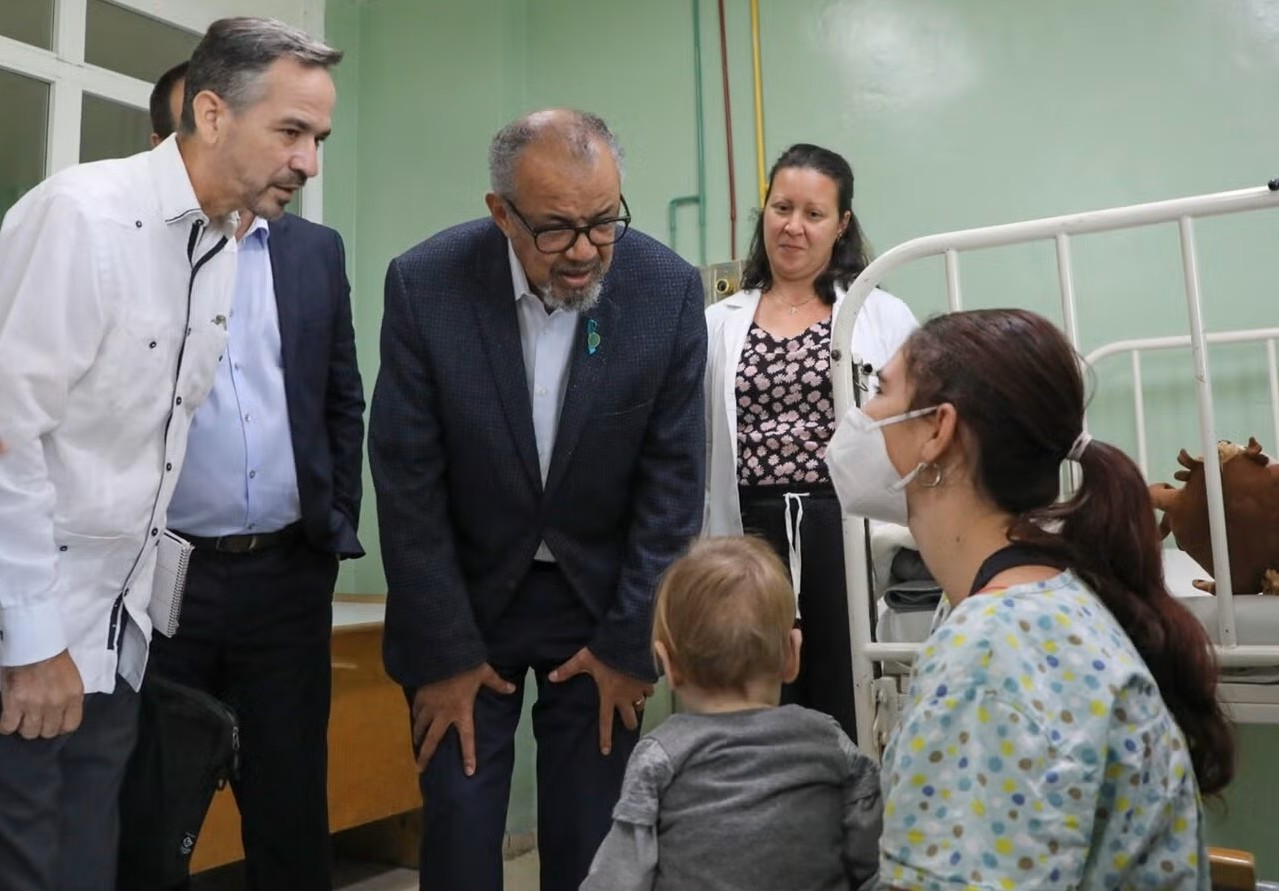
During his stay he visited the William Soler University Pediatric Hospital and its pediatric cardiology center, where he spoke with health workers and with families of children under treatment. The delegation traveling with him delivered essential medical supplies and equipment to strengthen the hospital’s response capacity. He also discussed financial and strategic backing for public health with the United Nations team in Cuba and other cooperation partners.
This is his second visit to Cuba since 2018 as W.H.O. Director-general. On arrival he said the trip would allow him “to better understand the challenges” facing the country, which is enduring a deep energy and economic crisis, and to “mobilize the international community to support them.”
The aid carries added weight in a country that has exported medical cooperation to dozens of nations while struggling with shortages at home. Cuba’s immunization program rests largely on vaccines produced domestically and covers a wide schedule from early childhood.
Cuba has long presented its health record as proof that a small, blockaded economy can deliver outcomes on par with far wealthier states. The new funding aims to sustain that system as economic pressures strain supplies and logistics. Officials have pointed to the coverage drop as a warning, and the W.H.O. pledge signals an effort to halt the erosion of routine vaccinations before it deepens.
End to U.S. Fuel Blockade Demanded
Director-General Tedros Adhanom Ghebreyesus called on United States to lift its fuel blockade against Cuba without delay, warning that the measure is putting children’s lives at risk.
“The intensification of fuel restrictions and sanctions is causing direct harm to the Cuban people, especially the most vulnerable,” he stated. “It is endangering their lives, including the lives of children,” Ghebreyesus warned.
The warning carries unusual weight. The World Health Organization rarely frames a member state’s foreign policy as a direct threat to public health, and Tedros placed responsibility squarely on the fuel blockade that Washington imposed in January and tightened in the months that followed.
The appeal also matters because it comes from the head of a technical agency rather than a political body. Tedros framed the blockade not as a diplomatic dispute but as a health emergency, language that could sharpen pressure on Washington as it weighs its next moves.
The effects reach far beyond dark homes. Cuban authorities report daily blackouts that stretch twenty hours or longer, critical shortages of medicines and surgical supplies, and a decline in health indicators such as infant mortality rates.
President Donald Trump intensified pressure on Cuba starting in January, imposing the fuel blockade and stiff sanctions against a range of Cuban officials and state entities.
UN bodies have repeatedly described the situation on the island as a growing humanitarian crisis and have branded the fuel blockade a violation of international law and of the human rights of all Cubans.
Every year since 1992 the UN General Assembly has approved a nonbinding resolution demanding an end to the U.S. blockade against Cuba, and every year the margin has been wide. That unbroken string of votes has made the blockade one of the most repudiated policies in the international system.
Author: Laura V. Mor
Source: WHO / Cuban Health Ministry / Agencies
Source: teleSUR
