

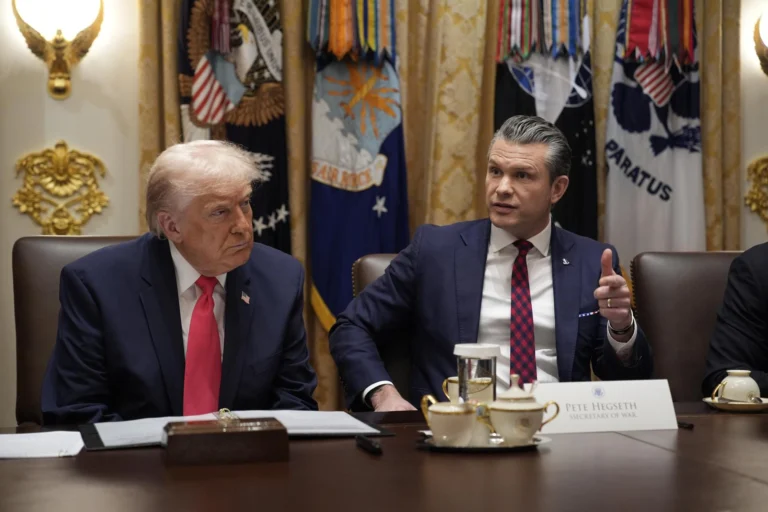
US President Donald Trump reiterated on Tuesday that his Armed Forces will begin ground operations against suspected drug cartels “very soon,” following more than 20 attacks on boats in the Caribbean Sea and the Eastern Pacific, which have left approximately 83 people dead.
During a meeting with his cabinet at the White House, Trump asserted that “on land it’s much easier. We know the routes they take. We know where the bad guys live. And we’re going to start on that very soon, too.”
RELATED:
U.S. Senate and House Leaders Launch Oversight of Caribbean Military Operations
The offensive is part of Operation “Southern Spear,” announced by Secretary of Defense and head of the Pentagon, Pete Hegseth. The recent announcement comes amid criticism of the high-ranking official, who, according to US media, ordered a second bombing to eliminate two survivors, an action that experts say could constitute a war crime.
When asked, Trump stated he had no information on the matter, defended Hegseth, and praised Admiral Frank Bradley, commander of the operation, as “an extraordinary person.”
Donald Trump’s threats, under the guise of the war on drugs, extend to all countries that traffic drugs, alluding to Colombia as a possible inclusion in his proposed ground operations.
“I’ve heard that Colombia, the country of Colombia, produces cocaine. They have manufacturing plants, okay? And then they sell us cocaine. But yes, anyone who does that and sells it to our country is subject to attacks, not necessarily just Venezuela,” Trump stated at the meeting with his cabinet. The US president commented that, although Venezuela “has been worse than most,” there are other nations that, in his view, export drugs to his country.
Operation Southern Spear has been a cover for a military deployment in the Caribbean Sea, which includes the aircraft carrier Gerald R. Ford among its deployed forces, raising tensions in the region with Latin American countries.
The president justified the military actions by claiming they have saved “thousands of lives” in the U.S. by destroying drug-laden boats, while Hegseth denied seeing any survivors while monitoring the attacks and accused the media of spreading information “that is not based on the truth.” Both the White House and the Pentagon insist that all operations are “completely legal” and support Bradley’s actions.
“I didn’t personally see the survivors, but I still support the decision because that thing was on fire. It exploded in fire and smoke. You can’t see it even though there are digital images. This is called fog of war.” “This is what you and the press don’t understand,” the U.S. official asserted when asked about the double fatal attack, perpetrated on September 2.
Venezuela has not responded militarily to the threats, although it has denounced the U.S. pressure aimed at destabilizing the Bolivarian nation and the Latin American region. Venezuelan President Nicolás Maduro emphasized at yesterday’s rally in Caracas that the nation has endured “22 weeks of psychological terrorism,” but they have not succeeded, nor will they succeed, in derailing the country from building the homeland that Venezuelans deserve.
