

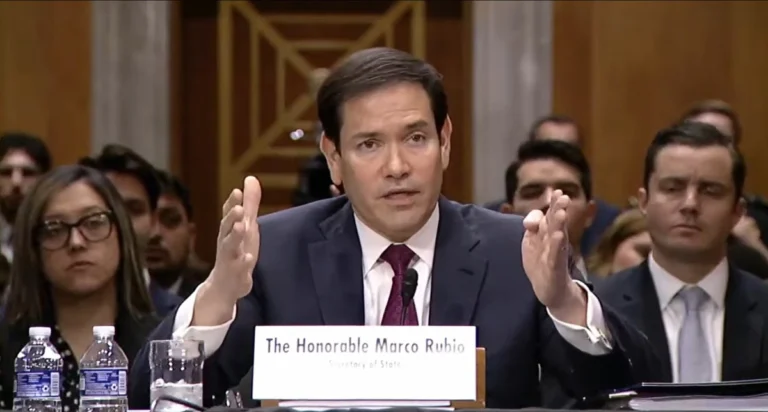
A major political clash shook the U.S. Senate after Republican Senator Rand Paul publicly confronted Secretary of State Marco Rubio for justifying the recent military intervention against Venezuela without congressional authorization, a requirement established in the US Constitution.
During a hearing before the Senate Foreign Relations Committee, Paul denounced the Administration’s attempt to redefine a large-scale military operation as a mere “law enforcement operation,” despite the fact that it included bombings against air defense systems, the blockade of Venezuelan territory, and the kidnapping of President Nicolás Maduro and his wife, Congresswoman Cilia Flores.
The senator directly challenged the official narrative by posing the opposite scenario: if a foreign power were to bomb US defenses, kidnap the President, and leave the country within hours, no one would hesitate to call it an act of war.
Paul emphasized that legal standards cannot be applied unilaterally, warning that double standards erode the constitutional order.
Marco Rubio avoided a direct response and reiterated that the intervention, which according to him lasted only four and a half hours, did not meet the “constitutional definition of war,” citing its speed and the low number of casualties. However, Paul insisted that the duration of an operation does not eliminate its warlike nature, reminding everyone that even brief actions can constitute acts of war under international law.
The senator emphasized that Congress is the only body with the authority to authorize armed conflicts, a prerogative that, he denounced, has been systematically ignored by various US administrations for decades.
Paul also recalled that Donald Trump had promised in 2016 to abandon “regime change” policies, but that the current administration, under his leadership, not only pushed for the removal of the Venezuelan government but also publicly announced that the United States would “administer the country” until a political transition was achieved, thus confirming a direct intervention in the internal affairs of a sovereign nation.
The episode reignited historical comparisons with conflicts such as Vietnam, Afghanistan, Iraq, and Libya, where the United States avoided formally declaring war while conducting large-scale military operations. Paul warned that this practice of rebranding wars as “special missions” or “police actions” constitutes semantic manipulation intended to evade legal and political responsibility.
At a key moment in the hearing, the senator asserted that arguments that cannot be universally applied lack legitimacy, accusing U.S. foreign policy of operating under a framework of exceptionalism that justifies the use of force without accountability.
IMAGE CREDIT: The exchange exposed the deep internal tensions within the US political establishment. Photo: EFE
[ SOURCE: teleSUR ]
