

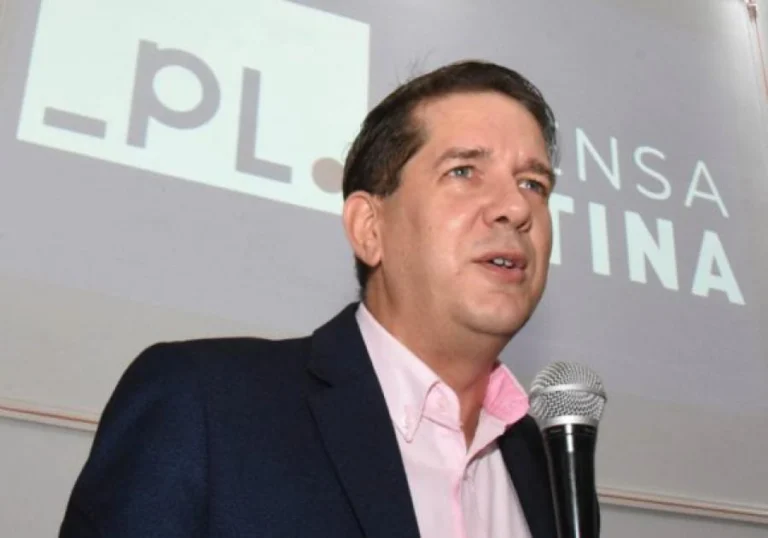
Jorge Legañoa, president of Prensa Latina, has denounced a new energy blockade, which he calls “genocide,” and the intensification of unfounded accusations of terrorism against Cuba, revealing decades of “false narratives.”
The Cuban journalists affirmed that his country faces a complex situation due to the intensification of the economic blockade imposed by the United States government, led by Donald Trump. The new measures seek to prevent the supply of oil to the Caribbean island, generating energy shortages and directly affecting the daily lives of its citizens.
In an interview with teleSUR, Jorge Legañoa, president of the Prensa Latina news agency, emphasized that the nation is preparing for this contingency. He recalled President Miguel Díaz-Canel’s declaration: “We will not stand idly by; we will resolve this through the talent of Cuban men and women,” underscoring a resistance “based on action.”
Legañoa referred to the executive order signed by Donald Trump that establishes tariffs for nations that sell oil to Cuba. The journalist emphasized that this is not a “gift of oil, that no nation gives oil to Cuba,” but rather the “legitimate right of a nation to trade and to seek the minimum resources its people need to live.”
The president of Prensa Latina warned that the current escalation will be “very harsh” and will amount to “practically genocide.” “How can a people—let’s imagine any country in the world—manage its economy, how can it manage food, its daily life, without oil, without gasoline, without fuel?” he asked.
The journalist highlighted the resilience of the Cuban people and cited historical examples. “Let’s remember the two years in the 1990s, the Special Period, when Cuba, after the collapse of the socialist bloc, also found itself without 85% of its fossil fuels,” he pointed out.
He recalled that this is not the first time a decree or executive order of this type has invoked a national emergency against Cuba. Since 1996, under Bill Clinton, these orders have been revalidated and updated by George W. Bush, Obama, and Trump himself, who in 2018 “included the characterization of Cuba as an alleged extraordinary threat to U.S. national security and foreign policy.”
Jorge Legañoa denounced the “most complicated aspect of all” as “the issue of Cuba as a supposed terrorist threat,” calling it “manipulation” without a shred of evidence. He recalled Trump’s first term, when “the US embassy in Havana accused the Cuban government of sonic attacks.”
Cuba’s role as guarantor in the peace talks between the Colombian government and the National Liberation Army (ELN) was also used as a pretext. Legañoa pointed out: “After the breakdown of that dialogue… the Cuban government, which was a guarantor and had responsibilities toward those guerrillas, was accused of being a state sponsor of terrorism for having protected the guerrillas, because that was what international agreements stipulated.”
The journalist compared these accusations to previous tactics by Washington: “Just as governments have been labeled, just as President Nicolás Maduro and Venezuela were unjustly accused of being narco-states, narco-terrorists, or part of the Cartel of the Suns, now they are trying to do the same thing. The same Donald Trump administration, with Secretary Marco Rubio, is trying to label Cuba as a state sponsor of terrorism without presenting a single shred of evidence.”
Jorge Legañoa emphasized that the “false narratives” of the Donald Trump administration are not new, but rather systematize decades of lies against the Cuban Revolution. He mentioned “Operation Truth” of 1959, which brought journalists to Cuba. He asserted that “the fake news that is now so popular against this country has been going on for seven decades. Therefore, it is nothing new for the Cuban people.”
The president of Prensa Latina news agency denounced the “dehumanization of politics” in the United States and suggested that the Trump administration uses issues like Cuba and Iran, and others in the region, to divert attention from domestic problems. These include police violence, anti-immigrant raids, the upcoming midterm elections in Congress and the Senate, and the “Epstein scandal”—just a sample of “what the ruling class of this world does” and that “we often don’t know about.”
The journalist emphasized that Cuba, over the years, “has sown solidarity through its international aid,” sending doctors, teachers, and engineers in the aftermath of earthquakes and hurricanes. This track record allows it to now “reap” the support of nations like Mexico, whose government, under President Claudia Sheinbaum, is “consistent with Cuba’s actions throughout all these years.”
Regarding the alleged contacts or communications between Washington and Havana, Legañoa clarified that the Cuban government “has never stopped engaging in dialogue with the United States government, but these are technical meetings” on matters such as the fight against drug trafficking and counterterrorism.
He pointed out: “The Donald Trump administration insists that it’s at the highest levels… and has stated that there is no dialogue at that level today.” However, Havana maintains “the door completely open to a dialogue between equals, on equal terms.”
Jorge Legañoa described the current situation as “another moment of onslaught” and “politicization of Cuban reality,” driven by figures like Marco Rubio.
Finally, Legañoa questioned the veracity of Trump’s claims about contacts and dialogues, noting that the US president often claims to have discussed topics that never materialized. He cited the case of Claudia Sheinbaum, who denied having a conversation with Trump about Cuba. He stated: “The truth is that there are many manipulated narratives… those who suffer the most, unfortunately, are our people.”
IMAGE CREDIT: President of Prensa Latina, Jorge Legañoa, denounced that the “most complicated aspect of all” is “the issue of Cuba as a supposed terrorist threat,” calling it “manipulation” without a shred of evidence.
Photo: Cuba Diplomática
[ SOURCE: teleSUR ]
