

Pseudo-theological argumentation masks the absence of a coherent military strategy.
In today’s political climate, few images are as striking as that of U.S. religious leaders gathered around the president in the Oval Office with their hands extended in prayer.
RELATED:
Trump’s War on Iran Grows More Contradictory Daily: Schumer
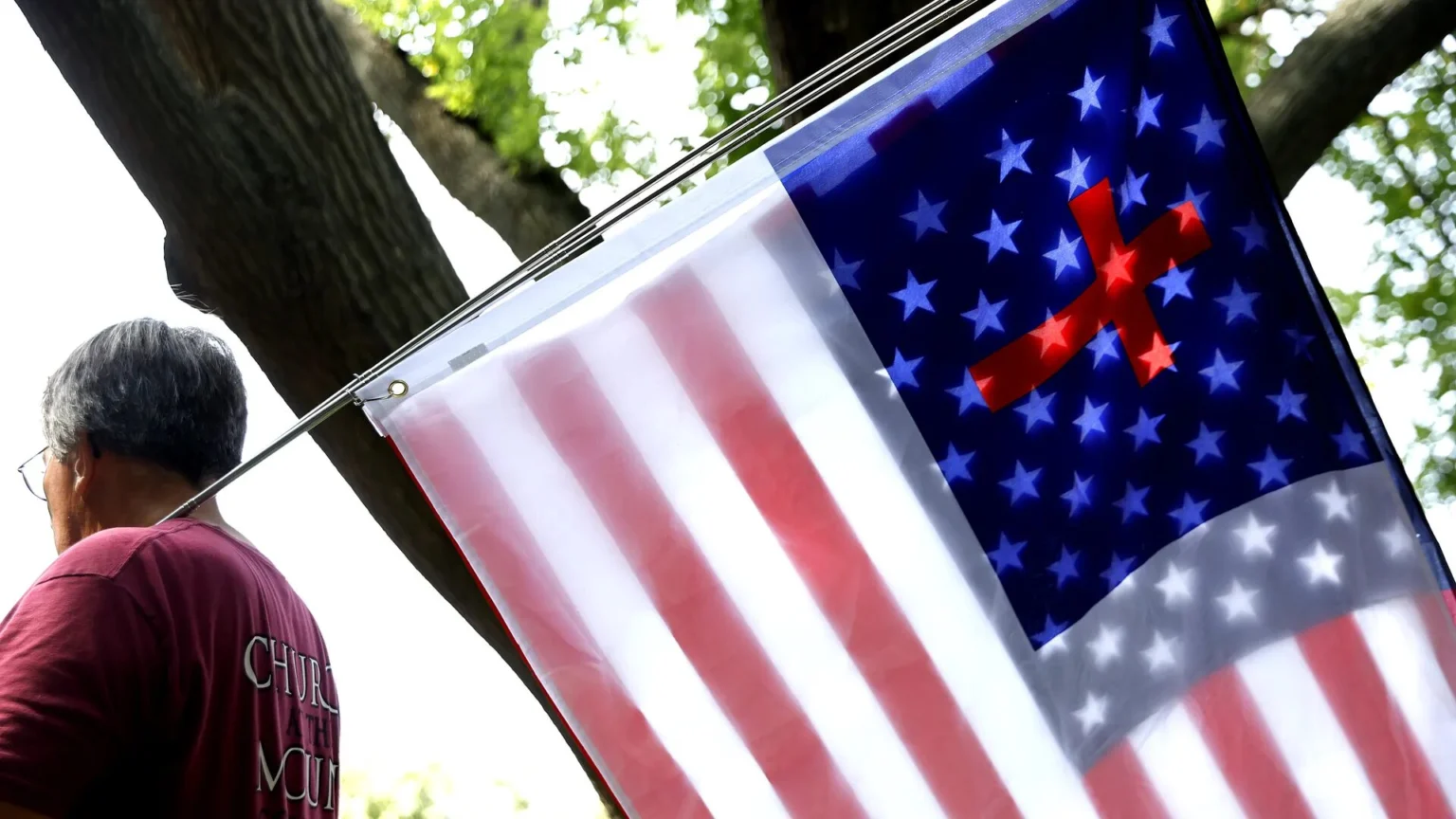
To some, it is a traditional expression of faith. However, to many scholars, it symbolizes something far more political: the public ritual of Christian nationalism.
What was once a fringe movement has now become a central force in American politics. Christian nationalism is no longer just a matter of private belief; it is a political project. Its goal is to redefine the United States as a “Christian nation” guided by divine authority, not a secular democracy.
By 2026, this religious-political shift will influence global events, framing new conflicts in West Asia as part of a modern-day “Holy War.”
What Is Christian Nationalism?
To understand this movement, it is important to distinguish between Christianity as a personal faith and Christian nationalism as an ideology.
According to sociologists Andrew Whitehead and Samuel Perry, Christian nationalism is a cultural framework that fuses Christianity with American civic life. At its core is the belief that the U.S. has a divine mission and should prioritize Christian symbols and leadership in public life.
Researchers often describe the ideology as resting on three main pillars of dominion:
- Sacred hierarchy. The idea that society follows a divinely ordered structure that often favors traditional patriarchy and a national identity centered on white Christian heritage.
- The Myth of Founding: The belief that America was created by and for Christians, which downplays the secular ideas behind the U.S. Constitution.
- Divine Sanction for Power: The belief that Christians must control key sectors of influence, such as government, media, and education, to keep the nation “in covenant” with God.
Social scientists classify Americans on a “Christian Nationalism Scale” into four groups:
- Adherents: Those who want the government to declare the U.S. a Christian nation.
- Sympathizers: Support mixing Christian values with policy but stop short of creating a state religion.
- Skeptics: Cautious about blurring church and state.
- Rejecters: Defend strict separation as vital to democracy.
Myths of Origin: America as the “New Israel”
This ideology borrows heavily from a mythical vision of national destiny. Its followers view the United States as a contemporary version of biblical Israel, a “chosen nation” in covenant with God.
This myth gained strength in the nineteenth century and reemerged during the Cold War. According to this narrative, America’s success is a divine reward for its faith, and moral decline could result in divine punishment.
This narrative relies on historical revisionism. It downplays the influence of the Enlightenment on the Founding Fathers and misrepresents the Establishment Clause of the First Amendment.
By portraying figures such as Jefferson and Madison as theocrats, it depicts the secular republic as a distortion of America’s “true” Christian origins.
This imagined “Golden Age” lends legitimacy to current calls for “national renewal” or “taking back” the country for God, a rallying cry that transforms political diversity into a perceived moral threat.
The Architects of Power: From Weyrich to Today
The institutional structure of Christian nationalism did not emerge by accident. Throughout the late 20th century, conservative strategists such as Paul Weyrich and Jerry Falwell Sr. helped transform evangelical churches into political platforms through the Moral Majority.
These efforts transformed American evangelicalism from an inward-focused faith community into a movement driven by power and seeking political dominance.
Today, this legacy has evolved into a sophisticated political machine. Projects such as Project 2025 aim to reshape federal institutions along explicitly Christian nationalist lines.
Figures such as Speaker Mike Johnson and Secretary of Defense Pete Hegseth view their government roles as spiritual missions and cast political conflict in theological terms.
Institutes such as Theopolis and thinkers like Stephen Wolfe provide the intellectual foundation for this agenda, promoting Christian rule as both divinely justified and socially necessary.
By placing ideological loyalists in key institutions such as the Justice Department and the Pentagon, Christian nationalism has transitioned from activist rhetoric to a functioning arm of state power.
Geopolitics and Prophecy: The Alliance with Zionism
The partnership between American Christian nationalism and Zionism is rooted in shared religious symbolism, not mere geopolitics.
For Christian nationalists, modern Israel holds prophetic significance as the setting necessary for Christ’s return. This belief, known as Christian Zionism, establishes a connection between biblical prophecy and U.S. foreign policy.
Therefore, support for Israeli territorial expansion becomes a spiritual duty rather than a diplomatic choice. A two-state solution is rejected not on policy grounds, but on theological ones.
Consequently, U.S. aid and political support often have religious overtones, portraying Israel as a symbol of Western Christian identity amid a broader “civilizational” struggle.
Yet this alliance is filled with tension. Many Christian Zionists believe that Israel plays an important role in Christian prophecy, viewing the Jewish people as participants in a divine plan that culminates in global conversion. This paradox creates an uneasy relationship of deep political solidarity paired with subtle theological exclusion.
By 2026, the rhetoric of prophecy has reshaped narratives of international conflict. The defense of Israel has become intertwined with defending Western Christian identity, transforming political disputes into moral crusades between “holy” and “unholy” forces.
Trump as the “Cyrus” Figure
Donald Trump occupies a special role within this movement: that of the unlikely “chosen” leader. His supporters compare him to King Cyrus the Great, a nonbeliever from the Bible who helped rebuild Jerusalem. This analogy allows Christian nationalists to view Trump as a divine instrument, flawed yet chosen to protect the faithful.
This narrative separates personal virtue from political effectiveness. Trump’s leadership is not about setting a moral example, but rather about divine purpose. His rallies often take on revival-like tones, presenting political battles as “spiritual warfare.”
The creation of a Religious Liberty Commission by his administration and its efforts to “eradicate anti-Christian bias” demonstrate how this theology has become policy.
The dynamic is transactional: Christian nationalists provide unwavering support in exchange for legislation and appointments that align with their agenda. In this worldview, opposing him becomes not just political dissent, but defiance of divine will.
Operation Epic Fury: America’s 21st-Century “Holy War”
In early 2026, the U.S. military launched Operation Epic Fury against Iran. The mission’s official goal was to prevent nuclear escalation and secure trade routes through the Strait of Hormuz. However, internal reports tell a different story, one steeped in theology.
According to the Military Religious Freedom Foundation, officers at multiple military bases framed the operation as a divinely sanctioned battle.
Some have even described it as a step toward “Armageddon.” These messages have transformed a geopolitical mission into a crusade.
Top officials echo this tone. Secretary Hegseth has called the conflict a defense of “Western Christian values,” and Speaker Johnson has labeled Iran’s leaders as followers of a “false religion.” Describing war in religious terms turns diplomacy into weakness and peace efforts into betrayal.
This trend risks transforming regional conflicts into global spiritual wars where prophecy takes precedence over negotiation and international law.
Reclaiming the Secular State
The rise of Christian nationalism as a political force challenges one of America’s core democratic principles: the separation of church and state.
By merging faith and governance, Christian nationalism replaces the pluralistic vision of E pluribus unum, “out of many, one”, with a mandate for divine rule.
The portrayal of Trump as a “Cyrus” figure and the theological rhetoric surrounding Operation Epic Fury demonstrate the risks of allowing religious prophecy to influence state policy. When decisions about war and diplomacy are seen as part of a divine plan, accountability disappears.
To move forward, citizens, journalists, and scholars must de-sacralize the state. This requires reaffirming secular governance and rejecting religious justifications for war.
As the fires of conflict burn in West Asia, the United States faces a test of identity. Will it remain a secular democracy accountable to all its people, or will it continue its drift into a 21st-century crusade? The answer will define not only America’s future, but also the moral shape of global politics.
[ SOURCE: teleSUR ]
