

By René Tamayo
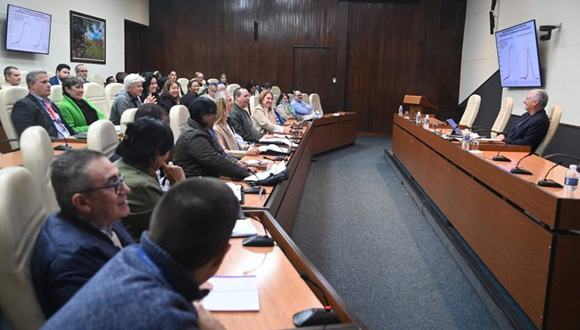
The first, preliminary results of the use of Artificial Intelligence in the prediction and treatment of cardiovascular diseases were the focus of this week’s meeting between the First Secretary of the Central Committee of the Communist Party and President of the Republic, Miguel Díaz-Canel Bermúdez, and health experts and scientists.
The research, underway for two years, is the result of collaboration between specialists from the Hermanos Ameijeiras Hospital, the University of Havana, the Havana Science and Technology Park, BioCubaFarma entities such as Combiomed, and other institutions.
The project, called CARDENT, is one of three being developed by Cuban experts and scientists in fundamental areas such as movement disorders and tremor analysis, including Parkinson’s disease, senile diseases, and neurodegenerative diseases, and another dedicated to multimodal X-ray imaging.
Dr. Ernesto Estévez Rams, professor at the Faculty of Physics of the University of Havana and Member of Merit of the Cuban Academy of Sciences, pointed out that these initiatives constitute scientific and innovation projects to develop technologies based on data analysis and AI that will lead to improved medical services and clinical technologies in accordance with the current state of the art internationally.
In a preamble to the presentation of the preliminary results of the project dedicated to diseases within his specialty, the eminent cardiologist Juan Prohías Martínez, PhD and head of the National Cardiology Group, noted that these diseases have been the leading cause of death in Cuba for more than 20 years and the second leading cause of potential life loss, after cancer. They are also the leading cause of premature death in people between 30 and 69 years of age.
Dr. C. Prohías Martínez, with extensive experience in this field, emphasized the transformative impact that Artificial Intelligence (AI), despite being a relatively recent technology, will have on the early diagnosis of these diseases, the prediction of events, and the generation of algorithms for personalized medical treatments.
In the presentation of the CARDENT project, on the application of AI in cardiovascular diseases, Dr. C. Estévez Rams underscored the impact that AI is already having on medicine.
It was a consensus among the President of the Republic and health experts and scientists that these technologies do not replace specialists; however, physicians are now obligated to master AI.
In his presentation, Estévez Rams detailed the impact of AI on the classification, monitoring, and modeling of cardiovascular diseases.
He referred to the work being done to equip Cuba with its own technologies in areas such as signal reconstruction, AI-based filtering, coding, and data analysis, among others.
Our goal, he noted, is not to be users of technologies, but rather developers of our own technologies, including Artificial Intelligence.
Among Cuba’s strengths for achieving results in this area, he highlighted, among many others, the robustness of our healthcare system, its international prestige, its participation in international health networks, including medical collaboration; as well as its capacity to gather relevant data on multiple health and disease topics, and its availability of world-class specialists in many areas of medicine.
The scientist emphasized the impact that the use of Artificial Intelligence will have on our healthcare system and, consequently, on improving the population’s quality of life. It will allow us, he stressed, to reach a higher level in preventive healthcare, the development of new devices, and the creation of new services.
In addition to these and other opportunities opening up to the National Health System with the accelerated introduction of AI, based on its own projects, Dr. C. Estévez Rams emphasized the need for a training strategy that includes training physicians and technologists in the use of AI and its application in their daily practices, training healthcare support staff, incorporating AI elements into medical school curricula, and integrating them into training processes.
Arboviruses Under Control
At this week’s meeting between the First Secretary of the Central Committee of the Party and President of the Republic, Miguel Díaz-Canel Bermúdez, and health experts and scientists, the current situation regarding arboviruses was discussed.
Dr. Carilda Peña García, Vice Minister of Public Health, reported that the endemic channel for Febrile Syndrome in the country is progressing successfully, with a decrease in cases in the last week and no province reporting an increase. Confirmed and suspected cases of both dengue and chikungunya continue to decline.
This trend was confirmed by Dr. Raúl Guinovart Díaz, Director of Science and Technology at the University of Havana, during the presentation of mathematical models used to interpret the behavior of arboviruses in the country.
He reiterated that progress is being made toward definitively controlling the epidemic wave, although he urged continued vector control efforts to prevent a resurgence during the summer.
IMAGE CREDIT: Photo: Estudios Revolución
[ SOURCE: CUBA DEBATE ]
