

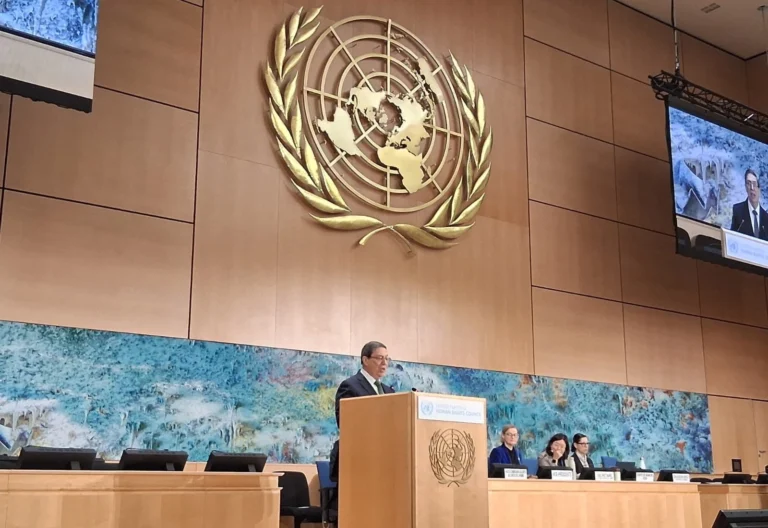
Cuban Foreign Minister Bruno Rodríguez denounced on Monday, February 23, at the 61st session of the United Nations Human Rights Council, the emergence of a “globalized dictatorship” by the United States and its aggression against the Caribbean island and Venezuela.
Rodríguez stated that the international order born from World War II, conceived to prevent a third global conflict, is being destroyed. In its place, the Cuban Foreign Minister pointed out, a philosophy of dispossession is being proclaimed, interpreted as the exceptional and supreme right of the United States to conquest and the use of force in an inherent and everyday manner.
Beyond ideologies, all nation-states are in danger, regardless of their cultural or political models, he warned. The Cuban diplomat cited the case of Venezuela, the world’s largest hydrocarbon reserve, which, according to him, was vilely attacked.
In this regard, he questioned the future of critical mineral and rare earth deposits, water reserves, the Amazon rainforest, the seabed, the Arctic, and Antarctica. He also expressed concern about the occupation of strategic enclaves, interoceanic passages, and trade routes, emphasizing that weakness and opportunism encourage conquest.
The Cuban minister questioned the freedom of trade and navigation in the face of the use of tariffs as an instrument of aggression and the extraterritorial application of U.S. laws and the jurisdiction of U.S. courts.
Rodríguez specifically denounced the executive order signed by US President Donald Trump on January 29, which he described as collective punishment against the Cuban people. The objective of this measure, he emphasized, is to create a humanitarian catastrophe through an energy blockade against Cuba.
The Foreign Minister questioned whether a great power can allow itself to attempt to destroy a small, peaceful nation, provoke a humanitarian tragedy, destroy its national culture, and subject a noble and compassionate people to genocide under the “crude pretext of national security.”
Meanwhile, the Foreign Minister emphasized that the Cuban people will defend with the utmost vigor and courage, in close unity and broad consensus, their right to self-determination, independence, sovereignty, territorial integrity, and constitutional order. He affirmed that this defense will be carried out with “the participation of Cubans residing in other countries. We will prevent a humanitarian crisis in Cuba,” he stated.
Despite the hardships and suffering they may face, Rodríguez emphasized that the Cuban people are aware, educated, and courageous. He highlighted that Cuba has highly qualified human resources, as well as universal education, healthcare, and science systems.
Furthermore, he underscored that the island possesses arable land, water and mineral reserves, infrastructure, produces almost half of the crude oil it consumes, has refining capacity, and is making significant and efficient progress in solar energy.
The minister recalled that, with great suffering, three generations of Cubans have overcome the US blockade for more than 60 years. He also emphasized Cuba’s solidarity with everyone, especially with the nations of the Global South. He affirmed that, even in the worst-case scenario, they will persevere and find creative solutions, mitigating humanitarian damage and maintaining solidarity.
In his remarks, Rodríguez underscored Cuba’s commitment to the defense and promotion of all human rights. The Foreign Minister reaffirmed his country’s support for the inalienable rights of the Palestinian people and the integrity of migrants. He also expressed admiration for the community resilience of the people of Minnesota, USA, and reiterated Cuba’s opposition to double standards and political manipulation in the international arena.
On the occasion of the centennial of the birth of the Commander-in-Chief of the Cuban Revolution, Fidel Castro Ruz, the minister emphasized the island’s determination to defend its nation. He also stressed its commitment to safeguarding a society focused on achieving the full dignity of the human being.
Finally, he reiterated the Cuban nation’s willingness to engage in dialogue with the United States, based on sovereign equality, international law, mutual respect, and reciprocal benefit, without preconditions or interference in internal affairs. This dialogue, Rodríguez said, would seek to achieve a civilized relationship despite existing differences and even promote cooperation in areas feasible for both nations.
At the end of January, the White House occupant signed an executive order declaring Cuba an alleged “unusual and extraordinary threat” to U.S. national security, arguing that “Cuba brazenly harbors dangerous adversaries of the United States.”
Following the announcement of Trump’s latest attack, which was condemned by various world leaders, Cuban President Miguel Díaz-Canel described the measure as an attempt to strangle his country’s economy.
“Under a mendacious and baseless pretext, peddled by those who profit from the suffering of our people, President Trump intends to strangle the Cuban economy by imposing tariffs on countries that sovereignly trade oil with Cuba,” the president stated in a post on his official Twitter account.
IMAGE CREDIT: The Cuban minister questioned the freedom of trade and navigation in light of the use of tariffs as an instrument of aggression. Photo: @BrunoRguezP
[ SOURCE: teleSUR ]
