

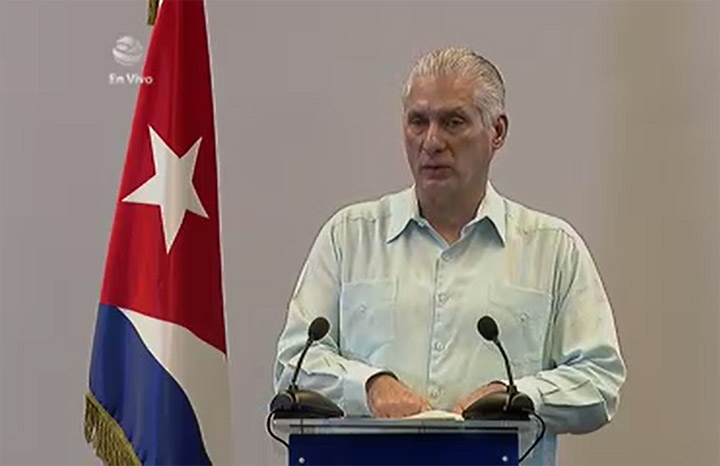
During a press conference held this Friday, broadcast on Cuban radio and TV, President Miguel Díaz-Canel spoke on a number of issues affecting the island and outlined a roadmap that places communities at the very heart of the national response to the current energy crisis.
With workers reassigned to local projects, corporate funds activated, and unions following their members beyond the factory walls, the Cuban government is working to build a collective response to the labor impact of the energy crunch.
The Cuban government said that the energy crisis currently gripping the island does more than just turn out the lights. It paralyzes workplaces, reduces wages, and compels the government to rethink the role of its labor institutions from the ground up.
“Productive activity has slowed down. Without energy, no country can produce at normal levels,” the President acknowledged before correspondents of national and international press.
Work stoppages, reassignments, and changes in duties are impacting the incomes of thousands of workers — a reality the government is addressing through specific protective measures and a firm commitment to territorial mobilization.
The first principal Díaz-Canel established was clear: “Rather than resorting to work stoppages, let us try to adapt and seek labor reassignment or a change of duties, for there is much to be done,” he asserted. This proposal is not mere rhetoric.
Local food production, care for vulnerable populations, solid waste collection, and support for educational processes in municipal centers—the President identified a concrete chain of community needs capable of absorbing employees displaced from their regular workplaces. “It is best that everyone—even if we have to be reassigned—continues to contribute,” the president insisted. The logic behind this approach is both political and economic. Keeping the workforce active and organized during times of productive contraction prevents social demobilization and sustains services that the crisis directly threatens.
** Three Funds to Sustain Wages**
On the financial front, the government identified mechanisms that state-owned enterprises can activate to protect their workers’ incomes—tools that were already employed during the COVID-19 pandemic. Contingency reserves, reserves of undistributed profits, and enterprise compensation funds can supplement what the State budget already guarantees by law.
For budgeted entities, legislation stipulates that a worker who has not been reassigned receives 100 percent of their salary during the first month, and 60 percent thereafter—funding provided by the State following approval by the Ministry of Labor and Social Security. “These are procedures that are processed quickly,” Díaz-Canel noted. The protection exists, and it can be utilized.
The third facet of the presidential approach was directed squarely at the Workers’ Central Union of Cuba (CTC). If employees are no longer in their factories but rather in communities, photovoltaic parks, or local projects, the unions must follow them. “Today, the union needs to be less in the factory and more in those spaces where its workers have been reassigned,” the president asserted.
This requirement implies a fundamental transformation. The traditional union model– anchored to a fixed workplace — proves insufficient in the face of a crisis that disperses the workforce across the territory. Díaz-Canel framed this modernization as part of the same collective effort that encompasses the government, the Party, and business management.
**Education: A Non-Negotiable Priority**
The date chosen for the address carried its own symbolic weight. On March 13th—the anniversary of the 1957 assault on the Presidential Palace—the president took a moment to reaffirm the place of higher education within the revolutionary project. In the midst of the dictatorship, the University Student Federation and the Student Directorate grew alongside the 26th of July Movement, aligning the university movement with the causes of the people. That legacy, Díaz-Canel stated, carries an imperative.
“Education — and higher education in particular — are priorities, and we will continue to uphold them as such,” he affirmed. The adjustments to the academic calendar necessitated by the energy crisis are, in his view, temporary. Once conditions permit, in-person instruction will return to the classrooms, backed by the full weight of an educational system he described as a benchmark for Latin America, the Caribbean, and the world.
Details regarding the measures adopted within the sector will be provided by the Minister of Education and the Minister of Higher Education during appearances scheduled for next week, as part of the systematic follow-up that the Government has pledged to maintain with the press and the public.
IMAGE CREDIT: The first principle Díaz-Canel established was clear: “Rather than resorting to work stoppages, let us try to adapt and seek labor reassignment or a change of duties, for there is much to be done.” Photo: Screenshot / Presidency of Cuba
[ SOURCE: teleSUR ]
