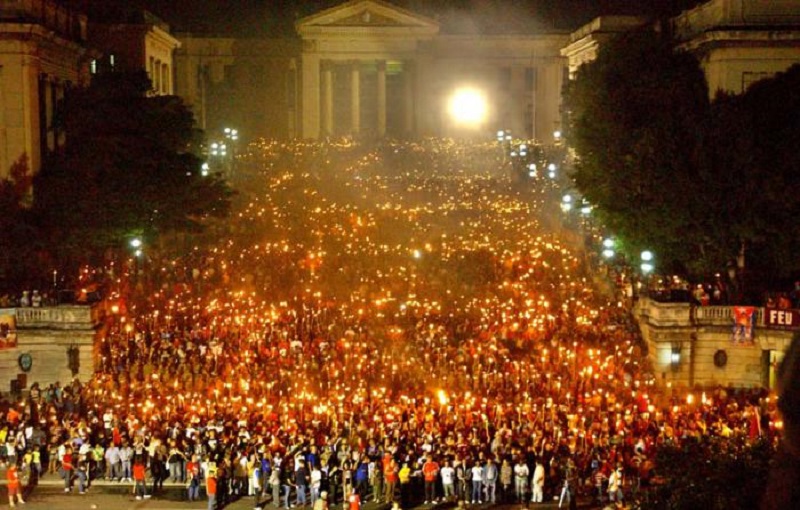
Today, as in the past, young revolutionaries, coinciding with the anniversary of José Martí's birth, begin the patriotic ritual that began more than half a century ago with the Centennial Generation, led by a young man named Fidel Castro.

To prevent the Apostle from being forgotten in the year of his centenary, each anniversary of the Torchlight March, the parade serves as a demonstration of student support for the historical leadership of the Revolution.

The Torchlight March of 1953, held under the tyranny of the Batista regime, became one of the first scenes in the revolutionary movement that would culminate in the triumph of 1959.

That day, the procession began on the steps of the University of Havana, proceeded down San Lázaro Street to Espada Street, continued to 27th and Hospital Streets, and ended at the Fragua Martiana, where young leaders took turns speaking, commemorating José Martí on the centenary of his birth. The march was supported by youth organizations, revolutionary groups, and a segment of the people of Havana, who joined the procession along the route and chanted slogans of "Revolution" and "Freedom."

The first Torchlight March signaled the emergence of what would later be known as the Centennial Generation.  Prominent men and women participated, including Fidel and Raúl Castro; Juan Almeida, Camilo Cienfuegos, Ramiro Valdés Menéndez, Abel and Haydée Santamaría, Raúl Gómez García, Frank and Josué País; José Antonio Echeverría, Armando and Enrique Hart, and Alfredo Guevara, among others.

At the head of the parade was a Cuban flag carried by female university and high school students; behind the national emblem marched the entire executive committee of the Federation of University Students (FEU). The women inspired by Martí walked arm in arm; it was a large group, but the most striking and impressive part of the parade was the group of more than five hundred young people, perfectly formed, who marched behind Fidel. Their discipline was impeccable.

Some of these young people would later participate in July in the heroic assault on the Moncada and Carlos Manuel de Céspedes barracks. As every year, the Torchlight March returns, an event of great patriotic significance whose first edition took place in 1953. It was the young people of the Centennial Generation who, on January 27 of that year, set out to illuminate the night with a redeeming fire that still burns brightly today.

When they began to chant the slogans: "Revolution! Revolution!", the voices of the group following Fidel stood out; it was like a thundering torrent that made the street vibrate and impressed a people who were paying tribute on the centenary of the man of "The Golden Age."

The Torchlight March is inspired by Martí. Consequently, it should serve to evoke the best of the Apostle's ideals, which are ethical and patriotic.

The greatness of Martí lies not in a single sphere of his life, but in several: he was a prominent figure in Hispanic literature, a skilled journalist, an extraordinary thinker, and a successful politician who managed to unite the efforts of Cuban patriots to wage the Necessary War in the last years of the 19th century.