

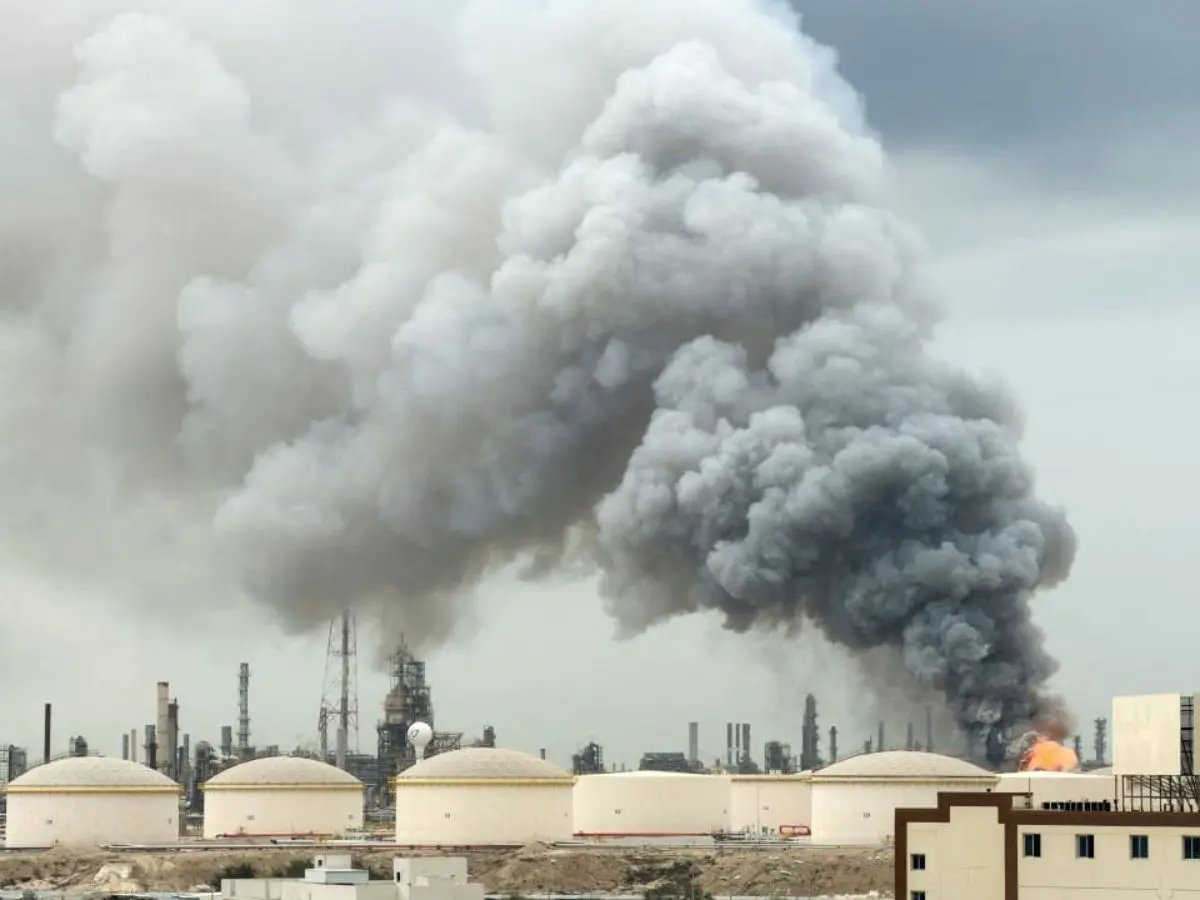
Oil and gas markets react to blockades, drone strikes, and refinery hits.
The Strait of Hormuz entered a state of effective closure after a sharp military escalation on February 28, 2026. This narrow maritime chokepoint connects the Persian Gulf to the Gulf of Oman and the Arabian Sea, making it one of the world’s most strategic shipping routes.
RELATED:
Iran Hits U.S Naval Base and Ras Laffan Gas Hub
The current conflict has halted normal commercial shipping through the area. Maritime insurance companies have suspended coverage for ships crossing the 21-mile-wide passage, which makes standard operations financially impossible.
By mid-March 2026, commercial traffic had decreased by about 92% compared to January 2026. This level of disruption transformed the stable energy supply model into a state of open energy warfare, with regional infrastructure becoming a central target of military operations.
Energy Facilities and Export Capacity
The Persian Gulf’s energy system is organized around four main hubs. These facilities determine how much crude oil and liquefied natural gas (LNG) reach international markets, as well as how quickly flows can adjust in a crisis.
Kharg Island (Iran)
Located about 25 kilometers off Iran’s coast in the Persian Gulf, Kharg Island serves as the country’s main sea terminal for oil exports. Its primary function is to load and store heavy and light crude oil.
The terminal can handle up to seven million barrels per day (bpd), which is central to Iran’s export capacity. The terminal also operates a large tank farm with a storage capacity of approximately 28 million barrels, which provides temporary buffering when exports are disrupted.
Jask Terminal (Iran)
The Jask terminal is located on the Gulf of Oman, east of the Strait of Hormuz. It was built to allow Iranian oil to bypass the strait’s narrowest point. It exports crude oil via the 1,000-kilometer Goreh–Jask pipeline, which connects interior oil fields directly to the coast.
Initially, Jask was designed to transport around 1 million barrels per day (bpd), but operations in early 2026 demonstrated its capacity to load tankers carrying up to 2 million barrels each. This gives Iran a partial outlet even when the Strait of Hormuz is unsafe.
Fujairah Port (United Arab Emirates)
Fujairah is the only multipurpose port on the eastern coast of the UAE. It is connected to the Habshan oil fields via the ADCOP pipeline. The port serves as a hub for bunkering, crude oil export, and refined product storage.
The port handles approximately 1.7 million barrels per day (bpd) of Murban crude oil and has become the world’s fourth-largest bunkering hub, with a storage capacity of about 18 million cubic meters. These capabilities make Fujairah a key node for flows that avoid the Strait of Hormuz.
Ras Laffan (Qatar)
Ras Laffan Industrial City, located about 80 kilometers north of Doha, is the heart of Qatar’s gas industry. The complex produces and exports LNG, condensates, and sulfur.
The complex produces 77 to 80 million tons of LNG each year, accounting for nearly 20% of the global supply. Therefore, any shutdown at Ras Laffan has immediate global consequences, especially for Europe and Asia.
Conflict Timeline and Targeted Facilities
The escalation that began on February 28, 2026 quickly turned into an all-out war on energy infrastructure in early March. Military operations escalated beyond naval clashes, targeting upstream and downstream facilities in Iran, Qatar, Saudi Arabia, and the United Arab Emirates.
On March 18, 2026, Israel struck the South Pars gas field, the world’s largest natural gas reservoir. Reports indicate that fires occurred at offshore production platforms and the onshore hub in Asaluyeh. Iranian officials estimate that parts of the complex responsible for about 12% of its total output were hit.
In response, Iranian forces launched missile and drone attacks on major Gulf energy hubs. Ras Laffan in Qatar was targeted on March 2 and again on the 18th and 19th.
QatarEnergy reported “extensive damage” to the Pearl GTL (gas-to-liquids) plant and several LNG (liquefied natural gas) trains. The company declared force majeure on delivery contracts.
In the UAE, a drone attack on March 17 hit the Shah gas field, which supplies 20% of the country’s domestic gas.
Debris from missile interceptions has also caused temporary shutdowns at the Habshan gas facilities and the Bab oil field.
The attacks also hit key refinery hubs intended to provide alternatives to the Hormuz route. On March 19, 2026, a drone struck the SAMREF refinery in Yanbu on the Red Sea coast. The refinery is jointly owned by Aramco and ExxonMobil.
SAMREF is a critical export outlet for oil rerouted away from the Strait of Hormuz. Around the same time, intercepted missiles sent debris falling near refineries south of Riyadh. Kuwait reported fires at the Mina al Ahmadi and Mina Abdullah refineries following drone strikes.
Impact on the Global Gas Market
The closure of the Strait of Hormuz and the damage to Ras Laffan have caused a historic shock to the global gas market. The effective blockade has removed approximately two billion cubic meters of gas from the market each week.
Since Ras Laffan accounts for approximately one-fifth of LNG trade, its shutdown has reduced global LNG availability by about 20%.
Prices reacted immediately. On March 19, 2026, the European benchmark (Dutch TTF) surged 35%, reaching its highest level in four years. Meanwhile, UK wholesale gas prices have more than doubled since the end of February.
With Qatari cargoes offline, European and Asian buyers are competing for limited spot shipments from the United States and West Africa. This competition exacerbates the crisis for countries that depend on imports and lack long-term contracts or storage. Gas rationing has hit energy-intensive industries first, especially fertilizer and petrochemicals.
The loss of granulated sulfur from the Shah field, which supplied approximately 5% of the world’s sulfur, has directly impacted the global phosphate fertilizer sector and threatens agricultural stability.
Asia: The Primary Destination
With a vulnerability score of 6.4, Japan is the most exposed major economy. It imports about 87% of its fossil fuels, most of which pass through the Strait of Hormuz.
The Bank of Japan has maintained an interest rate of 0.75% and has explicitly identified “geopolitical volatility” as a significant threat to industrial stability.
South Korea ranks second in vulnerability, with 81% of its energy coming from imported fossil fuels. After the March 19 escalation, the South Korean Kospi index fell 2.7%, reflecting market fears about supply security.
India, which imports 59% of its LNG from Qatar and the UAE, began gas rationing on March 13, 2026. The government prioritized household use and cut supplies to energy-intensive sectors, such as fertilizer and petrochemical production.
China is the largest importer of oil passing through the Strait of Hormuz but has partially absorbed the shock by relying on large crude oil stockpiles.
In South Asia, Pakistan and Bangladesh are facing acute shortages. Pakistan sourced nearly all of its 2025 LNG imports from Qatar, and the current blockade has resulted in widespread power outages.
Oil Price Volatility and Commodity Shifts
Since the launch of “Operation Epic Fury” on February 28, oil and gas prices have surged to levels not seen in four years. Brent crude surpassed 100 dollars per barrel on March 8, 2026.
By March 19, the price had climbed to $116 per barrel, a 60% increase since the conflict began. Oman crude, which is not tied to the Strait of Hormuz, has become a key alternative, reaching 154 dollars per barrel on March 19 as refiners scrambled for non-Gulf supplies.
Natural gas prices have followed a similar pattern. European wholesale prices at the Dutch TTF increased by 35% in a single day following the March 19 strikes, reaching 74 euros per megawatt hour.
Russia has emerged as a major winner in this phase. It earned an estimated six billion euros from fossil fuel exports in the first three weeks of the conflict and remains a crucial supplier for countries like India, which is shifting from Gulf crude to Russian and U.S. barrels.
In the United States, crude oil futures prices have risen to nearly $100 per barrel. Although US exports have increased, logistical and infrastructural limitations prevent Washington from replacing the approximately 20 million barrels per day (bpd) that usually move through the Strait of Hormuz.
A Permanent Shift in Global Energy Security
The events of February 28 and the strikes of March 18–19 changed the global energy landscape in lasting ways. What was once considered a reliable transit route is now an active war zone with no clear path back to normalcy.
The focus of the conflict has shifted from general regional tension to systematic attacks on energy infrastructure, with pipelines, terminals, and fields now serving as frontline targets.
The crisis has pushed prices higher and accelerated a broader geopolitical shift. Countries such as India and China are shifting toward Russian supplies and their own domestic resources, while European states face the dual challenges of high costs and physical shortages.
The long-term recovery of damaged facilities is uncertain. While technical repairs are possible, restoring insurance coverage, shipping confidence, and commercial stability will require a broad de-escalation that does not seem imminent.
The 2026 crisis signals the end of the era of inexpensive, reliable energy flows from the Persian Gulf.
