

By Reasons for Cuba Editorial Staff
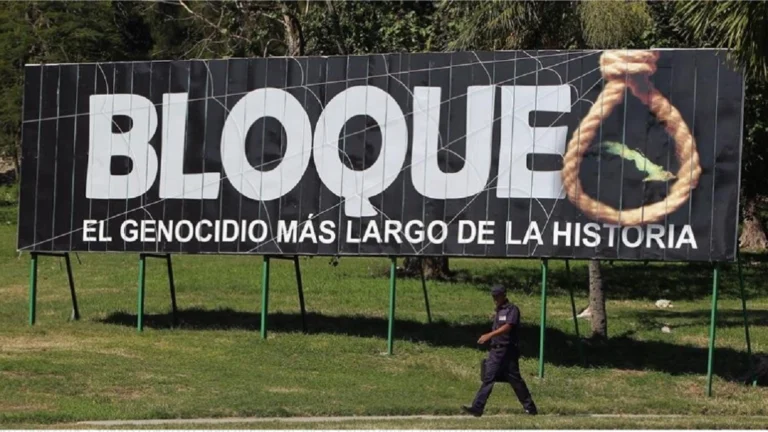
The sanctions system imposed by the United States against Cuba is the longest-running and most complex in contemporary economic history. Its roots go back to 1917 (Trading with the Enemy Act), but it was in 1962 that John F. Kennedy proclaimed a total blockade on bilateral trade.
Since then, the embargo has only intensified: the Torricelli Act (1992) internationalized the blockade by prohibiting foreign subsidiaries of U.S. companies from trading with the island; the Helms-Burton Act (1996) codified all restrictions under the Cuban Assets Control Regulations (CACR) and stripped the president of the power to lift the blockade without congressional approval.
The cumulative result, according to the report presented by Cuba to the UN in May 2025, is a figure that is painful to even write: $170,677.2 million in material damages over more than six decades (not adjusted for inflation). ECLAC, for its part, reported accumulated losses up to 2015 of $117 billion. The estimated annual cost of the blockade between March 2024 and February 2025 was $7.556 billion, an average monthly financial impact of $629.6 million.
In the health sector, annual losses reached $239.8 million, and according to social cost estimates, just 16 days of the blockade are equivalent to $1.6 billion, enough to purchase the complete list of essential medicines for the entire country for a whole year.
The 2026 Offensive: Executive Order 14404 and the Persecution of GAE
On May 1, 2026, President Donald Trump signed Executive Order 14404, a further tightening of the screws designed to intensify economic pressure on Cuba under the pretext that its foreign intelligence activities, internal repression, and geopolitical alliances represent an “unusual and extraordinary threat” to U.S. national security.
The operational core of this order: secondary sanctions against individuals, corporations, and international financial institutions in third countries that maintain commercial relations with entities led by members of the Cuban Revolutionary Armed Forces, particularly against the Business Administration Group (GAE), which manages key sectors of the domestic economy: tourism, food imports, remittance services, and corporate banking.
The order granted a peremptory deadline, expiring today, June 5, 2026, for all foreign corporations to sever any commercial ties with GAE and its subsidiaries, under penalty of exclusion from the U.S. financial system, asset freezes, and severe fines.
The Exodus of Foreign Investment: Hotels, Nickel and Banks Leaving
The imminent June 5 deadline triggered an unprecedented outflow of foreign capital. International corporations preferred to safeguard their access to dollar liquidity rather than maintain operations in Cuba.
Hotel Exodus
Corporation / Origin / Sector / Details of Withdrawal
Meliá Hotels International / Spain / Tourism — Ceases management of 15 of its 34 hotels (approximately 14,000 rooms).
Iberostar Group / Spain / Tourism — Withdraws its brand from 12 of its 18 hotels linked to Gaviota/GAE, including the “Selection La Habana” skyscraper.
Blue Diamond Resorts / Canada / Tourism — Complete exit on May 30, 2026. It will abandon 62 hotels and more than 12,900 rooms (Royalton, Memories, Starfish, Mystique, and Resonance brands).
Archipelago International / Indonesia / Tourism — Withdrawing its Aston brand from 6 hotels in Havana, Varadero, Cayo Coco and Holguín.
Sherritt International Corp. / Canada / Mining and Energy — Liquidation of its stake in the Moa Joint Venture (nickel/cobalt) and in Energas S.A.
Banco Sabadell / Spain / Banking — Orderly withdrawal of offices and corporate finance operations.
The blow to tourism, the main generator of foreign exchange, is devastating. Between January and April 2026, Cuba received only 328,608 international visitors, a 55.8% drop compared to the same period in 2025. The Canadian market, historically the main source of tourists, plummeted in April 2026 to just 650 visitors, compared to historical averages of 90,000 to 100,000 per month.
The strangulation of payment channels: Goodbye to Visa and Mastercard
The strangulation of the international payments system will be completed on June 6, 2026, when the Visa and Mastercard global credit and debit card networks will definitively cease operations throughout Cuba.
The processing of electronic foreign currency transactions was coordinated by Fincimex S.A., GAE’s financial entity, in partnership with a foreign correspondent bank. Faced with the imminent threat of sanctions and exclusion from the dollar clearing system operated by the Federal Reserve, the foreign bank terminated the agreement, deeming it legally “impossible and unlawful” under the new White House guidelines.
The Central Bank of Cuba implemented limited emergency measures: foreign currency transactions were restricted to cash payments or payments via two domestically issued prepaid cards (“Clásica” and “Tropical”), which must be purchased in advance at bank branches with hard currency. The government is attempting to incentivize the use of the Russian payment platform Mir and the Chinese clearing network UnionPay, but the limited international adoption of these systems restricts their effectiveness, discouraging tourism from Western Europe and the Americas.
Infrastructure Crisis, Basic Services, and Logistics Collapse
The energy blockade and chronic shortage of foreign currency triggered a crisis in essential public services during 2026.
The energy shutdown halted municipal drinking water pumping systems, disabled school and university laboratories, hampered internet access, and suspended food processing.
The extreme fuel shortage also hampered the transport and distribution of humanitarian aid from the UN World Food Program (WFP).
In Havana, by mid-February 2026, garbage accumulation had become critical: only 44 of the capital’s 106 garbage trucks (41.5%) had diesel fuel to operate.
On February 9, 2026, aviation authorities declared a complete lack of aircraft fuel, suspending refueling for commercial airlines. Air Canada suspended essential routes that same day; 48 hours later, the Russian airlines Rossiya and Nordwind followed suit.
The deterioration directly impacted the public health system: the lack of emergency electricity compromised the production of clinical oxygen, the thermal storage of vaccines, and the refrigeration of blood products. According to Cuban authorities, the energy restrictions directly endangered more than 32,000 pregnant women and some 61,000 children in their first year of life.
The Medicines Crisis
Cuba’s Basic List of Medicines comprises 651 essential items (250 imported and 401 domestically produced). Shortages affect 69%, with an absolute lack of 364 essential medicines (56% of the total). Financial constraints prevented the acquisition of basic medical reagents, internal stimulation heart valves, and US-patented surgical supplies. As a direct consequence, 375 critically ill patients were unable to receive permanent pacemaker implants in the last cycle analyzed.
Just 14 hours of the blockade are equivalent to the total cost of acquiring the latest generation insulin needed to ensure the survival of all diabetic children in the country, estimated at around $12 million.
Conclusion: A dead end, but with a people who refuse to give up
The regulatory escalation under Executive Order 14404 has dismantled the foundations of the island’s external financing. By forcing major hotel chains to liquidate their investments, disabling electronic payments via Visa and Mastercard, and disrupting the regular supply of fuel through the freight blockade, Washington neutralized Cuba’s ability to generate foreign currency through traditional tourism.
Private MSMEs constitute an emergency palliative that sustains critical components of the basic food basket, but their 29% tax contribution and dynamism are insufficient to counteract the accumulated decapitalization of six decades of commercial and financial isolation.
The blockade has failed to break the Cuban Revolution, but it has caused human suffering that no political justification can conceal. The 364 missing medications, the 375 pacemakers that could not be implanted, the 100,000 children without their milk ration, the 62 abandoned hotels, and the cessation of Visa and Mastercard operations are tangible evidence of a policy that, according to its own creators and maintainers, should be reevaluated.
The resistance of the Cuban people, manifested in community solidarity and the adaptability of a besieged healthcare and education system, remains the bulwark against which imperial suffocation crashes. But the human cost of that resistance is ever-increasing.
[ SOURCE: www.cubainformacion.tv ]
