

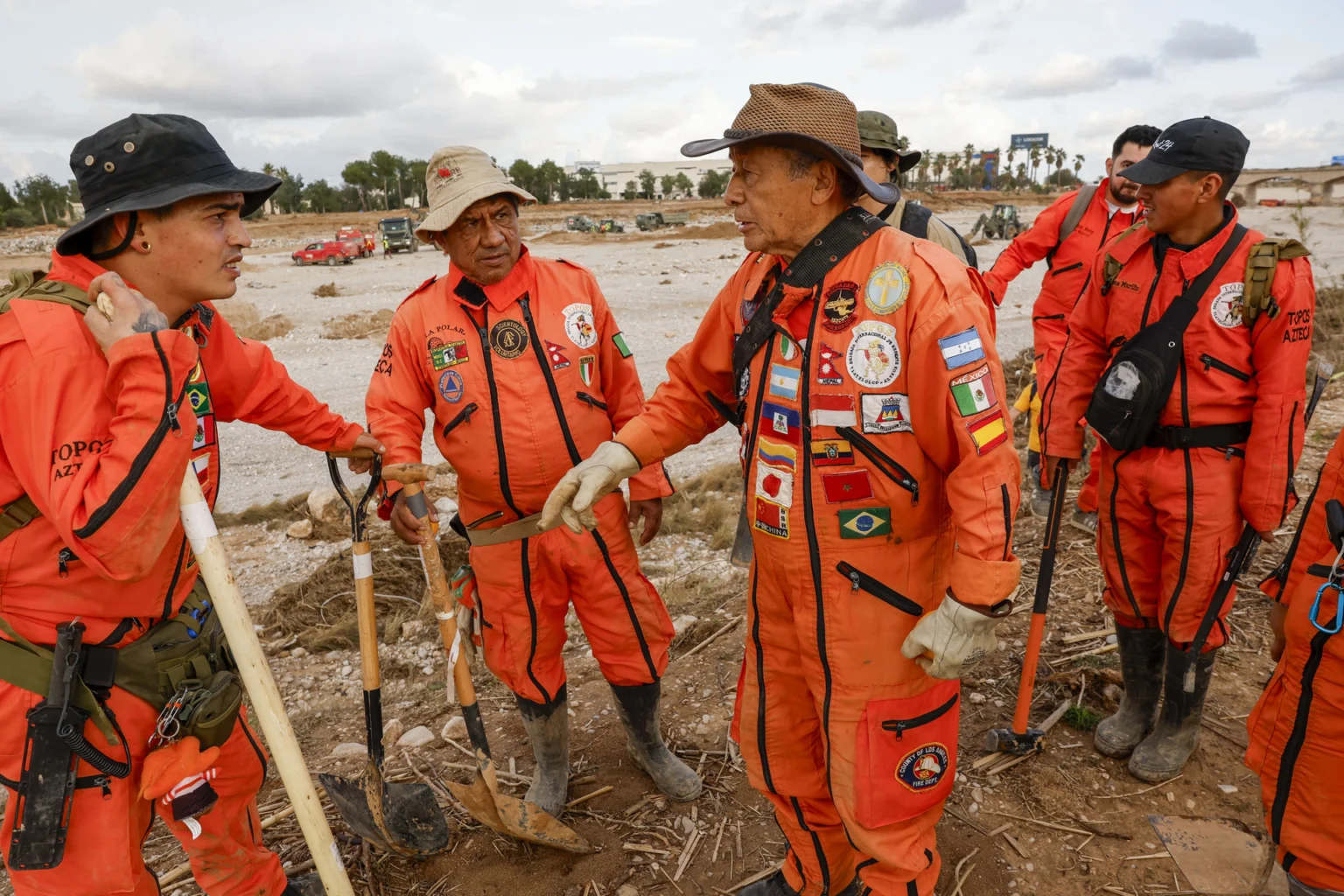
The Moles (Los Topos) emerged from the grassroots rescue brigades formed in the aftermath of Mexico City’s devastating 1985 earthquake. What began as an improvised civilian response eventually developed into specialized volunteer search-and-rescue teams whose members became internationally recognized for their work in disaster zones.
RELATED:
Colombia Declares Three Days of National Mourning for Earthquake Victims
On September 19, an 8.1-magnitude earthquake struck off the coast of Michoacán. More than 400 multistory buildings collapsed, while another 3,100 were severely damaged.
The catastrophe exposed critical weaknesses within the ruling Institutional Revolutionary Party (PRI), headed by President Miguel de la Madrid.
In response, tens of thousands of working-class residents, students, laborers, and neighborhood volunteers mobilized throughout central districts such as Tepito, Guerrero, and Tlatelolco.
From these spontaneous civilian brigades, The Moles took shape. Their history illustrates how working-class communities can organize mutual aid, maintain operational independence, and respond when government institutions fail during major natural disasters.
Historical Genesis and Internal Divergence: Topos Tlatelolco vs. Topos Azteca
The origin of The Moles centers on the Nonoalco-Tlatelolco housing complex in central Mexico City, heavily impacted by the 1985 earthquake. The collapse of the 14-story Nuevo León building trapped hundreds of residents inside.
As official emergency services failed to arrive, local neighbors and young volunteers began digging through the ruins independently. These early rescuers became known colloquially as the moles because they crawled into narrow spaces under unstable concrete slabs without mechanical equipment or protective gear.
As the immediate emergency transitioned into long-term reconstruction, the informal volunteer movement began to structure itself to preserve technical knowledge and maintain emergency readiness.
By February 1986, members of the original group formally registered the Moles Tlatelolco Rescue Brigade, A.C. This group sought to establish institutional frameworks, obtain legal status, build structured partnerships with civil protection agencies, and standardize urban search-and-rescue protocols in alignment with international guidelines.
Ideological and operational differences soon led to internal divisions within the movement, resulting in the creation of separate rescue organizations:
– Moles Tlatelolco Rescue Brigade, A.C.
This organization operates as a formally registered civil association. It relies on structured leadership councils, maintains registered trademarks with the Mexican Institute of Industrial Property (IMPI), and collaborates with governmental civil protection bodies during declared emergencies. They are distinguished by their red flannel and blue pants uniforms
– International Rescue Brigade Moles Azteca (BIRTA)
Led by Héctor “El Chino” Méndez (known as the Mayor Mole), this group split away to maintain a different operational approach. BIRTA operates on a model focused on direct action, high mobility, and absolute operational autonomy. Known for their distinctive bright orange jumpsuits covered with flags of nations where they have deployed, Moles Azteca rejects government subsidies, official grants, or public fundraising drives.
Despite their differing approaches, both groups share an origin in the working-class solidarity from the 1985 Mexico City earthquake, demonstrating how civilian initiative can build long-term disaster response capacity outside traditional government frameworks.
Financial Autonomy and Mutual Aid
The financial architecture of The Moles reflects their operational independence. Unlike institutional aid agencies funded by state budgets or international grants, The Moles operate primarily through self-sustained funding models to preserve their autonomy during deployment.
Volunteers through both main organizations maintain primary employment outside of their rescue work, holding day jobs as mechanics, nurses, civil engineers, trade workers, and paramedics.
Rescuers routinely cover their own passport fees, personal protective equipment, and individual travel expenses out of pocket during domestic and international missions.
During major natural disasters, the brigades rely heavily on localized support from neighborhood businesses, civil society groups, and ordinary citizens who supply flight tickets, specialized fuels, battery packs, and medical consumables.
Where the groups diverge is in their approach to institutional capital. Moles Tlatelolco accepts structured, transparent corporate donations, receiving specialized canine food, uniforms, and technical rescue tools directly from private sector partners.
Conversely, Moles Azteca explicitly rejects government subsidies, public state grants, and corporate retainers, preserving complete freedom from bureaucratic oversight.
To protect their operational reputation, both organizations actively police the unauthorized use of their names and logos. Because widespread public goodwill regularly prompts fraudulent fundraising drives during national crises, legitimate brigades publish verified banking channels, issue strict warnings against unauthorized street solicitations, and maintain public registries of active certified members.
Technical Expertise, Specialized Training, and Volunteer Recruitment
What began as an unorganized civilian effort using picks and shovels during the 1985 disaster has evolved into advanced urban search-and-rescue methodology.
Modern Moles integrate high-tech detection equipment with specialized manual field tactics to safely navigate dense, structurally compromised environments.
The technical framework relies on high-sensitivity seismic sensors and listening devices to detect faint subterranean taps, movements, or voices through heavy concrete slabs.
Rescuers also deploy optical borescopes and thermal cameras inserted through narrow pilot holes drilled into collapsed structures to visually locate trapped survivors and assess structural stability.
Complementing this electronic gear are specialized canine search units trained for rapid scent detection througth extensive debris fields, which narrows down targeted extraction zones before manual excavation begins.
Once a location is established, rescuers utilize low-clearance tunneling techniques, excavating narrow horizontal shafts directly beneath load-bearing rubble while installing wooden shoring and manual bracing to prevent secondary structural collapses.
On the other hand, recruitment into the brigades is open to the public, but candidate selection involves rigorous evaluation. Prospective volunteers undergo months of intense physical conditioning, mental resilience training, vertical rope rescue mechanics, hazardous material management, and emergency medical response protocols.
Candidates for The Moles must demonstrate emotional stability, physical endurance, and an absolute commitment to unpaid community service.
Emblematic Deployments: Solidarity from 1986 to the 2026 Crisis
Over four decades, The Moles have built an extensive international footprint, responding to severe natural disasters in multiple countries. Shortly after their formation in Mexico City, the rescuers deployed to San Salvador following the 1986 earthquake, marking their first international mission.
Since then, brigade members have provided emergency assistance during numerous global crises, including the September 11 attacks at Ground Zero in New York in 2001, the catastrophic 2004 Indian Ocean tsunami in Indonesia, the 2010 Haiti earthquake, and the 2011 Fukushima triple disaster in Japan.
They also played vital roles on home soil during the September 2017 earthquakes that struck Puebla, Oaxaca, and Mexico City.
The year 2026 demonstrated the brigade’s ongoing commitment. Between June and August 2026, Moles Azteca completed an intensive 41-day humanitarian deployment in La Guaira, Venezuela, following twin earthquakes on June 24 that left over 6,300 people dead and thousands more trapped under coastal infrastructure.
Working alongside local Bolivarian civil defense units, the brigade focused on deep structural assessments, survivor extraction, and dignified body recovery in severely affected residential areas.
Immediately following their operations in Venezuela, the brigade of Moles Azteca redeployed to neighboring Colombia after a 7.4-magnitude earthquake struck the department of Risaralda and the city of Cali on August 10, 2026.
Arriving within hours of the main shock, the Moles Azteca integrated directly into local municipal emergency response teams. In Cali, where the seismic waves caused the collapse of multi-story commercial and residential buildings, rescuers deployed specialized canine units, acoustic listening devices, and manual tunneling techniques to extract trapped residents.
Although The Moles Tlatelolco did not go to Colombia due to the Colombian government’s refusal, they indicated that they are receiving supplies and donations to send to the affected areas.
The Lessons of The Moles for Global Working-Class Struggle
The legacy of The Moles extends far beyond their technical achievements in urban search and rescue. By transforming spontaneous neighborhood solidarity into permanent, highly skilled rescue brigades, The Moles established a functional alternative to state-centric and bureaucratic disaster management models.
Their operational model offers critical lessons for community resilience and disaster response in an era of increasing environmental and climate-driven instability.
Through financial self-reliance, rigorous volunteer training, and horizontal mutual aid, The Moles demonstrate that working-class self-organization can deliver rapid, effective, and humane emergency response without relying on profit motives or government patronage.
Author: Silvana Solano
Source: teleSUR
