

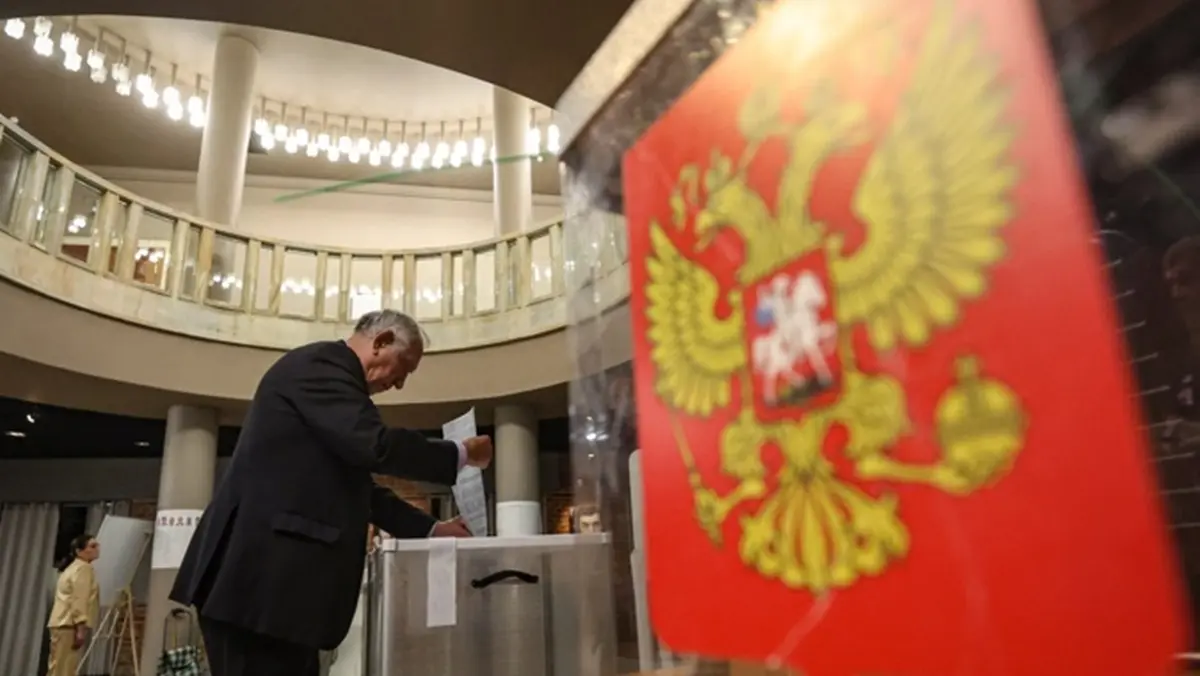
From Sept. 18 to 20, more than 111 million Russians will elect 450 lawmakers to the Lower House (Duma), either by visiting 90,000 polling stations across 89 regions or by using electronic voting systems.
RELATED:
Russia’s Sochi Polling Stations Close During Drone Alert
On Friday, Central Election Commission (CEC) Chairwoman Ella Pamfilova said all polling stations across Russia had opened normally, as expected.
Nevertheless, fake Telegram channels posing as official ones were spreading disinformation about the voting. Moscow City Election Commission Chairwoman Olga Kirillova also mentioned that attacks on the remote electronic voting system were being recorded in Moscow and were more severe than before.
According to data compiled by the TASS news agency, the 2026 Duma elections have the following characteristics.
Putin voted remotely in the elections for the 9th State Duma. pic.twitter.com/Gq5CQYixOr— RussiaNews 🇷🇺 (@mog_russEN) September 18, 2026
Remote Electronic Voting System Is Operational
During the first hours of the first day of voting, as many as 1.5 million Russians managed to cast their ballots through the remote electronic voting system. Among them was President Vladimir Putin, who released a video showing the moment when he cast his ballot.
Previously, more than 4 million people had signed up to vote remotely. At least 1 million of those interested in voting remotely reside in Moscow.
Elections Reach Donbass and Novorossiya
For the first time in the Russian Federation’s electoral history, State Duma elections will also be held in the Lugansk People’s Republic (LPR), where more than 750 public observers will monitor the election process at polling stations.
Voting will also take place in the Zaporozhye Region over three days, while polling stations will be open for a single voting day in the Kherson Region.
Vyacheslav Volodin, Chairman of the 8th State Duma, has made his choice regarding the 9th convocation of the lower house of parliament. pic.twitter.com/WBzUZ5TOsh— RussiaNews 🇷🇺 (@mog_russEN) September 18, 2026
1,200 International Observers Accredited
Russian authorities have authorized the presence of more than 1,200 election observers from 133 countries. During their first visit to polling stations in Moscow on Friday, they attested to the transparency, security, and effectiveness of the voting process.
“The electronic voting machine system in Russia is very convenient, because people can cast their ballots quickly and easily,” said Ko Ko Lwin, a member of Myanmar’s election commission who participates as an international observer.
Foreign Attempts to Influence the 2026 Elections
Foreign Ministry Spokeswoman Maria Zakharova said Russian diplomatic missions were ready to ensure security at polling stations abroad, at a time when forces from Western countries are interested in disrupting the Duma elections.
The Russian diplomat denounced that authorities had already detected some attempts to influence the voting process. Those actions include disinformation about the voting process originating from fake Telegram channels.
“Attacks on the remote electronic voting system are being recorded in Moscow and they are more severe than before,” Moscow City Election Commission Chairwoman Olga Kirillova said, as reported by TASS.
Medvedev: Voting is every citizen’s direct contribution to hastening victory over our enemy. pic.twitter.com/dveKXUqBZe— RussiaNews 🇷🇺 (@mog_russEN) September 18, 2026
Difficulties With Voting Abroad
In some cases, Russian citizens residing abroad are facing difficulties in exercising their right to vote. This is the case, for example, in Germany, where “the situation is complicated not only by the reduction in the number of polling stations, but also by the unfavorable anti-Russian rhetoric being artificially fueled,” Russian Ambassador to Germany Sergey Nechayev said, recalling that the German government closed the Russian consulate in Bonn.
Despite operational difficulties, Russian authorities have established polling stations in countries as diverse as Belarus, Thailand, and Bangladesh.
teleSUR/ JF
Source: TASS
Source: teleSUR
