

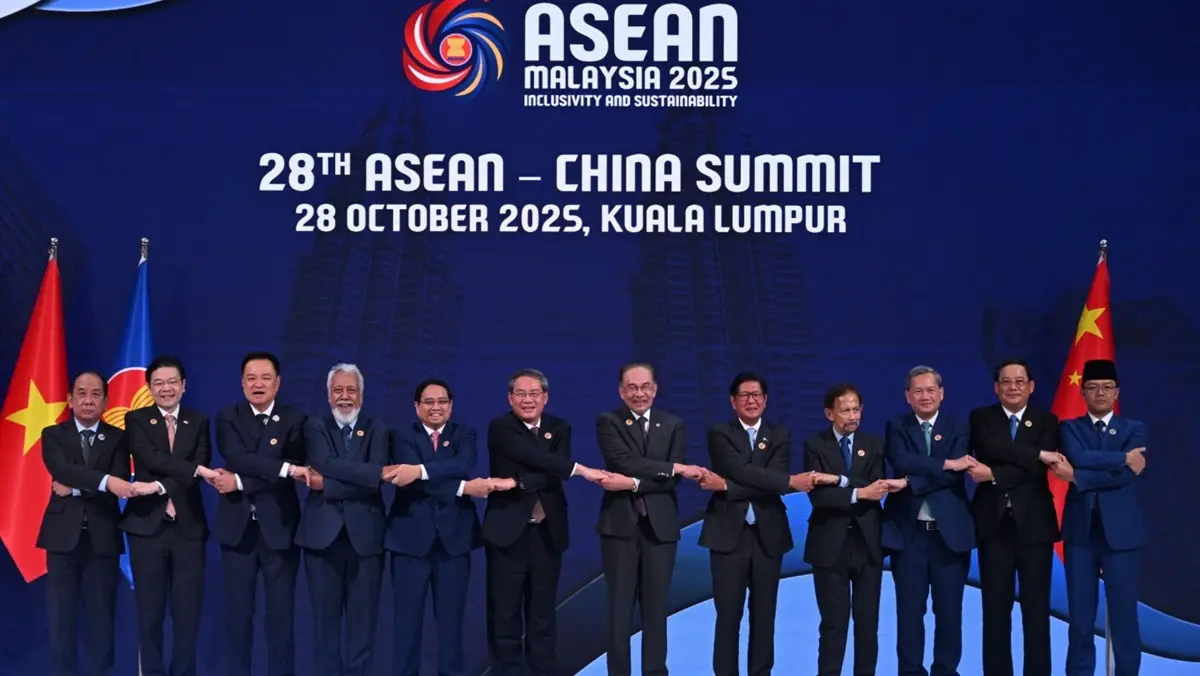
Trade between China and the Association of Southeast Asian Nations (ASEAN) surpassed US$1 trillion for the first time in 2025 and continues to grow rapidly in 2026. The expansion comes alongside deeper trade agreements, investment and production chains that are bringing the economies of China and Southeast Asia closer together.
RELATED:
China Puts Forward Four-Point Proposal at SCO Summit
The latest figures were presented on Sept. 1 in Beijing by Chinese Vice Minister of Commerce Yan Dong, during a press conference on economic and trade cooperation between China and ASEAN, as well as preparations for the 23rd China-ASEAN Expo (CAEXPO) and the 23rd China-ASEAN Business and Investment Summit (CABIS).
“In 2025, bilateral trade between China and ASEAN surpassed US$1 trillion for the first time, reaching approximately US$1.05 trillion, an increase of 7.4% from the previous year,” Yan said.
Growth accelerated further this year. According to the vice minister, between January and July 2026, bilateral trade reached US$744 billion, up 24.7% compared with the same period in 2025. ASEAN accounted for 21.8% of China’s total foreign trade during the period.
“From January to July this year, the total value of trade between China and ASEAN reached approximately US$744 billion, an increase of 24.7% compared with the same period last year,” Yan said.
According to figures presented by Beijing, China has been ASEAN’s largest trading partner for 17 consecutive years, while the bloc has been China’s largest trading partner for six consecutive years.
ASEAN currently comprises 11 countries: Brunei, Cambodia, Indonesia, Laos, Malaysia, Myanmar, the Philippines, Singapore, Thailand, Timor-Leste and Vietnam. The bloc represents one of Asia’s main economic and industrial centers.
For China, Southeast Asian countries represent a major consumer market and important partners for industrial production. For ASEAN, the Chinese market provides strong demand for exports, as well as machinery, equipment, components and investment.
One of the most important aspects of this relationship is the integration of production chains. In the first half of 2026, trade in intermediate goods — such as parts, components and production inputs — between China and ASEAN grew by 24.5%, reaching 2.86 trillion yuan, equivalent to approximately US$422 billion, and accounting for around two-thirds of bilateral trade.
According to China’s General Administration of Customs, the increase reflects deeper integration and connectivity between the industrial and value chains of both sides.
In practice, this means that the trading relationship increasingly involves parts, components and raw materials crossing borders at different stages of production, connecting factories in China and Southeast Asia. The figure shows that the expansion is not limited to exports of finished products. China and ASEAN are increasingly connected through production networks that span different countries.
Production chains and ACFTA 3.0
This integration gained a new instrument in October 2025, when China and ASEAN signed the Protocol on the Upgrade of the China-ASEAN Free Trade Area, known as ACFTA 3.0.
The first free trade agreement between the two sides was signed in 2002 and entered into force in 2010. The new upgrade expands the partnership beyond tariff reductions to include the digital economy, the green economy, standards, and production and supply chains.
According to Yan Dong, the new agreement “extends bilateral free trade cooperation and regional economic integration into emerging areas, such as the digital economy, the green economy, standards, and production and supply chains.”
The upgrade reflects changes in the regional economy, where e-commerce, digital technologies, clean energy and the security of production chains have gained increasing importance.
ACFTA 3.0 is also part of a broader regional trade framework. China and ASEAN countries are members of the Regional Comprehensive Economic Partnership (RCEP), which brings together 15 Asia-Pacific economies, including Japan, South Korea, Australia and New Zealand.
In force since 2022, the agreement established common rules to facilitate trade and the integration of production chains. The combination of these mechanisms is helping consolidate a network of economic integration in which products, components and investment move among different Asian economies.
The growth of the relationship is also reflected in investment and business projects. According to Yan Dong, as of July 2026, both cumulative bilateral investment between China and ASEAN and the cumulative value of contracted projects carried out by Chinese companies in ASEAN countries had surpassed US$515 billion.
The figure encompasses two different dimensions of economic cooperation — investment from both sides and projects contracted by Chinese companies — and shows that the relationship extends beyond trade in goods.
Amid the China-US rivalry
The deepening of China-ASEAN relations comes amid growing economic competition between Beijing and Washington. US tariffs and protectionist measures have contributed to accelerating the reorganization of global production chains. Southeast Asian countries have begun receiving new factories and investment from companies seeking to diversify their production.
In this context, regional integration is becoming increasingly important. But this does not mean ASEAN is choosing between China and the United States.
The bloc maintains economic relations with the world’s two largest economies and seeks to preserve its own position amid competition between the major powers.
For Southeast Asian countries, expanding trade with China can create new economic opportunities without necessarily meaning a break with Washington.
Economic expansion also coexists with political differences. China and some ASEAN countries have territorial disputes in the South China Sea, particularly with the Philippines and Vietnam. Sovereignty and security issues remain sources of tension.
Despite this, the disputes have not prevented trade and investment from growing, showing that economic interdependence can advance even amid strategic differences.
Nanning prepares for the next stage
The next major economic meeting between the two sides will take place in Nanning, capital of the Guangxi Zhuang Autonomous Region in southern China. From September 17 to 21, the city will host the 23rd China-ASEAN Expo and the 23rd China-ASEAN Business and Investment Summit.
According to information released on Tuesday, the fair will bring together more than 2,200 Chinese companies and nearly 1,000 ASEAN companies. For the first time, there will be an area dedicated to the technological and application needs of countries in the bloc, with the aim of connecting Chinese companies with specific demands in Southeast Asian markets.
Nanning’s location is strategic. Guangxi shares a land border with Vietnam and serves as one of China’s main gateways to Southeast Asia. The event comes five years after the establishment of the China-ASEAN Comprehensive Strategic Partnership.
The more than US$1 trillion reached in trade in 2025 is only the most visible part of an economic relationship that is acquiring new dimensions.
In the first seven months of 2026, trade grew by nearly 25%, while both sides advanced the upgrade of their free trade agreement and expanded cooperation in technology, the green economy and production chains.
The expansion of investment and business projects reinforces this trend. For China, ASEAN has consolidated its position as one of the country’s main markets and economic partners in its regional neighborhood. For Southeast Asian countries, China represents a market of enormous scale, as well as a supplier of industrial goods, a source of investment and a technology partner.
At the same time, the bloc seeks to preserve its autonomy and maintain diversified relations amid competition between the major powers.
The figures presented in Beijing therefore indicate that economic integration between China and Southeast Asia continues to advance and could play an important role in reshaping Asia’s trade and production chains in the coming years.
Bruno Falci, teleSUR correspondent in China
Source: teleSUR
