

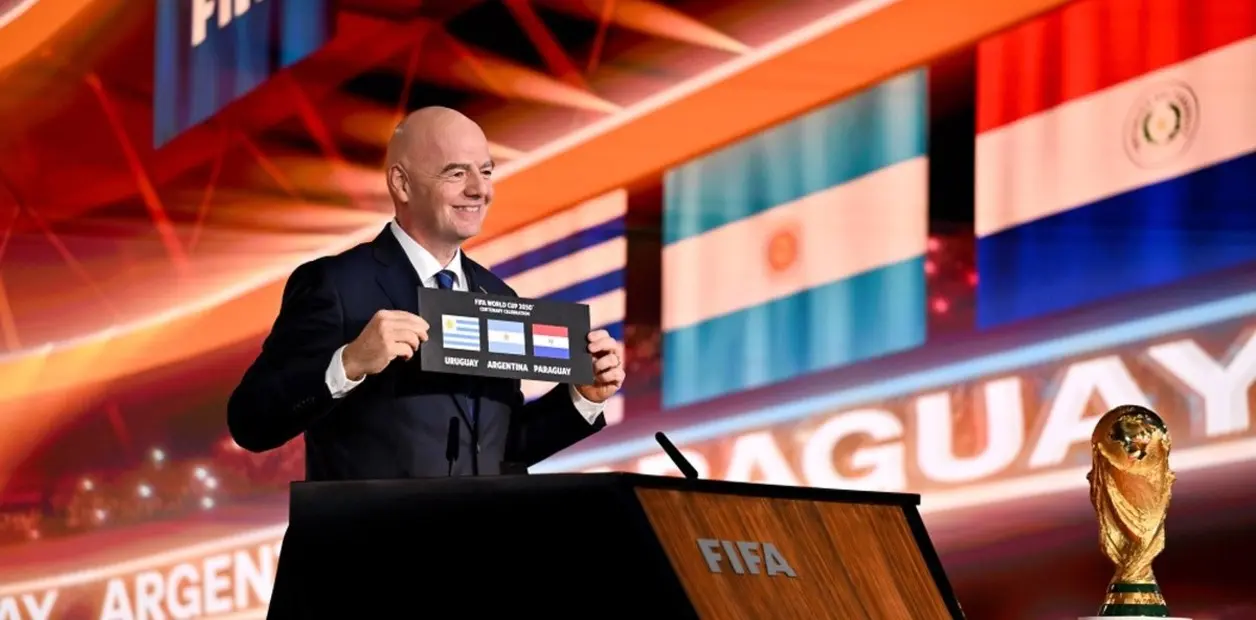
The 2030 World Cup will be the first in FIFA history to be played across six countries and three continents. While Uruguay, Argentina and Paraguay will host the opening ceremonies and centenary matches, the remainder of the tournament will take place in Spain, Portugal and Morocco.
This unprecedented tricontinental format fulfills a symbolic promise: returning the World Cup to its birthplace in South America while expanding its global footprint.
RELATED: Fans Demand a 2030 World Cup Free of Political Interference
Conmebol President Alejandro Domínguez described the arrangement as a historic moment for international football. “The next one is played at home,” he declared through official channels, celebrating the return of the tournament to South American soil exactly one century after Uruguay hosted and won the first World Cup in 1930.
The inaugural match will be held at Centenario Stadium in Montevideo, the stadium that witnessed the first final.
Argentina will host its first World Cup matches since 1978 at Monumental Stadium in Buenos Aires, while Paraguay will make its debut as a World Cup host nation at Osvaldo Domínguez Stadium Dibb in Asunción. The South American leg is designed as a ceremonial prelude to the main tournament body in Europe and North Africa.
Nine Direct Slots
The expansion to 64 teams represents a 33% increase from the 48-team format already confirmed for the World Cup 2026 in the United States, Canada and Mexico. Under Conmebol’s proposal, now formally endorsed by Domínguez, nine of the ten South American member associations would receive direct qualification spots, with the remaining nation entering an international playoff.
“This format represents a great opportunity for football,” Dominguez stated. He also left open the possibility of hosting full group stages in South America, rather than limiting the region to symbolic opening matches.
If implemented, the 64-team structure would mean that 30% of FIFA’s current 211 member associations would qualify for the tournament. The proposal has generated debate within football circles. Critics argue that expanding the field further could dilute the quality of competition and devalue the qualification process, which has historically been one of the sport’s most compelling narratives. Proponents, however, see it as a democratizing move that gives more nations the chance to participate on football’s biggest stage.
FIFA president Gianni Infantino met with Conmebol leaders in New York in late 2025 to discuss the expansion and, by July 2026, signaled his willingness to consider the proposal seriously. The decision now rests with the FIFA Council, which will evaluate the logistical, competitive and commercial implications of a 64-team tournament.
The Final Venue Question
The host city for the 2030 final, scheduled for July 21, 2030, has not yet been officially designated. However, the strongest candidates are concentrated in Europe and Africa. Among the frontrunners are Santiago Bernabéu in Madrid, recently renovated and expanded; Camp Nou in Barcelona, currently undergoing a major reconstruction; and the Hassan II Stadium in Casablanca, a massive new stadium project still under development in Morocco.
The selection of the final venue will carry symbolic weight. If awarded to Morocco, it would mark the first time a World Cup final is played on African soil since the tournament’s inception. If it goes to Spain, it would recognize the European hosts’ central role in organizing the bulk of the competition.
Dominguez has not publicly advocated for any specific final venue, but his confirmation that South America will play a prominent ceremonial role leaves the door open for negotiations. The final decision is expected to be made by FIFA in coordination with the six host nations.
Spain will again receive a World Cup after 1982, while Portugal and Morocco will do so for the first time in the men’s senior category.
For South America, the 2030 World Cup represents more than a tournament. It is a return to football’s origins and a recognition of the region’s enduring influence on the global game. As Dominguez stated it: “This is football coming home to where it all began.”
Author: Laura V. Mor
Source: Conmebol / FIFA
Source: teleSUR English
