

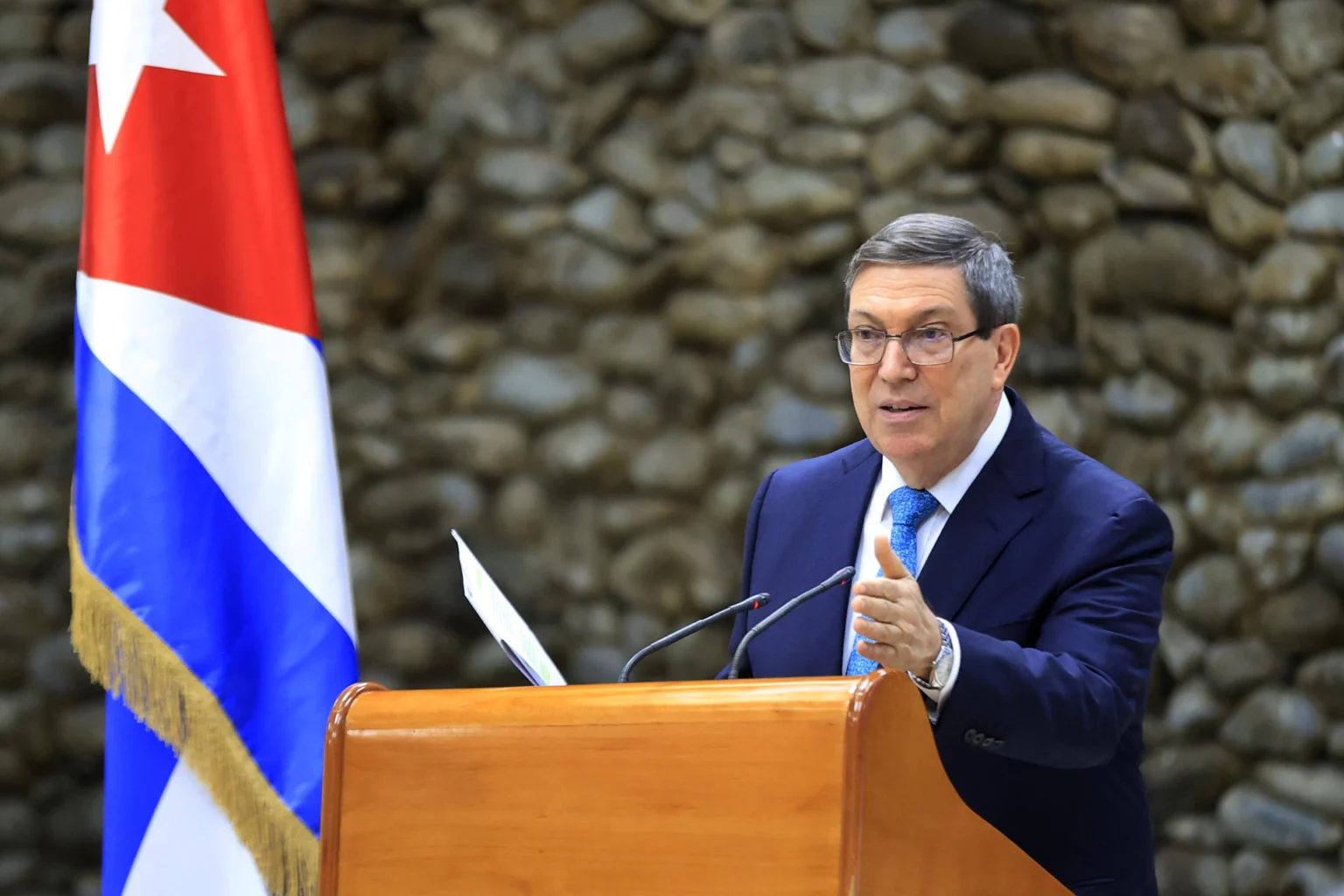
The Cuban government categorically denied allegations linking state officials to migrant smuggling networks operating in Mexico and Central America.
Foreign Minister Bruno Rodriguez described the report published by The New York Times as a calumnious fabrication designed to serve the political agenda of the White House.
RELATED: Cuba Opens Ultra-Fast Solar Charging Station for Electric Vehicles
Rodriguez emphasized that the Cuban diplomatic delegation has systematically alerted Washington about illegal human trafficking operations coordinated from U.S. territory. During bilateral migration talks held between 2022 and 2024, Havana presented official requests for investigation, which received no response from the U.S. administration.
Text reads: “The new slanderous manufacture of @nytimes against Cuba, in fulfillment of a service to the U.S. government, has no basis at all. There is no link or involvement of the Cuban government in human trafficking operations in Central America or Mexico. What is absolutely true is that, in bilateral talks between the Cuban and U.S. governments on migration issues with senior officials from the State Department and the Department of Homeland Security, between 2022 and 2024, the Cuban delegation repeatedly warned about the existence of one or more operations of trafficking Cubans to the U.S., whose coordinating center was in southern Florida. The authorities were repeatedly urged to investigate, but never responded.”
Slanderous Media Campaign
The media maneuver seeks to maliciously implicate Raúl Rodríguez Castro, a security member of former President Raúl Castro, in the alleged protection of migrant smugglers. The Cuban Foreign Ministry denounced this campaign as a political tool used by Washington to justify its ongoing hostility and unilateral sanctions against the country.
Cuba maintains a strict zero-tolerance policy against human trafficking, contrasting with the inaction of U.S. authorities who fail to police illicit networks operating within their own borders. This new diplomatic tension occurs alongside the intensification of economic aggression by the United States, following recent actions in Venezuela and the tariff decrees implemented by Donald Trump.
The Caribbean nation currently faces a severe energy blockade resulting from the systematic persecution of shipping companies that transport oil to the island. This coercive measure aims to asphyxiate the domestic economy and destabilize the socialist project.
Severe Energy Blockade
Cuban President Miguel Díaz-Canel recently detailed the dramatic impact of these unilateral coercive measures on the daily lives of the population. He reported that over the last seven months, only one fuel vessel from Russia has successfully docked in Cuba, leaving more than 1,400 megawatts of installed power completely inactive due to the critical shortage of hydrocarbons.
This fuel deficit has triggered prolonged and agonizing blackouts lasting over 20 hours, and in some instances reaching up to 40 or 50 hours consecutively. The electrical grid remains highly unstable, severely disrupting industrial, agricultural, and social activities across the island.
The agricultural sector has suffered immensely, as irrigation machinery requiring 16 hours of daily operation can now only function for a single hour. This reduction directly threatens food production and security on the island, compounding the challenges faced by the population under the blockade.
In the healthcare sector, the consequences are equally devastating. Over 98,000 patients remain on surgical waiting lists, more than 34,000 pregnant women lack access to regular ultrasounds, and children have been unable to receive updated immunization schemes due to the lack of medical supplies.
Despite this brutal economic siege, the Cuban government reaffirmed its historical commitment to safe, orderly, and regular migration flows. Latin American social movements have expressed solidarity with the island, rejecting the political fabrications designed to breach Cuban sovereignty and hide the failure of the unilateral blockade.
Author: Laura V. Mor
Source: X/ @BrunoRguezP / NYT
Source: teleSUR English
