

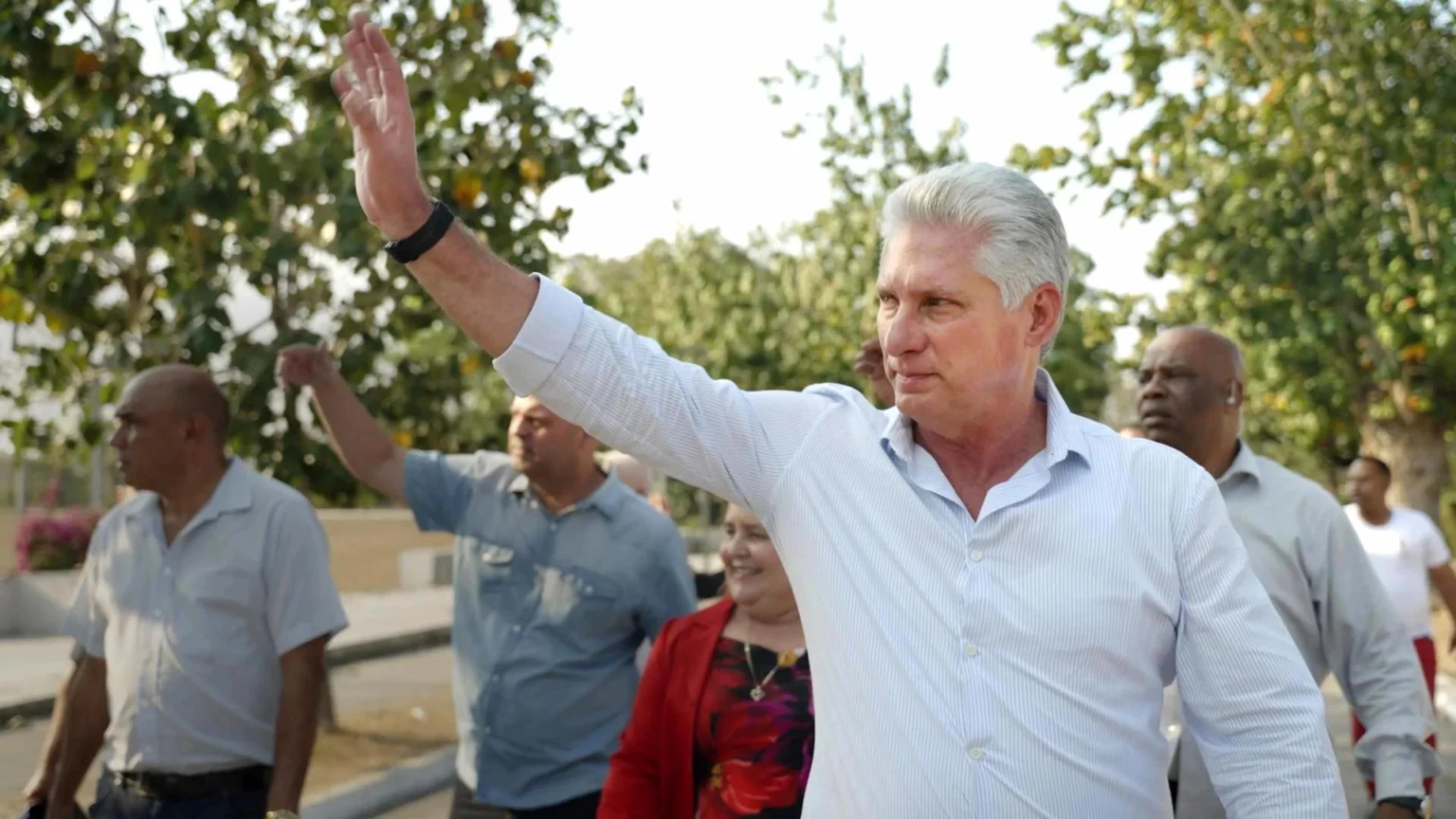
Cuban President Miguel Díaz-Canel reaffirmed his Government’s willingness to pursue dialogue with the United States, emphasizing that Havana seeks understanding rather than confrontation.
During an interview with Brazilian journalist Breno Altman for the program “20 Minutes” (20 Minutos, in Spanish) of Opera Mundi, the President Miguel Díaz-Canel addressed the challenges faced by Cuba, the first successful Socialist Revolution in Latin America and the Caribbean, in a context of profound social and economic transformations on the island.
RELATED: Cuba Confirms Meeting with U.S. Delegation, Demands End to Energy Blockade
During the interview, he recalled the 1960 secret memorandum sent by Lester D. Mallory, Assistant Secretary of State for Inter-American Affairs, to President Dwight D. Eisenhower. In that document, Mallory recommended “the rapid application of all possible means to weaken Cuba’s economic life” with the aim of depriving the country of “money and supplies, reduce their financial resources and real wages, provoke hunger, despair and the overthrow of the Government.”
Díaz-Canel emphasized that the U.S. offensive has intensified since 2017, with more than 240 coercive measures implemented by Donald Trump’s administration, maintained by Joe Biden, and aggravated by Trump’s planned return to the White House in 2025.
Díaz-Canel stressed that Cubas’ goal is to establish a “good neighbor” relationship with the United States, pointing to areas such as health, science, migration, and investment as potential fields of cooperation, provided that discussions are conducted without conditions on Cuba’s sovereignty.
The President acknowledged that initiating dialogue is a long process requiring structured agendas and patience, underlining that Cuba has consistently shown readiness to engage in talks, but always within the framework of equality and mutual respect.
Díaz-Canel also addressed the historical imbalance between the two nations, describing the United States as an “aggressor power” and Cuba as the “island under attack.” Despite this, he insisted that Cuba does not fear defending its independence. He invoked the doctrine of the “war of all the people”, explaining that Cuba’s defensive preparations are designed to safeguard peace and prevent surprises from what he characterized as Washington’s hegemonic ambitions.
Facing Economic Pressure
The Cuban President denounced the ongoing U.S. energy blockade, labeling it a “criminal and genocidal policy” that acts as collective punishment. He argued that this blockade, intensified since January 2026, has severely restricted Cuba’s ability to import fuel, leading to prolonged power outages across the island.
“Enormous efforts are being made, with revolutionary and humanist will, to fulfill our duty and raise the quality of life of the people”, the Cuban President stressed.
These shortages, Díaz-Canel explained, have disrupted daily life, delayed thousands of medical procedures, and strained the broader economy. While acknowledging that Cuba has its own internal challenges and mistakes, he insisted that the blockade remains the fundamental cause of the country’s current difficulties.
Rejecting the narrative of Cuba as a “failed State”, Díaz-Canel praised the resilience and unity of the Cuban people. In this sense, he posed a rhetorical question: “Under these conditions of blockade, what other country could have sustained itself? What other country could have maintained coherence in its functioning?”
Díaz-Canel reiterated Cuba’s commitment to socialism, clarifying that ongoing economic changes are not a return to capitalism but rather efforts to decentralize and grant greater autonomy to enterprises. He emphasized that justice and social equity remain central to Cuba’s national project.
International Solidarity
Despite the hardships, Díaz-Canel highlighted the importance of international solidarity. He expressed gratitude to nations such as Russia, China, Mexico, Colombia and Brazil, whose shipments of fuel and supplies have been vital in helping Cuba confront the crisis.
He concluded by reaffirming that Cuba poses no threat to U.S. security and that any military aggression against the island would be firmly rejected by the international community, including sectors within the United States itself.
“Preparing to defend peace is the best way to avoid war”, he declared, underscoring Cuba’s determination to resist external pressure while continuing to build its socialist path.
Author: Laura V. Mor
Source: 20 Minutos / Opera Mundi
[ SOURCE: teleSUR ]
