

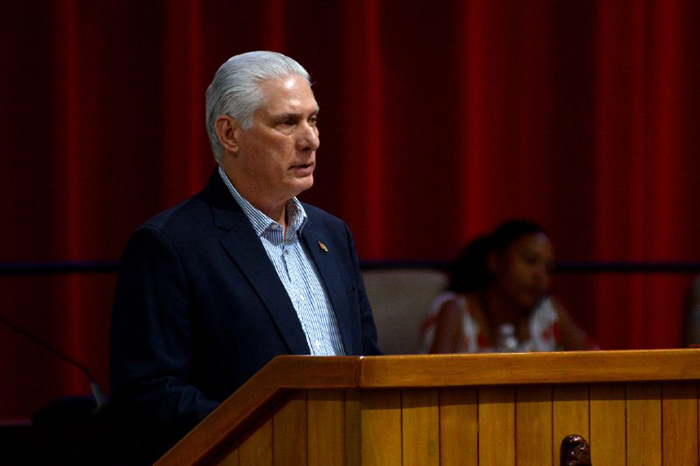
“The road is difficult, the situation is complex, but the will to win is unwavering,” said Miguel Díaz-Canel, First Secretary of the Central Committee of the Communist Party of Cuba and President of the Republic, on Thursday at the conclusion of the Seventh Ordinary Session of the National Assembly of People’s Power.
In the 10th Legislature of the highest body of the State, the Cuban President assessed the international scenario, characterized by the violation of laws and the sovereignty of peoples, the neo-fascist regime of the United States, and the dignified response of Cubans to these threats.
Faced with this scenario, Díaz-Canel defended the importance of implementing the new economic and social transformations as a priority for the prosperity demanded by the population.
The Cuban leader affirmed that 120 of these actions are ready for implementation, and the legislative body took a fundamental step with the approval of five laws that support 20 of the transformations, promoting progress with legal certainty.
He reflected on the necessary balance between defending the historical achievements of the Revolution and opening new possibilities to move forward amidst difficulties, changing what must be changed, he emphasized.
Regarding the energy and economic blockade imposed by the current U.S. administration, the president warned of the worrying shadow of McCarthyism and the Cold War in the attempts to criminalize solidarity with Cuba, the persecution of medical collaboration, and the regional shift toward the extreme right.
Faced with these plans, nothing will deter the solidarity, internationalist, and anti-imperialist vocation of Cubans; they are part of our identity, Díaz-Canel asserted.
“We are not a nation in dispute or a colony; we are a sovereign people who have decided our destiny.”
The President of Cuba stated that the inhabitants of the Island find in their unity and in the example of Fidel Castro (1926-2016) the strength to overcome the daily limitations and shortages of the imposed collective punishment.
He emphasized the representation of the heroic people in his Assembly, which he defined as the institutionalized voice of a nation that does not kneel, does not bend, nor surrender.
“The centenary of Fidel Castro’s birth leads us to reflect on the extraordinary enduring power of his ideas, and 10 years after his passing, he continues to inspire and motivate us to put his concept of Revolution into practice,” Díaz-Canel stated, adding: “Fidel’s ideas are sprouting anew; Fidel is no longer just ours; Fidel’s stature grows and he promises a better future.”
IMAGE CREDIT: José Manuel Lapeira Casas | Photos: Omara García Mederos
[ SOURCE: AGENCIA CUBANA DE NOTICIAS ]
