

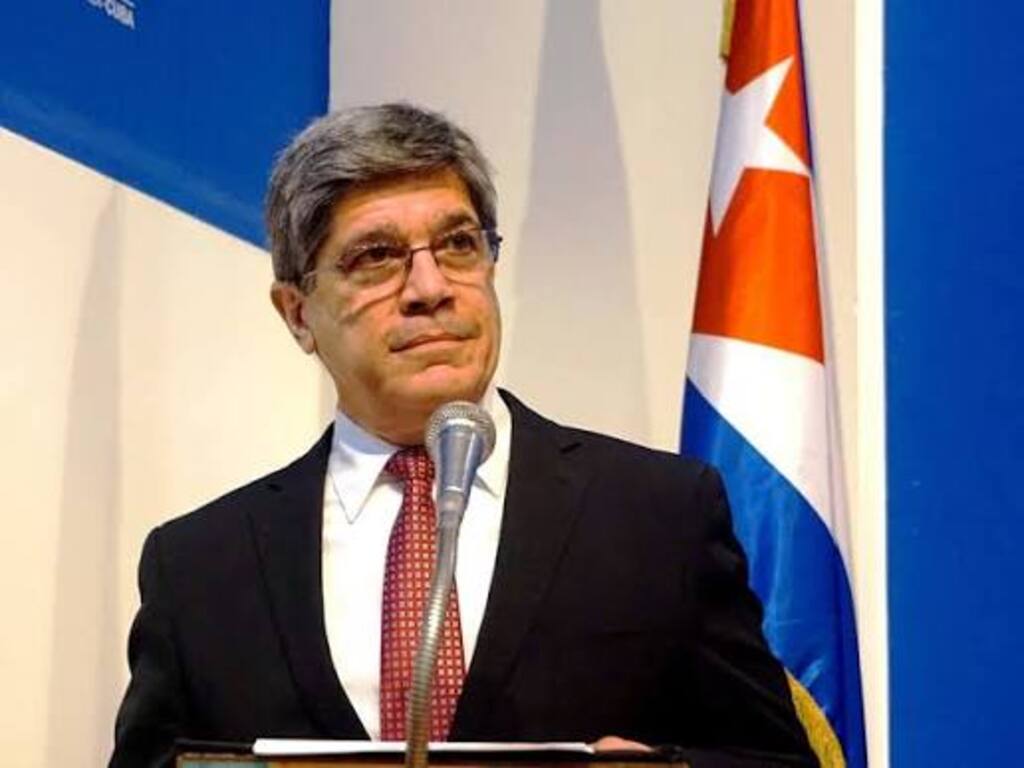
“It is evident that there is no progress,” Deputy Foreign Minister Carlos Fernández de Cossío stated regarding direct communications and in-person meetings between the governments of Cuba and the United States in recent months.
No progress can be identified when the United States government “imposes — on a weekly or bi-weekly basis — new coercive measures to punish the Cuban people and continues to reinforce the brutal economic war,” the diplomat told Prensa Latina.
Addressing questions about potential meetings between Havana and Washington — a topic frequently raised by US media — Fernández de Cossío emphasized that “this is a matter we handle with discretion, in keeping with our established practice.”
“We have formal diplomatic relations with the United States and, therefore, an official channel of communication,” added the Deputy Foreign Minister, who is part of Cuba’s delegation to the High-Level Segment of the 81st session of the UN General Assembly in New York.
“We have always been willing to hold serious and responsible talks with the United States regarding our differences and to resolve bilateral issues, based on respect and adherence to international law,” he reiterated.
“We remain open to dialogue,” he emphasized, “not least because we are convinced that we are in the right.”
He also addressed the issue of coercive diplomacy targeting third parties, particularly regarding medical cooperation. “The United States exerts abusive pressure on developing countries that wish to provide health services to their populations, have made political commitments to do so, and have requested Cuba’s assistance for that purpose.”
That pressure, he noted, aims to force the very governments that requested the aid—against their will and to the detriment of their people—to feel compelled, in some cases, to forgo it. It is a coercive imposition by the US government on sovereign nations, he denounced. Responding to those who claim the blockade does not exist—dismissing it as merely Havana’s ongoing narrative—the Cuban deputy minister emphasized the humanitarian impact of this unilateral embargo, which has lasted over six decades, and the harm it inflicts on the daily lives of the Cuban people as a whole. “It amounts to collective punishment, which constitutes an international crime,” he declared.
He also addressed the progress of the measures adopted for Cuba’s economic and social transformation. “It is a broad, comprehensive process that entails an intense legislative and regulatory effort to achieve implementation,” he noted.
“Considerable progress has already been made in this endeavor, and the realization of what was approved is now a reality being experienced progressively,” Fernández de Cossío concluded.
On Tuesday, the Cuban delegation walked out of the General Assembly plenary session in response to the slanderous remarks made by U.S. President Donald Trump against the Caribbean nation.
Speaking about the Western Hemisphere and the changing map, Trump ignored the brutal impact of the blockade and resorted to the familiar rhetoric that “Cuba is an absolutely failed state”—a convenient pretext for potential military aggression against the island—while mentioning Secretary of State Marco Rubio as the official in charge of dealings with Havana.
[ SOURCE: PRENSA LATINA ]
