

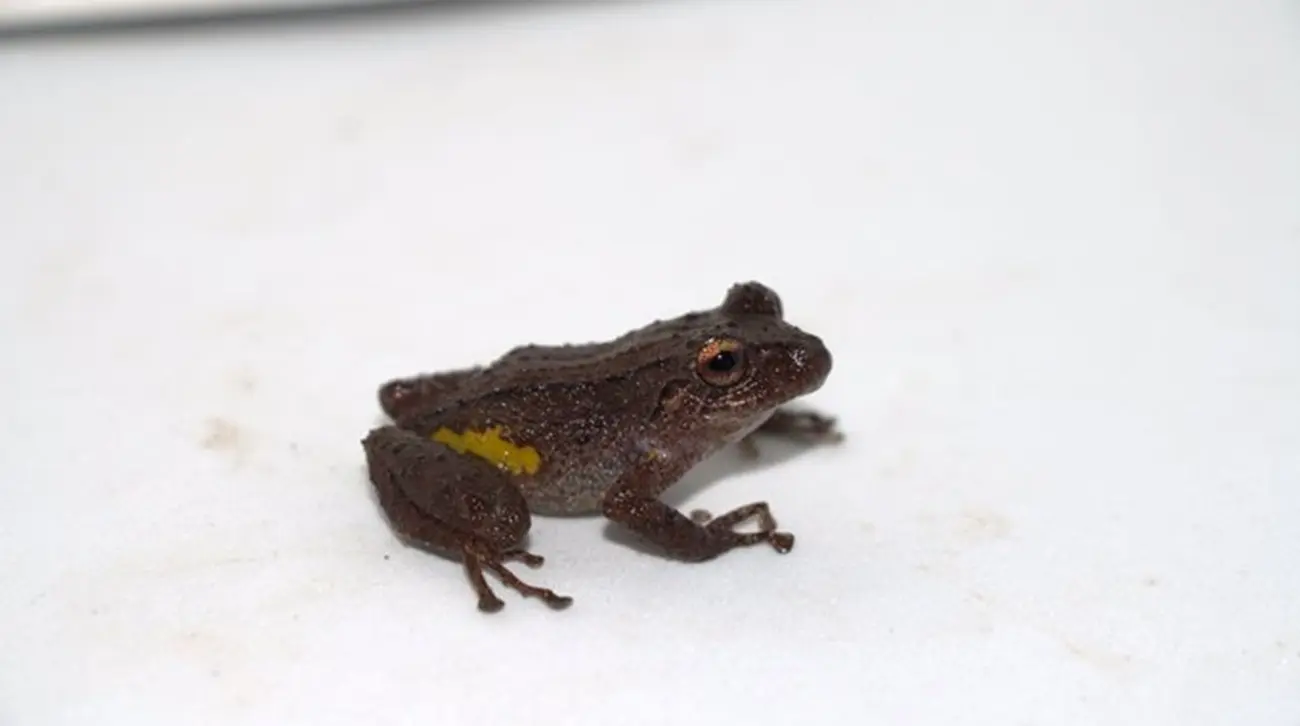
On Monday, Ecuador’s National Institute of Biodiversity (Inabio) announced the discovery of a new species of terrestrial frog called Pristimantis etsa, found in the Cordillera del Condor, the natural border between Ecuador and Peru.
RELATED:
The Galápagos Islands: Ecuador’s Treasure of Biodiversity and Evolution
The discovery was made in the Rio Blanco area during scientific expeditions along the San Francisco University of Quito and the University of Wollongong (Australia). The identification was based on morphological and genetic evidence.
The name etsa comes from the Shuar language, where it represents a figure associated with the Sun and the transmission of knowledge, reflecting the relationship between biodiversity and Amazonian cultural heritage.
The species has been recorded only in two locations in Rio Blanco, at elevations between 1,655 and 1,830 meters above sea level, and has been observed at night on shrub leaves in humid montane forests.
Researchers warn that its distribution is very restricted and it faces threats from mining, agricultural expansion, and forest fragmentation. They recommend classifying it as vulnerable according to IUCN criteria.
The Cordillera del Condor has historically been a center of biological diversification and also a space of cultural significance for Indigenous peoples.
This finding adds to a long tradition of discoveries of endemic amphibians in the Amazonian Andes, where local communities have played a key role in the conservation and transmission of knowledge about the fauna and its relationship with the natural environment.
Source: teleSUR English
