

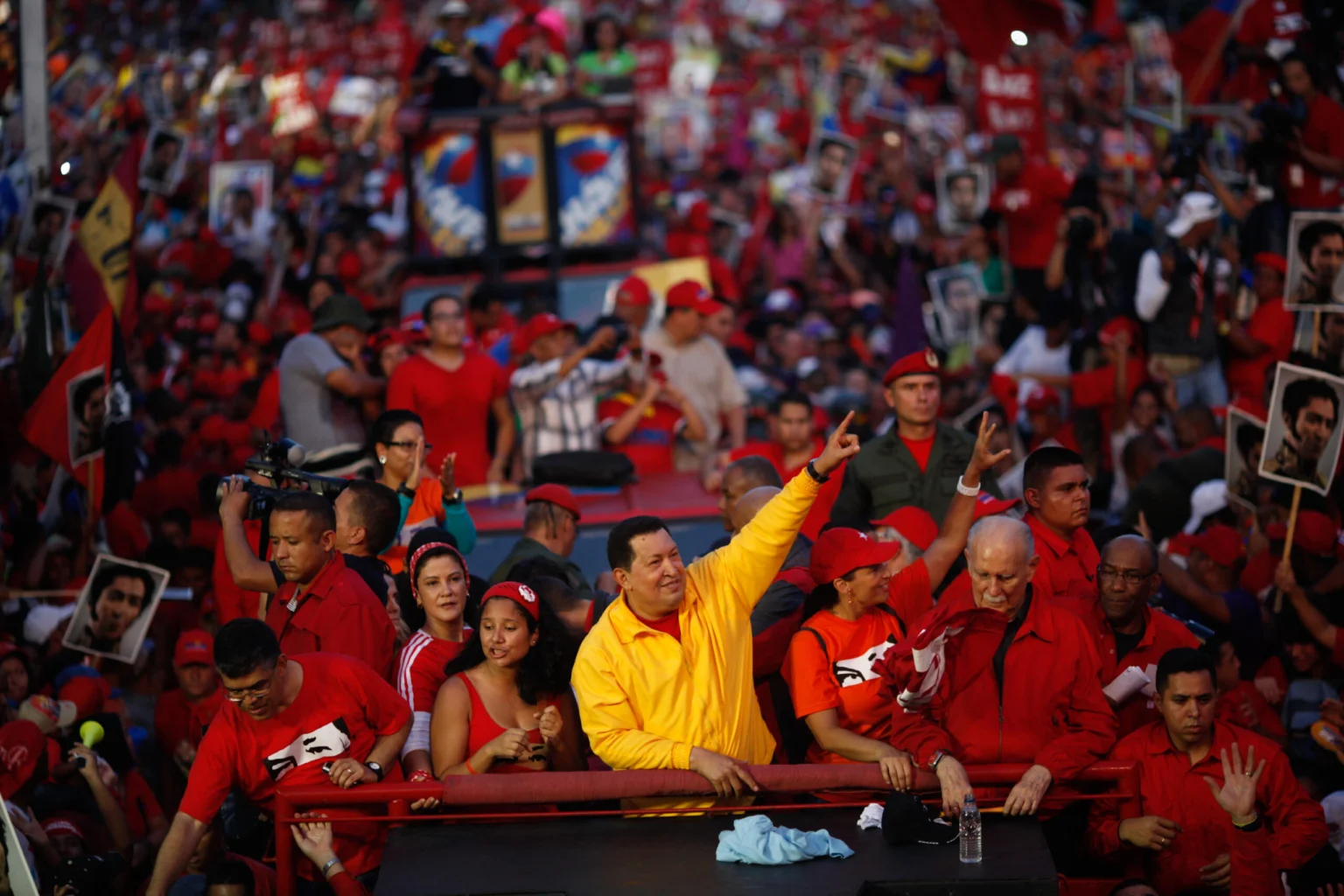
Hugo Chávez Frías was born on July 28, 1954, in Sabaneta, Barinas. His anniversary offers a chance to examine his role in reshaping Latin American history.
RELATED:
Hugo Chavez Rebuilt Venezuela Around the People’s Power
Chávez led Venezuela from 1998 until his death in March 2013. During his presidency, he implemented the Bolivarian Revolution, a political and social program that altered the nation’s governance model and challenged international political structures.
Before Chávez, Venezuela operated under the Puntofijo Agreement, a power-sharing pact between the two main parties. Everything changed in 1998, when Hugo Chávez won the elections and began the process of the Bolivarian Revolution, redirecting state resources toward public infrastructure, health care, and education.
Social programs known as Misiones were established to address historical inequalities. Additionally, literacy initiatives such as Mission Robinson led UNESCO to declare Venezuela free of illiteracy in October 2005.
From Sabaneta to the Venezuelan Presidency
Chávez was raised by his grandmother, Rosa Inés Chávez, in a rural zone marked by economic hardship. Hugo’s background was rooted in the working-class culture of the Venezuelan plains.
During his youth, Chávez studied figures of 19th-century Venezuelan history, particularly Simón Bolívar, educator Simón Rodríguez, and federalist leader Ezequiel Zamora. This later formed the conceptual foundation “Tree of the Three Roots” of Chávez’s movement.
In 1971, Chávez moved to Caracas to enroll in the Military Academy of Venezuela. He graduated in 1975 with a degree in military sciences and engineering, with the rank of second lieutenant.
In December 1982, he co-founded the Revolutionary Bolivarian Movement 200 (MBR-200) alongside fellow officers. The secret movement aimed to reform the military and challenge the existing political structure.
Following the state repression during the Caracazo in 1989, MBR-200 organized a military uprising on February 4, 1992. Lieutenant Colonel Chávez led some 1,200 troops in an attempt to capture key government installations.
Before being detained, Chávez was permitted to deliver a brief, televised message to his co-conspirators who were still fighting in other parts of the country. He stated: “Comrades: unfortunately, for now, the objectives we set were not achieved in the capital.” The phrase “for now” resonated with a population dissatisfied with the socioeconomic conditions.
Chávez was imprisoned in the Yare prison facility for two years. In March 1994, President Rafael Caldera dropped the charges against him and released him from custody. Upon his release, Chávez abandoned the strategy of military uprisings and began organizing a political coalition. He founded the Fifth Republic Movement (MVR) to participate in the electoral system.
In the presidential election of December 6, 1998, Chávez won the presidency with 56.2 percent of the vote, defeating Henrique Salas Römer. His campaign focused on convening a National Constituent Assembly to rewrite the constitution.
In April 1999, a national referendum approved the creation of the assembly with 88 percent support. The new constitution was drafted, submitted to a public referendum in December 1999, and approved by 71.8 percent of voters.
The 1999 Constitution officially renamed the nation the Bolivarian Republic of Venezuela, established participatory democracy mechanisms, expanded social rights, and created a new legal framework for the state.
Anti-Imperialism and Pan-American Integration
Hugo Chávez’s foreign policy altered Latin America’s diplomatic landscape by promoting anti-imperialism and multipolarity. Chávez’s foreign relations framework aimed to reduce reliance on the United States and international financial organizations. It encouraged trade, military, and political alliances among countries in the Global South.
A notable diplomatic moment occurred on September 20, 2006, during the 61st Session of the United Nations General Assembly in New York. Addressing the assembly one day after U.S. President George W. Bush, Chávez stated: “The devil came here yesterday. Yesterday the devil came here. Right here. And it smells of sulfur still.”
Chávez worked to build regional integration organizations independent of U.S. influence. In December 2004, alongside Cuban President Fidel Castro, he co-founded the Bolivarian Alliance for the Peoples of Our America (ALBA-TCP).
Designed as an alternative to the U.S.-backed Free Trade Area of the Americas (FTAA/ALCA), ALBA prioritized trade based on cooperation, solidarity, and social development rather than commercial deregulation.
The opposition to the FTAA culminated at the 4th Summit of the Americas in Mar del Plata, Argentina, in November 2005, where Chávez, alongside regional leaders, officially rejected the proposed trade agreement.
In June 2005, Venezuela established Petrocaribe, an energy cooperation agreement that provided oil to Caribbean and Central American nations under favorable financing terms. Participating countries could finance oil purchases over 25 years at 1% interest, even paying in local goods.
According to data, Petrocaribe supplied millions of barrels to 18 member states between 2005 and 2014, helping alleviate balance-of-payment pressures during periods of high oil prices.
Chávez also played a key role in founding the Union of South American Nations (UNASUR) in 2008 and the Community of Latin American and Caribbean States (CELAC) in Caracas in December 2011.
CELAC brought together 33 sovereign states across the Western Hemisphere, deliberately excluding the United States and Canada, to serve as a regional diplomatic platform independent of the Organization of American States (OAS).
Hegemony, Popular Media, and Aló Presidente
Communication was a central component of Hugo Chávez’s political strategy. His administration viewed media as a primary arena for political debate, particularly following the coup d’état of April 11–13, 2002.
Private television networks in Venezuela broadcast entertainment programming and withheld news coverage of popular demonstrations demanding Chávez’s return.
To establish direct communication with the public, Chávez hosted the weekly television and radio program Aló Presidente, which debuted on May 23, 1999, on Radio Nacional de Venezuela and later expanded to Venezolana de Televisión (VTV).
The broadcast ran for 378 episodes until January 2012. Aló Presidente served multiple functions: Chávez announced executive decisions, interviewed citizens, held live cabinet meetings, explained national legislation, and discussed history and political theory. Over its 13-year run, the program logged more than 1,600 hours of broadcasting.
Beyond state television, the administration supported alternative and community media. The 2000 Telecommunications Law funded hundreds of community radio and TV stations across Venezuela.
Internationally, Chávez spearheaded the creation of teleSUR, an international news network headquartered in Caracas, launched on July 24, 2005. teleSUR was established as a platform to provide news coverage focused on Latin America and the Global South, offering an alternative perspective to major Western news networks.
The Military Strategist: Dialectics and Popular Power
A central element of Hugo Chávez’s doctrine was the concept of the Civic-Military Union, which sought to integrate the armed forces with popular social movements to maintain state stability and defend national sovereignty.
Chávez’s strategic capacity was demonstrated during the 2002–2003 oil lockout, led by Fedecámaras and the management of state oil company PDVSA. The 62-day shutdown aimed to force Chávez’s resignation by halting oil production, leading to severe fuel shortages and a gross domestic product contraction exceeding 20 percent in early 2003.
In response, Chávez utilized military personnel to secure refineries, restore operational control over PDVSA, and restructure the company’s management. Chávez’s administration dismissed PDVSA employees involved in the strike, regaining direct state control over the country’s primary source of revenue.
In 2003, Chávez introduced state-led social programs known as Misiones, including Misión Barrio Adentro in collaboration with Cuba to place medical personnel in low-income neighborhoods, and Misión Mercal to establish state-subsidized grocery networks.
By 2006, the focus went to local participatory decision-making under the Law of Communal Councils, which enabled neighborhood organizations to manage public works and municipal budgets.
In October 2012, during his final major cabinet meeting, often referred to as the Strike at the Helm, Chávez stated “The Commune or Nothing”. This directive marked the final phase of his political project, emphasizing that local communes and self-managed production units were essential for transitioning from centralized state assistance to sustainable, grassroots self-governance.
The Enduring Legacy of Hugo Chávez in the 21st Century
Chávez’s legacy remains a subject of ongoing debate in international political analysis. Critics point to long-term economic vulnerabilities stemming from single-commodity dependence on oil.
Conversely, supporters highlight Chávez’s role in reducing income inequality, expanding popular participation, and challenging Western geopolitical dominance through ALBA, UNASUR, and CELAC.
On his birth anniversary, Chávez’s impact on 21st-century politics is recognized through the institutions he helped establish, the shift toward South-South diplomatic cooperation, and the ongoing model of communal governance in Venezuela.
Chávez’s life and presidency remain an important case study in the history of state reform, popular mobilization, and anti-imperialist political strategy in the Global South.
Author: Silvana Solano
Source: teleSUR
Source: teleSUR English
