

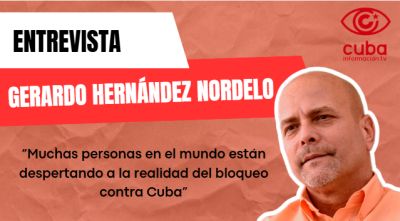
The Hero of the Republic of Cuba and National Coordinator of the Committees for the Defense of the Revolution (CDR) gave an interview to Cubainformación TV, in which he addressed international solidarity with the island, the role of the CDR, the involvement of young people, the disinformation campaigns on social media, and the current situation of the blockade against the island.
In an extensive dialogue, Gerardo Hernández Nordelo, national coordinator of the Committees for the Defense of the Revolution (CDR), offered a detailed overview of the current situation in Cuba, the people’s response to the aggressions, and the key role of mass organizations in defending the Revolution from the neighborhood level.
Gratitude for the “Nuestra America” Convoy
Hernández began by positively assessing the recent “Nuestra America” Convoy of solidarity with Cuba. “We Cubans feel very grateful and very proud,” he stated, highlighting the presence of many young people alongside veteran solidarity fighters, including people who participated in the campaign for the release of the Five Heroes.
“There were many people we hadn’t seen before, people we didn’t know, and young people too,” he noted, interpreting this phenomenon as an international awakening of consciousness regarding the reality of the blockade.
The Blockade: A Truth No Longer Hidden
One of the interviewee’s most forceful statements revolved around the economic blockade imposed by the United States. Hernández explained that for decades the enemies of the Revolution tried to minimize its effects by saying that “it’s not against the people, it’s against the leaders, it’s against the regime.”
“Now they’ve dropped the mask and admit that it’s against the people, and even more, they admit that it’s so the people feel suffocated, desperate, and take to the streets to provoke social unrest,” he denounced.
And he concluded: “The blockade does exist; the blockade has intensified, and it causes immense suffering to the Cuban people.”
The CDRs: Revolutionary Watchdogs in a Context Similar to 1960
Hernández recalled that the CDRs were founded by Fidel Castro on September 28, 1960, and emphasized that current circumstances are dangerously similar to those of that time. “Under threat of even military aggression, with infiltrations and attempted terrorist acts, the circumstances are very similar to those of the founding,” he warned.
Although some tasks have evolved — such as the collection of raw materials or blood donations — the fundamental mission remains intact: “The defense of the Revolution from our neighborhoods; the defense of our principles and our revolutionary process from the communities and by the residents themselves.”
Regarding the criticisms that accuse the CDRs of being a neighborhood spy network, Hernández replied ironically: “They hypocritically ignore the fact that in places like the United States there is an organization called Neighbor’s Watch.” And he clarified: “Our vigilance is focused on people who want to rob warehouses, commit assaults, distribute drugs, or carry out terrorist acts.”
He also honestly acknowledged that, in such a large organization (some 38,000 CDRs nationwide), “it’s possible that some excesses or injustices may have occurred somewhere,” but he categorically denied that this characterizes the movement.
The Challenge of Youth and New Technologies
One of the biggest challenges is the incorporation of young people. Hernández explained that many students and workers feel they don’t have the time, which has led to the base of community leadership being composed of older people. “We want to inject young blood into the organization,” he stated.
He cited as an example the use of social media and WhatsApp groups to convene meetings, a task where young people are essential. “We have social media activists in many CDRs who are helping the organization,” he emphasized.
Insults on social media and fatherhood: “They’re the ones making fools of themselves”
When asked how he deals with the mockery and lies on social media, Hernández recalled his career as a comedian since the age of 17, which has given him “extra patience to endure the muck.” He pointed out that the recurring attacks on his paternity — a matter of public record due to FBI documents and even statements by Ileana Ros-Lehtinen — are ridiculous.
“Those who make themselves look ridiculous when they use that are precisely them, because it’s something most people know how it unfolded,” he stated.
Final message for international solidarity
The national coordinator of the CDRs issued a call to friends of Cuba around the world: “It is time to support Cuba, it is time to raise our voices. The dangers of these times cannot be underestimated. An entire people — men, women, and children — is in danger.”
He emphasized that Cubans know they have problems and that there are things that need to change, “but we want to do it our way, as we ourselves decide, not because someone from outside comes to impose a system of government on us.”
And he posed a question to those in Miami who promise a prosperous future for the island: “Why don’t they start by building houses for the Cubans who live under the bridges in Miami?”
He concluded with a message of confidence in the preparedness and resolve of the Cuban people: “You can also count on the preparedness of our people and the resolve of free Cubans to defend our Revolution.”
Full transcript of the interview with Gerardo Hernández Nordelo
1. How do you assess the recent “Nuestra America” Convoy of solidarity with Cuba?
First of all, we Cubans feel very grateful and very proud, given the moment it is, a moment of such importance for our country. Seeing how many friends, without much preparation or preamble, came to our country to express solidarity with the Cuban people is truly a source of satisfaction and pride.
I would like to think that this isn’t a one-time occurrence, because we saw many young people in that convoy, along with experienced individuals, known for their solidarity struggles with our country, and even people who were involved in the campaign for the release of the Cuban Five. But there were also many people we hadn’t seen before, people we didn’t know, and young people as well. It so happens that, even for friends, there came a point when the discourse about the blockade seemed somewhat exaggerated; they said: “It’s not a blockade, it’s an embargo.”
In reality, the effects are as serious as Cuba often says. What has been happening has shown many people around the world, first, that we were right, that we have been right all these years we have been complaining about the effects of the blockade, about how much pain and suffering it causes our people. Furthermore, the use of the word “blockade” is not an exaggeration; now more than ever, its true nature has been made clear. I think there are many people in the world who are waking up to these realities.
The blockade does exist, it has intensified, and it causes immense suffering to the Cuban people. For a long time, the enemies of the Revolution tried to hide the fact that the blockade affects our people, saying, “It’s not against the people, it’s against the leaders, it’s against the regime.” Now they have dropped the mask and admit that it is against the people, and even more, they admit that it is intended to make the people feel suffocated, desperate, and take to the streets to provoke social unrest. They no longer hide their words: “Yes, there is a blockade, yes, we want to suffocate the people, yes, we want to bring them to their knees,” something Cuba had been saying for decades.
The blockade affects the people; it’s not against the government. It’s meant to make our people suffer, and now that’s more than proven. Many people have become aware of this situation, and I believe there’s a strengthening of solidarity, and I must say, not only abroad but also within our country. Those of us who have lived under the blockade for generations sometimes found that condemning it became a bit monotonous, and some people even began to doubt it again. However, now, with what has been happening, many more people in Cuba are aware that the blockade is meant to bring us to our knees, to subdue us through hunger and hardship, and to make this people rebel against their government.
2. What relationship do the CDRs have with international solidarity with Cuba?
We, the Committees for the Defense of the Revolution, have tried to strengthen our international relations. We have very good relations, to say the least, with organizations in other countries, but also with solidarity in general. As the largest mass organization in Cuba, with a presence in every neighborhood and corner of the country, we are an organization that lends itself to connecting people with those in need wherever they are.
As such, we have been working to strengthen our ties with fellow supporters around the world and with Cubans residing in many countries. As is well known, we are part of the “Cuba Must Be Loved” project, which has worked for several years, since its founding, on the issue of medicines. At the conclusion of the Barrio Debate event, hundreds of members of the Committees for the Defense of the Revolution (CDRs) from the Laguinera neighborhood in Arroyo Naranjo signed their names in support of the homeland, while Young Pioneers recognized veterans of the Rebel Army and the Bay of Pigs invasion for their dedication during crucial moments in the country’s history. Adán Morel, a Cuban news channel, reported on the United States’ blockade of Cuba, the lack of medicine for children, and the genocide against the Palestinian people, and demanded…
Therefore, there are different projects that we have been supporting, different initiatives of our compatriots who reside in other countries, through non-state means. Our message of solidarity with Cuba in these difficult times, when it is time to raise our voices and join forces in support of our people, is that you can count on the Committees for the Defense of the Revolution to help make any project viable that benefits our people.
3. What activities do the CDRs currently carry out, and which ones have they left behind?
As you know, the Committees for the Defense of the Revolution were founded by Fidel on September 28, 1960. For a long time, in recent years, I myself used to say when speaking about this anniversary: ”Times have changed a lot; the circumstances are not the same.” However, I must correct myself because the circumstances are now very similar to those of that time.
In these recent times, under the threat of even military aggression, with infiltrations and attempted terrorist acts, the circumstances closely resemble those of the founding of the Committees for the Defense of the Revolution. Therefore, while some of the founding tasks have changed, as the country and the world have changed, our fundamental mission continues to be the defense of the Revolution from our neighborhoods, the defense of our principles and our revolutionary process from within the communities and by the residents themselves. Other tasks have been added to this over the years. Our organization is involved, for example, in blood donations to voluntarily help people in need. We have been very involved in what was once known as “collecting raw materials,” now called “recovering assets.” The way we operate has changed somewhat. We now have very good relations with the business group known as Hermoso, which focuses on recovery.
We support this work of recovering raw materials. While these tasks have characterized the organization for many years, they have evolved and been modified in accordance with new circumstances. Some tasks have never changed and never will: the defense of our Revolution, the protection of our neighborhoods, and revolutionary vigilance. This is an aspect heavily criticized by the enemies of the Revolution and specifically by the enemies of the Committees for the Defense of the Revolution.
They say that the Committees are just a neighborhood organization spying on other neighbors, etc., and they hypocritically ignore the fact that in places like the United States there’s an organization called Neighbor’s Watch, where in any neighborhood, especially the wealthier ones where African Americans aren’t commonly seen, this organization exists. Its purpose is precisely that neighbors watch over their neighborhood and, when they see a stranger, they call the police. Our vigilance isn’t about people from another neighborhood who shouldn’t be there, but about people who want to steal from the corner stores where citizens’ basic necessities are kept, people who mug people for cell phones, and people who distribute drugs. This kind of protection, which we, the neighbors, must provide for ourselves, is what our vigilance consists of.
Of course, if there are people who want to sabotage, commit a terrorist act, or act against the Revolution, that’s also part of our vigilance, because it’s about defending a project that has taken a great deal of sacrifice to build, and we’re not going to give it away; we’re going to continue protecting it. You asked what we’ve left behind: the founding principles are the same; what may have changed is some of the way we develop our strategies in accordance with the times, which have changed. The codes for communicating our interests, for calling for the fulfillment of the organization’s missions, have changed.
We’ve tried to adapt to the new times, but the fundamental tasks are the same; we haven’t abandoned any essential ones. I can also tell you that, over sixty-odd years, in an organization that is the largest in Cuba, with a presence on every block, and considering the things that are said about the CDRs and the criticisms leveled against CDR members, I am the first to acknowledge that in such a large organization, with around 38,000 different CDRs throughout the country, it is possible that some excesses, some injustices, may have occurred somewhere, that some person may have overstepped their bounds. That may have happened, as it can happen with any organization anywhere in the world, but it is by no means what characterizes our organization, nor what should define a community organization like ours.
4. What are you doing to incorporate more young people?
This is one of the most important missions we have, one of the most important challenges for the Committees for the Defense of the Revolution: the incorporation of young people. This is due to several factors, including the fact that many people who were founders of the CDRs, who have dedicated their lives to the organization, who love it, who assumed a responsibility at some point, have wanted to remain involved as long as they have the strength. Therefore, we still have founders in our ranks, people who have dedicated their entire lives to community work through our organization. But we are also affected by the fact that there are very dedicated and highly active people in their workplaces; they work eight or more hours and when they get home they say, “I’ve done my job for today, now I need to rest.”
Essentially, they don’t have time to start community work at that hour. The same thing happens with young students who say: “I study all day at the university or wherever, and when I get home I have to attend a seminar, study,” and they also don’t say they have time to get involved in community work. So who takes on that responsibility? Who is that person in the family who has enough time? Well, it’s the grandfather or grandmother who, at a certain point, says, “Okay, I’ll take on the responsibility in the CDR and the work in the community.”
This has led to, and is one of the contributing factors to, our leadership in the blocks and neighborhoods generally being senior citizens, or at least middle-aged. We want to inject young blood into the organization. We are tremendously proud of the older members who, as I mentioned, have dedicated their entire lives to working in the organization and are very useful; that’s why we advocate for the incorporation of young people so they can take on all that experience alongside the older members.
It is essential for the Committees for the Defense of the Revolution (CDRs) that young people identify the organization as a platform from which to contribute to the country, their neighborhood, and their neighbors, and to fully develop their organizational skills and leadership. The community work they can carry out through our organization is limitless, and fortunately, more and more young people are identifying with it in this way and joining. I can tell you that we have very young people who are presidents of CDRs, even zone coordinators, and who contribute to our organization. Let me give you an example: social media. When the CDRs were founded, it didn’t exist; until recently, just a few years ago, it was completely unknown.
Those who are most adept at this today are young people. Nowadays, meetings are convened through WhatsApp groups, but for that to work, someone needs to teach others what a WhatsApp group is and how to use social media. We have social media activists in many CDRs who are helping the organization with this work. This is just one example.
5. We hear that “the blockade against Cuba” doesn’t exist.
They have never forgiven us Cubans for staging a revolution right under the empire’s nose, and from that point on, their tremendous cruelty has been unleashed, lasting for decades. A blockade as criminal and prolonged as this one is, I think, unique in the history of humankind. For many years, as we’ve said, they claimed that the blockade had nothing to do with the people, that it wasn’t against the people, that it was against the regime. But they’ve now exposed themselves; that lie had short legs.
Now they’ve had to acknowledge, in part and in quotes, thanks to the President of the United States, who doesn’t mince words when speaking about his intentions, is anything but diplomatic, and doesn’t hide them. Those people, even those of Cuban origin, who had a modicum of shame and refused to acknowledge that they were allying themselves with foreign interests to act against their own people, who refused to acknowledge that they were trying to starve their people and leave them destitute, who refused to acknowledge that the lack of medicine for their people was largely due to their actions—those people, following the line dictated by their masters, have now admitted that yes, the blockade is meant to strangle you, to suffocate you, and to force you to take to the streets against your government. They say so openly now. It is very sad that people of Cuban origin attack their country in this way and have the audacity to even call for military aggression against it, when they know that this will cost lives, possibly even children’s.
6. How do you deal with the insults and lies on social media?
It’s curious because they have a rather complicated job dealing with me in that regard. I’ve been a comedian since I was 17. I ventured into comedy, and comedians have to have extra patience to, as we Cubans say, “take the heat” or endure ridicule. So, ridicule doesn’t really hurt me personally, especially when they’re so unintelligent that they choose to make fun of something everyone knows about.
The issue of my paternity is documented in documentaries, in FBI files, in statements by their dear Ileana Ross. In short, it’s a public record. Anyone who wants to know how it happened only has to look it up. The way it happened was a real blow to them, to those who wanted me still in prison, to those who always want to create discord between the governments of Cuba and the United States, who negotiated behind their backs, and that hurts them a lot, which is why they’ve seized on this issue to make fun of me.
But those who make themselves look ridiculous when they use that are precisely them, because it’s something most people know how it developed. As for the organization, it’s also the product of campaigns of mockery and disinformation.
7. What would you say to so many friends in Cuba at this time?
I would tell them that in Cuba we take the dangers of these times very seriously. Cubans have never stopped preparing. Even the enemies of the Revolution, such lackeys and such obsequious followers, mock their own people when a report comes out on television about how the people are preparing to defend the homeland. What can you expect from people who claim to follow Martí and his ideas, but act against their own people in the interests of an empire like the United States?
Nothing can be expected from them. To our friends we would say: it is time to support Cuba, it is time to raise our voices. The dangers of these times cannot be underestimated. It is an entire people, the safety of an entire people—men, women, and children—that is at risk. It is a people who have endured countless hardships, countless needs, and who are, for the most part, willing to defend the revolution. Because we Cubans know we have problems, we know there are things that must be changed, but we want to do it our way, as we ourselves decide, not because someone from outside comes to impose a system of government or conditions on us. People realize that many of those who promise from the United States that when we take power in Cuba they will build houses for everyone and that Cuba will be prosperous…
Why don’t they start by building houses for the Cubans who live under bridges in Miami? Why don’t they start by solving the problems of the many people who are struggling there, Cubans too? I find it incredibly hypocritical that they are promising our people the moon when they know they can’t deliver, and that once they get their way, they will exploit the country, as they have always done, and subject it to the interests of the United States. In short, I would tell our brothers and sisters that it is time to raise their voices for Cuba, that we Cubans are grateful for their unwavering solidarity, and that this is a dangerous time, but that they can also count on the preparedness of our people and the resolve of free Cubans to defend our Revolution.
IMAGE CREDIT: Cubainformación – Video and graphic editing: Egoitz Santos
[ SOURCE: www.cubainformacion.tv ]
