

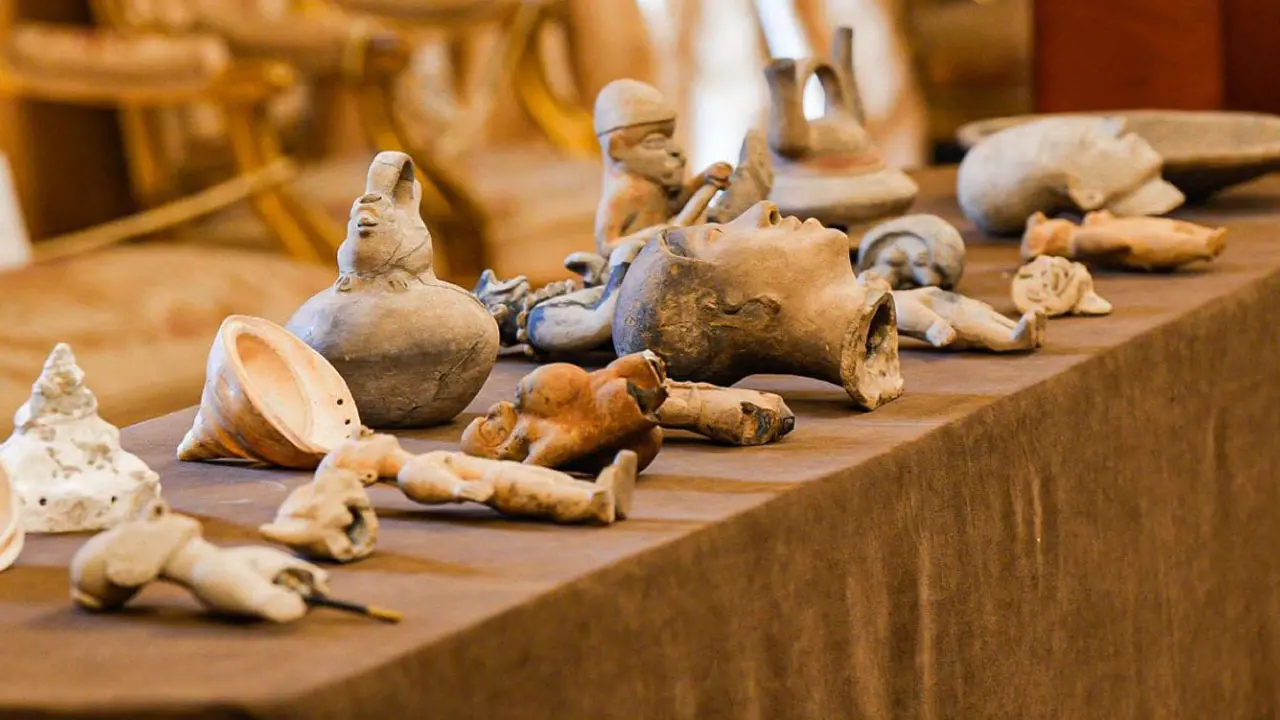
The Mexican Ministry of Foreign Affairs (SRE) announced the voluntary restitution of 1,132 pre-Hispanic archaeological artifacts, which were officially received by the Consulate General of Mexico in Boston, Massachusetts, United States. This action is part of the policies for the recovery of Mexico’s cultural heritage promoted by the SRE and the Ministry of Culture, through the National Institute of Anthropology and History (INAH).
RELATED:
Mexico Opens New Museums to Exhibit Pre-Columbian Artifacts
The Mexican Foreign Ministry explained in a statement that the voluntary handover was facilitated by Jeremy Pilver, a teacher and archaeologist at Farmington High School. This initiative is part of the institutional actions of the SRE and the Ministry of Culture to return paleontological, archaeological, and historical monuments located abroad to Mexico. According to the report prepared by INAH specialists, the collection consists of pre-Hispanic archaeological artifacts that form part of the nation’s cultural heritage.
The inventory of recovered pre-Hispanic artifacts stands out for its composition and material diversity. The official report highlights the presence of 1,053 smoothed, modeled, painted, and incised ceramic sherds, identified primarily as being for domestic use. The collection also includes two complete spindle whorls, three wooden fragments, 18 figurine fragments, nine obsidian flakes, and 11 flint flakes. An incomplete metamorphic rock slab, three rock polishers, and a rock slab fragment were also found.
Regarding the geographic origin and nature of the pieces, the document specifies: It was concluded that the collection of objects, which includes 36 shark teeth, is of pre-Hispanic origin and comes from southeastern Mexico. The items are associated with the artifacts and pottery shards mentioned in the report.
A fundamental feature of this restitution of archaeological artifacts was its significant educational dimension. For nearly two years, more than 40 high school students actively participated in the process. The young people carried out tasks such as classification, surface cleaning, cataloging, inventorying, creating a digital database, photographic documentation, and professionally packing the collection for its subsequent shipment.
The process was coordinated by the Consulate General of Mexico in Boston, in close collaboration with the National Institute of Anthropology and History (INAH), the Ministry of Foreign Affairs (SRE), and various academic institutions in the New England region of the United States.
Given the diverse age of the artifacts, the documentation provided by Pilver regarding their provenance will be used to establish dates and obtain other data useful for archaeological research.
The authorities concluded that this donation represents one of the largest archaeological collections received by the Mexican consular office in recent years. This event serves as an example of academic, ethical, and professional cooperation, as well as cultural diplomacy, for the protection of heritage.
Author: HGV/JF
Source: @INAHmx
Source: teleSUR
