

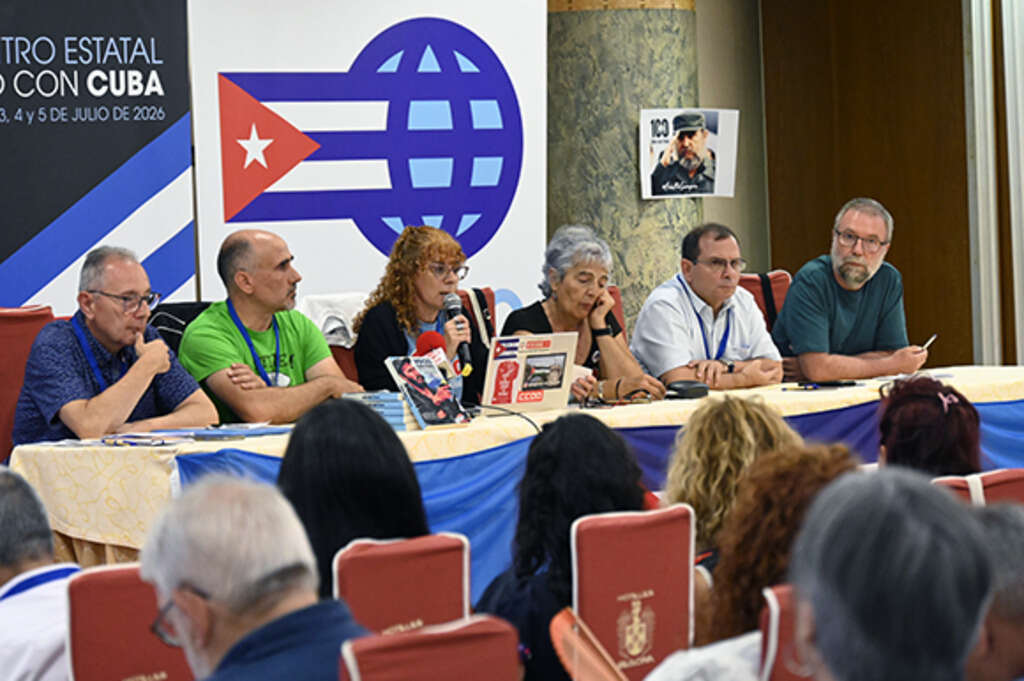
The 18th Meeting of Solidarity with Cuba in Spain has called for support for the Caribbean island “in times of the medieval siege” by the United States.
At the close of the meeting held in this Asturian city, twinned with Havana, the 200 participants from more than 40 associations in Spain condemned Washington’s harassment of Cuba, “in the form of an economic, financial, energy, and communications blockade.” On the closing day of the event, Nuria Rodríguez, Director General of Citizen Participation, Transparency, Sexual Diversity, and LGTBI of the Government of Asturias, offered a message of support for the Cuban Revolution and against fascism worldwide.
The event broadened its scope by taking place at the Gijón Noir Week, one of the most important forums for crime fiction held annually in Spain.
Three important conferences focused on the situation in Cuba, featuring Fernando González Llort, one of the Cuban Five who served time in prison in the United States.
Also participating were Elian González and scientist Fidel Castro Smirnov, grandson of the historic leader of the Cuban Revolution, Fidel Castro Ruz.
The Final Declaration of the meeting, convened by the State Movement of Solidarity with Cuba (MESC) in Spain, unequivocally condemned “an act of ruthless economic aggression that multiplies the extraterritorial effects of the blockade, with the potential application of secondary sanctions against foreign companies, banks, and entities.”
The Ministry of Economy and Social Culture (MESC) stated that the coercive measures implemented by the Trump administration further hinder the functioning of the national economy, while emphasizing that Washington is acting as the world’s policeman, in blatant violation of international law and the fundamental principles of free trade in goods and services.
MESC commended the implementation of the 176 measures of the “Economic and Social Program” promoted by the Party and Government of Cuba, and validated by the people through various forms of popular consultation.
It also resolved to renew its support for the Cuban Revolution in its struggle to defend its inalienable right to sovereignty and self-determination.
Furthermore, it condemned the treacherous threats of aggression, including military aggression, emanating from Washington, as well as “the silent war of attrition and fear that seeks to blame the government for all the hardships and difficulties the people are experiencing.”
Furthermore, they called for intensifying “the fight against the genocidal and inhumane blockade, as described in the judgment issued by the International Tribunal against the US blockade of Cuba, held in 2023 at the European Parliament in Brussels.”
Likewise, the delegates at the event in Gijón agreed to request the Spanish Government’s support for Cuba in denouncing the escalation of US aggression and threats at the session to be held on July 7 at the United Nations General Assembly.
Elsewhere in the Declaration, they emphasized the need to denounce “the manipulation of information about Cuba in the media and on social networks, the double standards, the demonization of its democratically elected leaders, the silence surrounding the social achievements and examples of internationalist solidarity that Cuba offers to the world,” along with the censorship of activities by the Ministry of Higher Education, Culture and Sport (MESC).
He also referred to the “unjust and vile inclusion of ICAP (Cuban Institute of Friendship with the Peoples), headed by Fernando González Llort and its travel agency, AMISTUR, on the list of institutions sanctioned by the U.S. Office of Foreign Assets Control (OFAC), and reiterated our commitment to continue working with both in all areas.”
He called on the European Union and its governments not to be complicit with U.S. imperialism, nor to yield to U.S. pressure, and to continue denouncing the blockade. He also demanded “the immediate return of the territory illegitimately occupied by the U.S. in Guantánamo to Cuban sovereignty,” a territory used as a detention center, torture site, and naval base that jeopardizes regional security and peace.
[ SOURCE: PRENSA LATINA ]
