

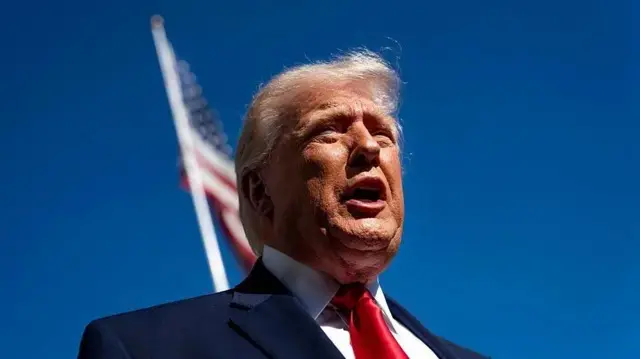
U.S. President Donald Trump has once again raised the possibility of military intervention in Cuba, arguing that such an option is feasible because of the island’s proximity to the United States. He contrasted Cuba with Venezuela, stating that “the difference is that Venezuela has oil, Cuba does not.”
RELATED: Cuba Approves 176 Structural Transformations to Overcome U.S. Blockade
In remarks to Axios, Trump said that “Cuba is one step away” and claimed that Havana “desperately wants to talk.” He added that Secretary of State Marco Rubio is leading U.S. policy toward the island.
The comments came hours after Cuban President Miguel Díaz-Canel told the National Assembly that Washington is attempting to impose its agenda through threats. Díaz-Canel denounced what he described as a “threat of military aggression” alongside an increasingly restrictive economic blockade, which he said has intensified since Trump returned to office for a second term in January 2025.
“If you truly want to help the Cuban people, let us live! Let Cuba trade; let Cuba buy its medicines; let Cuba import its fuel,” Díaz-Canel said.
Trump’s remarks have been echoed by other members of his administration. Vice President JD Vance called on Cuba to make “smart decisions,” repeated criticism that the country’s political and economic system “has not worked,” and argued that Cuba’s economy is in worse condition than Iran’s.
The latest exchange comes amid heightened bilateral tensions following an executive order signed by Trump on January 29 declaring a “national emergency” over what his administration describes as the threat Cuba poses to U.S. national security.
While Trump referred to a “flexible timeline” for resolving the situation in Cuba following the agreement with Iran, Díaz-Canel reiterated that freedom cannot be discussed while a nation is pushed into desperation through shortages of essential resources. He also reaffirmed Cuba’s rejection of external pressure and defended the economic reforms recently approved by the National Assembly as the country’s response to the blockade that has remained in place for more than six decades.
Author: MK
Source: teleSUR English
