

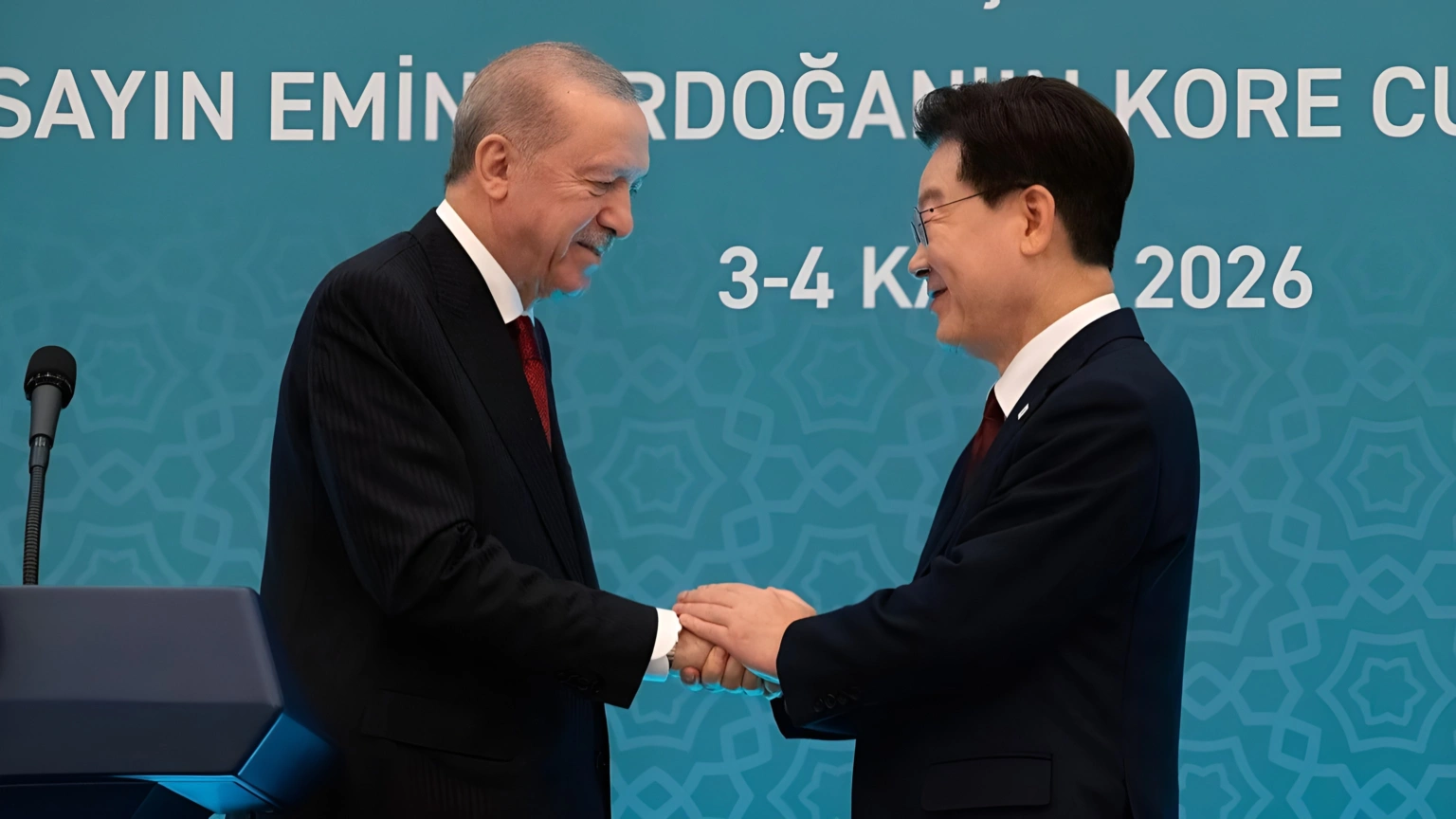
Turkish President Recep Tayyip Erdogan arrived in Seoul for an official state visit from November 1 to November 4, by the invitation of South Korean President Lee Jae-myung.
The formal high-level negotiations, conducted on November 3 at Cheong Wa Dae, focused on expanding the existing strategic partnership between the two nations across multiple economic, technological, and defensive sectors.
RELATED: South Korea Promotes Arctic Trade Route
Communications officials in Ankara noted that the discussions encompassed regional developments, multilateral collaboration within platforms such as the United Nations, MIKTA, and the G20, and the enhancement of bilateral ties.
The summit highlights the deepening diplomatic and economic engagement between middle powers navigating contemporary global shifts. With bilateral trade volumes hovering near $10.7 billion to $11 billion, both administrations have reiterated their commitment to elevating this figure toward a $15 billion target.
This cooperation allows both Ankara and Seoul to diversify their economic and industrial dependencies, establishing autonomous frameworks for energy infrastructure, advanced manufacturing, and technological development outside traditional Western-centric supply chains.
Energy Sovereignty and Nuclear Power
Another component of the bilateral meeting involved negotiations on South Korea’s construction participation in Türkiye’s second nuclear power plant project, slated for the northern coastal province of Sinop.
Representatives from the Korea Electric Power Corporation (KEPCO) and the Turkish Minister of Energy and the CEO of TUNAS (Türkiye Nükleer Enerji A.Ş.) held extensive talks to finalize the legal and financial mechanisms needed for the large-scale project.
During the meetings, Türkiye and South Korean counterparts signed key memoranda of understanding to structure project financing and mitigate long-term investment risks. This nuclear collaboration aligns with Ankara’s broader energy policy to reduce reliance on imported fossil fuels from Russia, Iraq, and Saudi Arabia, and diversify domestic generation. For South Korea, involvement in the Sinop facility represents a significant international deployment of its advanced nuclear reactor technology and construction capabilities.
Both governments emphasized that agreements include provisions for regulatory alignment, technological transfer, and joint risk management, ensuring project infrastructure proceeds with stable long-term financial backing and adherence to international safety standards.
Defense Industrial Synergies
Defense cooperation formed another pillar, reflecting a longstanding military-industrial relationship built on joint technological hardware initiatives. Historical joint projects, such as South Korean technical transfers for the Altay main battle tank program and the localized production of T-155 Fırtına self-propelled artillery systems, provided the baseline for expanding bilateral defense-industrial ties.
During the Cheong Wa Dae negotiations, both leaders discussed extending this partnership beyond domestic manufacturing into co-production models targeted at global export markets.
The framework established in Seoul outlines agreements to develop military hardware focused on heavy ground systems and aerospace technology, as well as South Korean engines developed by the firms SNT Dynamics and Hyundai Rotem for Türkiye’s main battle tank, the Altay.
The firms are pursuing contract opportunities in third-country markets across Asia, Africa, and Central Asia. Defense Ministry officials said that combining South Korea’s high-tech manufacturing base with Türkiye’s growing defense export networks allows both nations to establish scalable alternatives in international procurement.
This strategic alignment enables Ankara and Seoul to expand their market presence while strengthening their domestic defense-industrial capacities through shared research, development, and production structures.
Trade, Investment, and Mineral Extraction
Economic negotiations centered on addressing structural disparities within bilateral trade under the existing Free Trade Agreement framework. Official trade figures indicate a significant imbalance; for instance, in 2025, South Korean exports to Türkiye reached approximately $9.08 billion, whereas Turkish exports to South Korea stood at roughly $1.14 billion.
To change this deficit, Turkish economic representatives advocated for updated tariff concessions, the removal of non-tariff barriers, and streamlined customs procedures to facilitate greater market access for Turkish agricultural, industrial, and textile goods.
Both delegations reaffirmed their commitment to scaling annual bilateral trade toward the $15 billion milestone while broadening the scope of foreign direct investment. A primary outcome of the economic sessions was the signing of a Memorandum of Understanding on Natural Resources and Mining.
This agreement targets joint exploration and processing of critical raw materials, including lithium and rare earth elements. Securing reliable access to critical minerals forms a shared priority for both countries to support their domestic automotive, electronic, and renewable energy manufacturing sectors.
Technological Integration and Future-Oriented Industries
Technological cooperation was also on the agenda in Seoul, highlighted by the signing of a new Memorandum of Understanding on Cooperation in Science, Technology, and Innovation.
This agreement establishes a framework for direct research partnerships in artificial intelligence, advanced semiconductor manufacturing, battery production, quantum materials, and next-generation telecommunications networks.
Under the agreement, Ankara and Seoul resolved to convene their bilateral Joint Science and Technology Committee for the first time, institutionalizing regular administrative and scientific exchanges. The technological partnership extends into industrial application and medical biotechnology.
President Lee Jae Myung noted that South Korean biotechnology firm SK Plasma is advancing a project to construct a plasma-derived pharmaceutical manufacturing facility in Türkiye. This industrial effort combines South Korea’s specialized research base with Türkiye’s strategic logistics positioning to supply regional markets.
To support these joint ventures, both governments agreed to address administrative bottlenecks regarding work permits and technical visas, ensuring smoother labor mobility for researchers, engineers, and corporate personnel.
Geopolitical Outlook
The formal conclusion of the November 3 summit saw the execution of four major governmental agreements spanning energy financing, mining operations, science and technology development, and trade facilitation.
President Lee Jae Myung stated during the press conference that the summit served to reaffirm trust between the two nations and marked an important milestone in their strategic partnership. For his part, Turkish President Recep Tayyip Erdogan similarly highlighted that the signed protocols provide a clear roadmap to expand bilateral trade and technical coordination across multiple economic sectors.
Looking ahead to the upcoming 70th anniversary of diplomatic relations between Ankara and Seoul, the summit reflects a broader trend among non-Western and middle-power economies seeking pragmatic, mutually beneficial partnerships.
By building direct supply chains in energy infrastructure, defense co-production, critical mineral extraction, and advanced technology, both Türkiye and South Korea are enhancing their industrial self-reliance.
The long-term outlook for bilateral relations depends on the practical implementation of these memoranda and the ability of both nations to maintain balanced trade and sustained institutional cooperation.
Sources: TeleSUR – Al Jazeera – Anadolu Agency – BBC – Xinhua – CGTN – Press TV – Al Mayadeen
Author: Silvana Solano – LVM
Source: TeleSUR
