

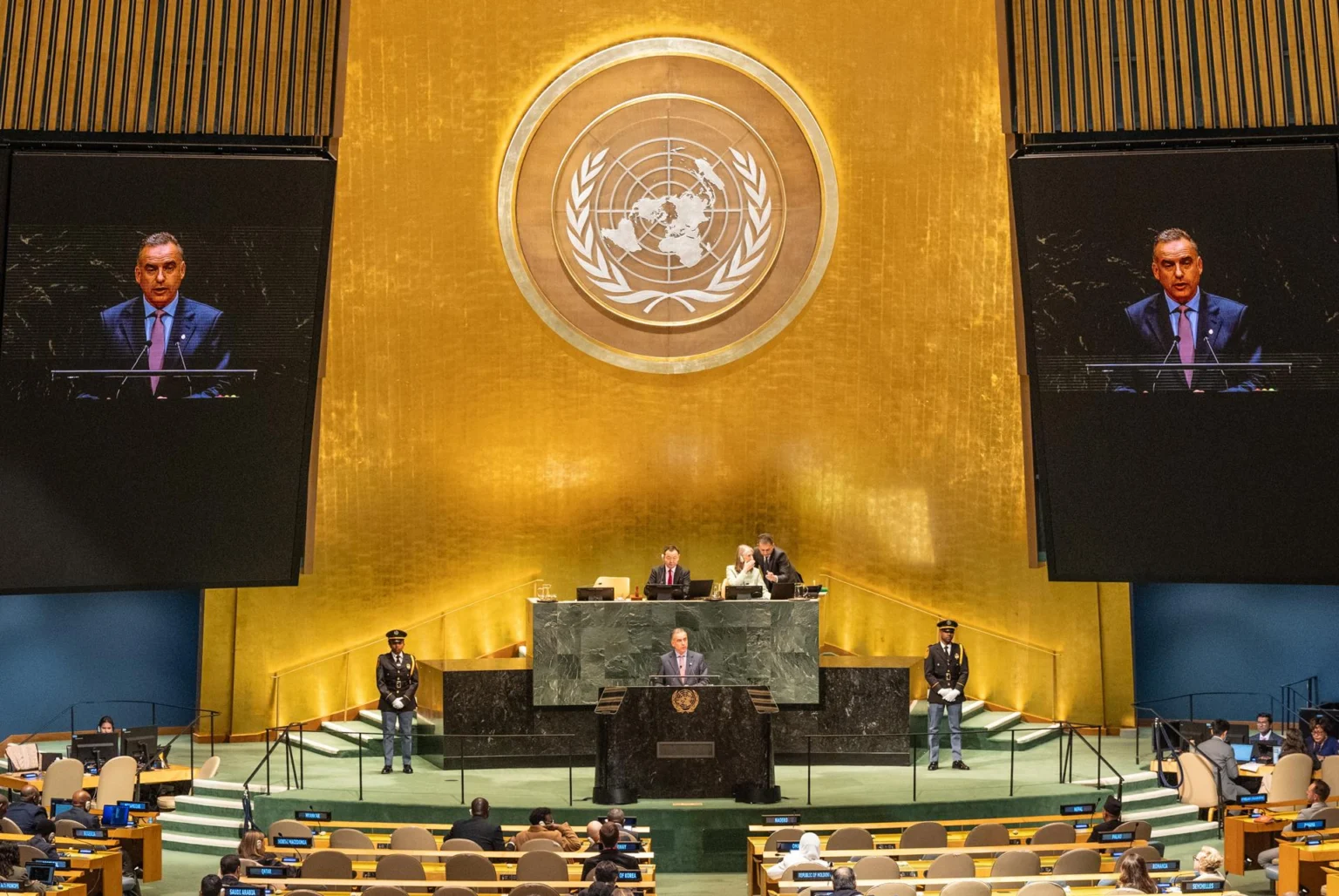
In line with Uruguay’s foreign policy principles, Orsi rejected the idea of taking sides in global conflicts to avoid deepening diplomatic rifts. He advocated for humility in international relations, citing the Uruguayan proverb, “no one is greater than anyone else”, to argue that no state has a monopoly on solutions or the right to impose political models on others.
The Uruguayan head of State reaffirmed his country’s participation in U.N. peacekeeping missions and his government’s willingness to maintain that operational support for the international community going forward.
RELATED: Pope Leo XIV to Visit Uruguay, First Stop in Latin American Tour
Orsi also emphasized that politics and economics should be oriented towards the well-being of citizens, highlighting Uruguay’s unwavering commitment to human dignity.
The Uruguayan President stressed that peace should not be understood merely as the absence of armed conflict, but as a permanent undertaking that requires refusing to distinguish between different forms of human suffering. He condemned, in equal measure, the destructive impact of organized crime, repression, terrorism and prolonged economic blockades, specifically citing the one affecting Cuba since over six decades ago.
Toward A Fairer System
The Uruguayan President called for a profound reform of the multilateral system and the end of geopolitical privileges. He argued that advances in artificial intelligence, energy transition, and the economy are meaningless if they do not address poverty, hunger, and lack of housing. In this sense, Orsi asserted that technology and politics are only justified when they expand real freedoms and improve social conditions to bring happiness to communities.
In the realm of global governance, Orsi demanded an urgent overhaul to multilateral institutions to make them more effective, representative, and fiscally responsible. He questioned the current international order, which he said is still dominated by a few powerful nations, and called for resolutions to be binding on all member states. Following this, he called for U.N. resolutions to become binding rather than merely advisory.
Orsi’s speech also addressed the issue of geopolitical polarization and the oversimplification of global conflicts into “good vs. evil” narratives. He defended the inviolability of national borders as a fundamental guarantee for preserving local identities and emphasized the inevitable interdependence of societies.
On institutional development, Orsi highlighted the importance of strengthening democracy and sovereignty through lasting achievements that guarantee universal access to education and opportunity. He framed Uruguay’s own experience of democratic coexistence among diverse ideologies as a valuable contribution to a fragmented international community in need of restoring trust in collective action.
The Uruguayan President concluded his address by calling for a more inclusive and equitable international system, where the voices of all nations are heard and respected. He reiterated Uruguay’s commitment to working with the international community to build a more peaceful and prosperous world, emphasizing that no nation can achieve prosperity through isolation or confrontation.
losing his remarks, Orsi urged world leaders not to use the U.N. platform to level unilateral accusations or stoke tensions that obstruct the resolution of disputes, arguing that the organization’s true effectiveness depends on abandoning political inertia in favor of durable stability grounded in mutual respect. With these remarks, Uruguay’s delegation reaffirmed its pacifist vocation within the community of nations.
Author: Laura V. Mor
Source: UN / Agencies
