

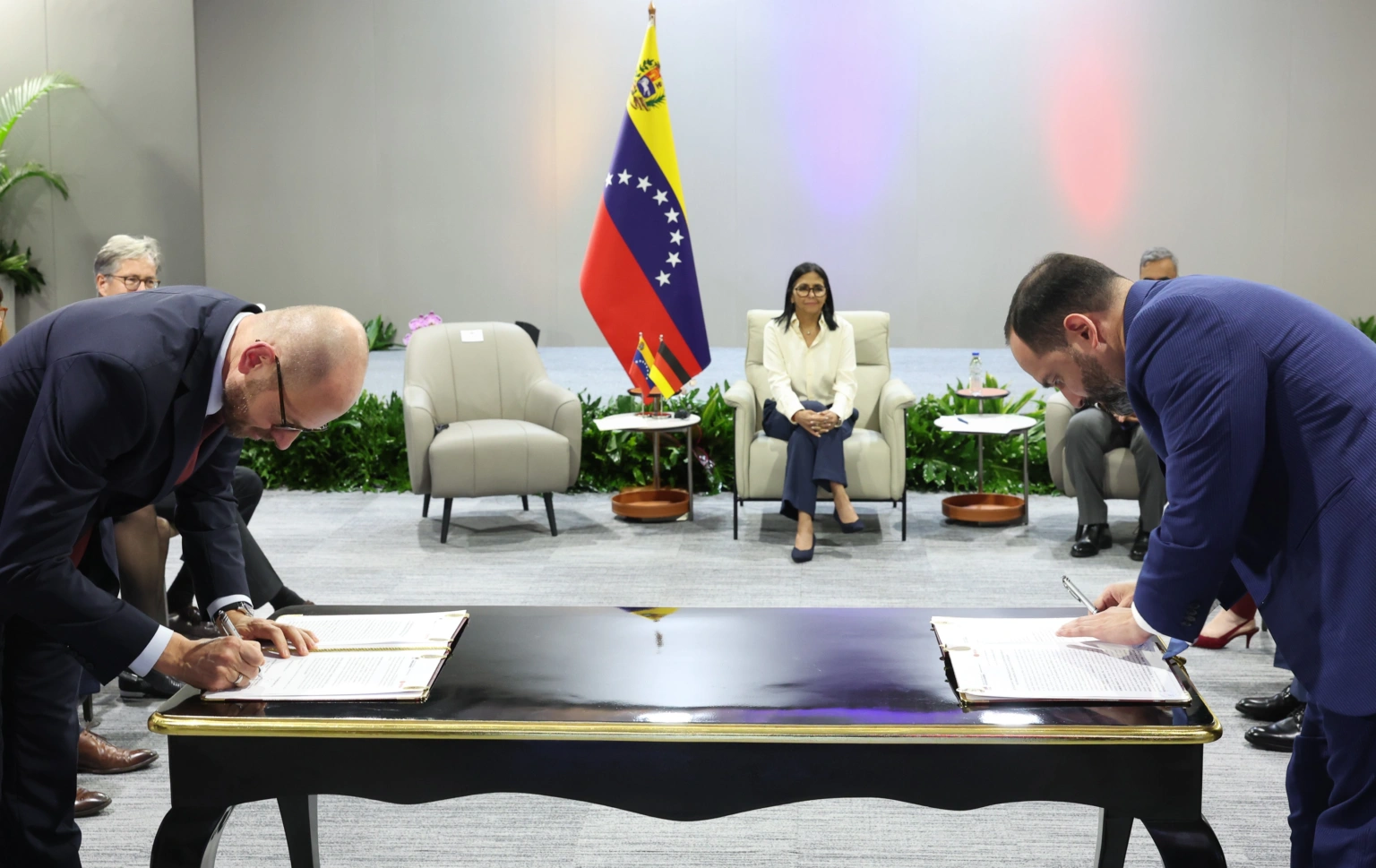
The accords were signed in Caracas together with the Ministry of People’s Power for Electric Energy. Their stated goal is the recovery and modernization of the national electric system along with the energy infrastructure tied to the hydrocarbons industry.
For more than a decade, the grid could not obtain the parts, pieces and equipment it needed, Acting President Rodriguez said. In the case of Siemens, the restrictions were absolute.
RELATED: Venezuela Unveils 10-Year Plan to Rebuild Economy
“Venezuela’s electrical system was unable to access parts and equipment for more than a decade. In the specific case of Siemens, we could not access because of the issue of sanctions and now we are making it possible,” affirmed the Acting President.
Rodriguez argued that the bilateral understanding will speed up the technical work. The Ministry of Electric Energy and PDVSA have already diagnosed with precision which components must be replaced, so crews can move without the usual delays.
The German firm has operated in the South American nation for more than 70 years and supports a large portion of its thermoelectric capacity. “This is a fundamental milestone, the recovery of the national electric system,” Rodriguez emphasized.
Rebuilding the National Grid
The agreements cover the optimization of electrical stations and the efficient use of gas in the oil industry under environmental sustainability criteria. Both areas sit at the center of the Bolivarian government’s economic recovery agenda.
Acting President Delcy Rodriguez tied the advance directly to the development strategy announced one day earlier, the Venezuela Rises Plan, which goals depend on the country’s energy stabilization, a precondition for attracting investment and reviving production.
The Venezuela Rises Plan, unveiled a day earlier, aims to stabilize the economy, accelerate growth and resolve the country’s debt. Reliable electricity is the starting point for that agenda, according to the Acting President.
Rodriguez thanked Siemens Energy Chief Executive Christian Bruch and the German business delegation that traveled to Caracas. She also credited the diplomatic work begun two years ago by Germany’s ambassador, which reopened the channel for joint projects.
“It is the signal that, through diplomatic dialogue, Venezuela, Europe, Germany in this case, we can sign in favor of our countries,” she said, recalling German solidarity in June, when rescuers and humanitarian aid arrived after a double seismic event devastated parts of the country.
At the close of her remarks, Rodriguez instructed the technical teams of Corpoelec, PDVSA and Siemens Energy to begin operational work immediately. “We have signed the initiation and materialization act so that we get to work,” she concluded.
Venezuela’s power grid has suffered recurring blackouts over the past decade. The government attributes them to the U.S.-led blockade, which has cut off access to spare parts, technology and financing for both the electrical system and the oil industry.
The signing also marks a new chapter for the state oil company, which has struggled to maintain its own generation infrastructure. Gas that is currently flared or underused could now be channeled to generate electricity, reducing losses and easing pressure on the national grid.
The technical teams now face the task of turning the signed act into visible repairs. No timeline was announced, but the immediate start of operational work signals that the government wants results before the economic plan’s next milestones.
Author: Laura V. Mor
Source: Venezuelan Presidential Press
Source: teleSUR
