

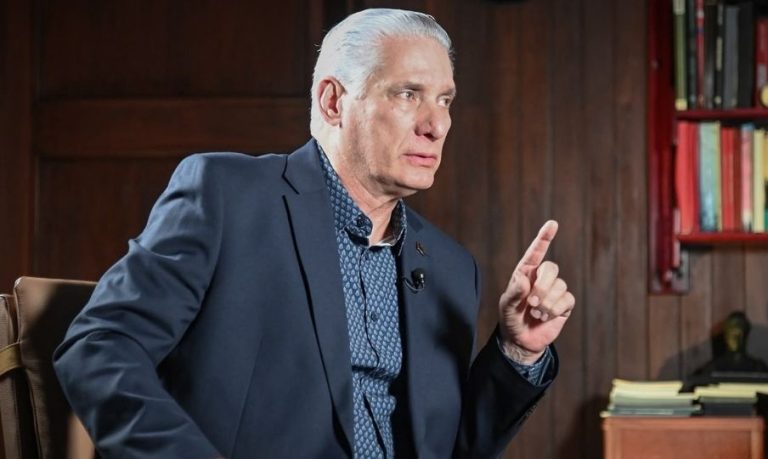
Cuban President Miguel Díaz-Canel endorsed the economic transformations promoted by the government and reaffirmed his willingness to engage in dialogue with the United States without impositions.
In a conversation with journalist Roberto Cavada in Havana, broadcast last night on the prime-time news program Telenoticias, Díaz-Canel also highlighted the historical relations between Cuba and the Dominican Republic.
When questioned about the recently announced economic transformations, the president asserted that they are intended to preserve the Revolution and maintained that, to preserve social gains amidst an intensified economic, commercial, and financial blockade imposed by the United States, the country cannot remain unchanged.
“Times have changed, geopolitics have changed, and the United States’ aggression toward Cuba has intensified; we cannot remain the same, we must transform,” he stated.
He also recalled that the leader of the Revolution, Fidel Castro, always maintained that in times of crisis, it was necessary not to renounce thought or creativity, and to find opportunities for growth and improvement in difficulties.
Díaz-Canel also referred to greater flexibility and facilitation for foreign investment and foreign trade, with the participation not only of foreign investors, but also of Cubans residing on the island and in other countries.
He noted that these issues are of particular interest to the Cuban community residing in the Dominican Republic and to Dominican businesses, with which Cuba has traditionally maintained good relations in sectors such as agriculture and tourism.
He considered that there are numerous areas with the potential to expand and strengthen economic and trade ties between the two countries.
The Cuban president emphasized that it makes no sense to support foreign investment and not simultaneously support investment by Cuban nationals, whether state-owned or private.
Diaz-Canel also pointed out that a fundamental element of the transformations is the reform of the banking and financial system, which, in his view, currently limits development and does not adequately facilitate trade, investment, or agricultural production.
He indicated that many of these distortions are closely related to the concept of a “besieged city” imposed by the blockade, and explained that the proposals promoted by his government are the result of ideas developed over time to confront a context marked by adversity.
Díaz-Canel asserted that Cuba’s social achievements are sacred and affirmed that no family or community can be left at a disadvantage.
In that regard, he assured that a universal system of free healthcare and education, accessible to all Cuban citizens and with high-quality standards, will continue to exist.
The Cuban leader added that this same vision will be maintained in areas such as culture, sports, and social security, among others.
“With a stronger economy, there will be more possibilities to sustain this immense work of social justice that the Revolution has developed, and even expand it.”
He reiterated that Cuba is an independent, sovereign, and socialist nation, and that it will continue working to achieve the prosperity its people deserve.
The Cuban president guaranteed legal security for investors and affirmed that the country must advance even further in that direction. In that regard, he noted that the ongoing transformations require expanding the legal framework, particularly regarding concessions.
He denied that the changes currently being implemented by Cuba are a response to pressure from the United States and maintained that there is manipulation of information surrounding this issue.
He asserted that these measures are the result of debates and analyses conducted over a long period.
“The situation of maximum pressure leads us to accelerate decision-making because we are seeking ways to overcome these pressures without jeopardizing the sovereignty and independence of our country, which also depend on the decisions of our people.”
He added that, nevertheless, the enemy always seeks mechanisms to present these decisions as their own victory.
Díaz-Canel defined the transformations as an exercise of sovereignty that emerged from a process of popular consultation. He considered that this citizen participation must now materialize in the implementation of the measures and in popular oversight of their execution.
Popular participation must be realized in the application and the control that the people must exercise over the transformations, he affirmed.
During the interview, which addressed economic, political, and international issues, Díaz-Canel stated that the changes underway in Cuba are aimed at expanding opportunities for the population, particularly for the younger generations.
The Cuban president also reiterated that any dialogue process with the United States must be based on mutual respect and take place without impositions or preconditions.
He highlighted the historic ties between Cuba and the Dominican Republic and expressed his gratitude for the expressions of solidarity that, he noted, the island has received at different times.
The president also addressed the issue of youth emigration, stating that it is not a reality unique to Cuba, but rather a phenomenon present in numerous nations.
In that context, he emphasized the importance of preserving national identity and questioned proposals that present Cuba’s eventual political integration with the United States as a solution to the problems facing the country.
“There is no future for Cuba with annexation to the United States.”
The United States will never understand or accept what we do because it aspires to a completely dependent Cuba, he stressed.
“We are not seeking a capitalist restoration in the country, but rather the improvement of socialist construction under the very adverse conditions in which we live today internationally, and also as a consequence of the White House’s policy toward Cuba,” the head of state said in the interview, which lasted approximately one hour.
[ SOURCE: PRENSA LATINA ]
