

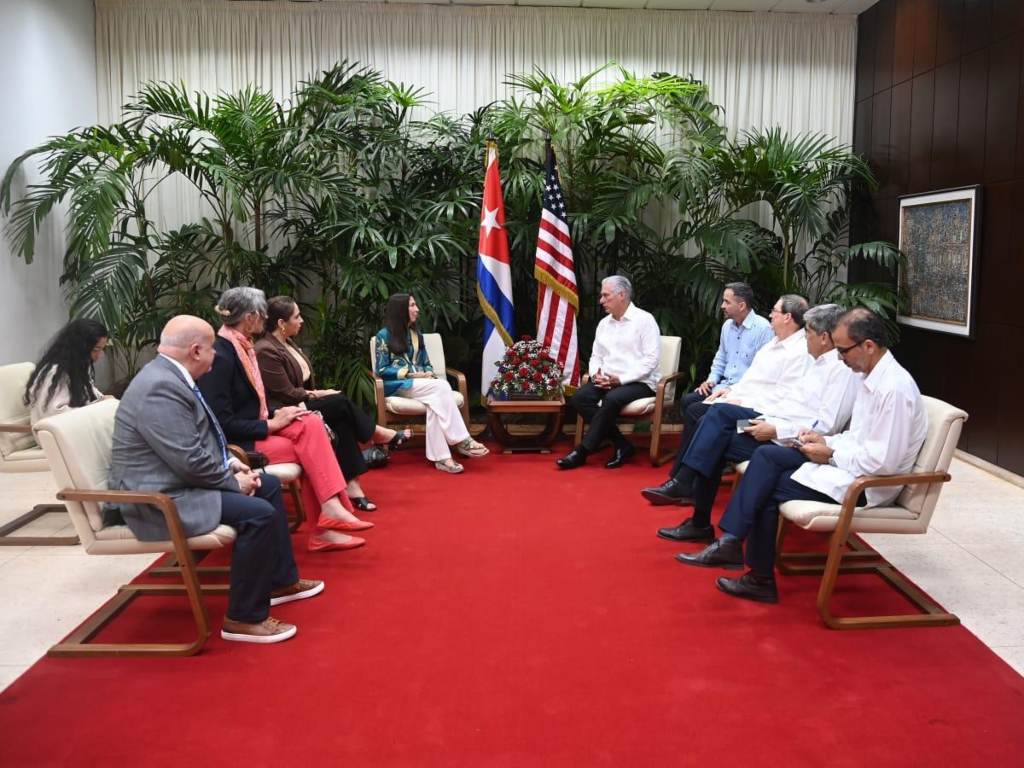
Miguel Díaz-Canel Bermúdez, First Secretary of the Central Committee of the Communist Party of Cuba and President of the Republic, received a delegation of Democratic members of the US House of Representatives on July 11. The delegation visited the island between July 9 and 13, according to Granma newspaper and the Presidency’s social media accounts.
The delegation included Teresa Lager Fernández from New Mexico; Delia Catalina Ramírez from Illinois; and Maxine Elizabeth Dexer from Oregon. and Mark Pocan of Wisconsin, the President’s office reported on the digital network X.
During the meeting, they discussed the potential for a respectful relationship between the two countries, similar to the one attempted in the previous decade under the administration of Barack Obama.
Representing Cuba were Bruno Rodríguez Parrilla, member of the Political Bureau and Minister of Foreign Affairs, and Carlos Fernández de Cossío, Deputy Minister of Foreign Affairs.
Bruno Rodríguez stated that the visitors witnessed the severe collective punishment to which the U.S. government subjects the Cuban people and observed the impact of the sanctions on daily life.
Following their visit, the congressional representatives issued a joint statement acknowledging that their country’s policies are seriously affecting Cuban citizens and requested that the White House lift the current sanctions.
They explained that they traveled to Havana to meet with Cubans from various sectors and hear about the difficulties caused by the maximum pressure measures implemented by the Trump administration.
They expressed interest in learning about the recent measures aimed at modernizing the Cuban economy and in exploring ways to restore bilateral relations based on mutual respect.
The legislators noted the deteriorating living conditions of the Cuban population and stated that they had met with religious leaders, businesspeople, civil society organizations, professionals, doctors and farmers.
In their statement, they emphasized that all those present felt affected by the executive orders and the long-standing economic, commercial, and financial embargo, and denied that Cuba poses a threat to U.S. national security.
The U.S. congressional representatives warned that a military operation against the island would exacerbate the humanitarian crisis and urged their colleagues in Congress to listen to the majority of U.S. and Cuban citizens, lift the sanctions and engage in serious negotiations with Cuban authorities.
[ SOURCE: AGENCIA CUBANA DE NOTICIAS ]
