

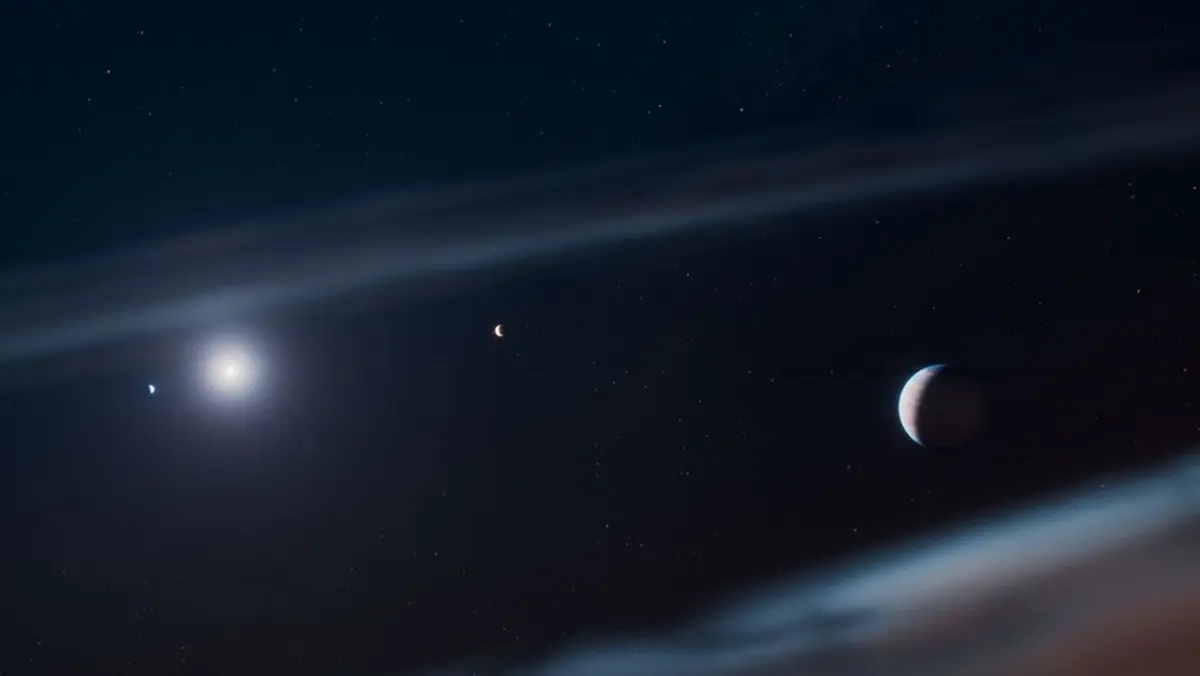
On Wednesday, the European Southern Observatory (ESO) announced that a team of astronomers discovered an exoplanet, named Beta Pictoris d, located about 63 light-years from Earth.
RELATED:
NASA Sets Roman Space Telescope Launch for No Earlier Than Aug. 30
Detected with the Very Large Telescope (VLT), Beta Pictoris d is a gas giant, like Jupiter or Saturn, although it is 2.4 times more massive than the former.
However, compared with the planets that share the Beta Pictoris star in the Beta Pictoris planetary system, known as Beta Pictoris b and Beta Pictoris c, the newly discovered planet is smaller.
Beta Pictoris b and Beta Pictoris c each have a mass about 10 times greater than that of Jupiter, the largest planet in the solar system.
Beta Pictoris d remained hidden from astronomers for years, in part because it is relatively cool and therefore extremely faint compared with its host star. However, years of analyzing images of the Beta Pictoris system led to the detection of Beta Pictoris d, for which direct photographs already existed, although the planet had remained “hidden” in those images.
“Direct imaging, in which the light from an object is captured as in a photograph, only works for planets that are bright enough to appear alongside their much brighter host stars,” the ESO said, referring to the challenge of detecting Beta Pictoris d.
According to Markus Bonse, an ESO astronomer in Germany and co-author of the study on the planet’s discovery, the new planet is 100 times fainter than Beta Pictoris b, the well-known planet in the same system, making it the faintest exoplanet ever directly imaged from Earth.
The planet Beta Pictoris b was photographed almost 18 years ago in one of the most iconic images in astrophysics when ESO produced the first direct image of a planet orbiting another star in the Beta Pictoris system, where scientists had initially only seen a disk of cosmic dust.
Following the discovery of Beta Pictoris b came that of Beta Pictoris c, and, thanks to the use of the VLT’s ERIS instrument, Bonse and his team discovered the existence of Beta Pictoris d.
The ESO describes the instrument as a new technology on the VLT designed to obtain the clearest images of space through spectrographic and infrared technology.
The discovery of Beta Pictoris d was confirmed by another independent study by the space agencies of the United States, Europe and Canada, which used the James Webb Space Telescope.
teleSUR/ JF
Source: EFE
Source: teleSUR English
