

By Hedelberto López Blanch* / Special Collaboration for Resumen Latinoamericano.
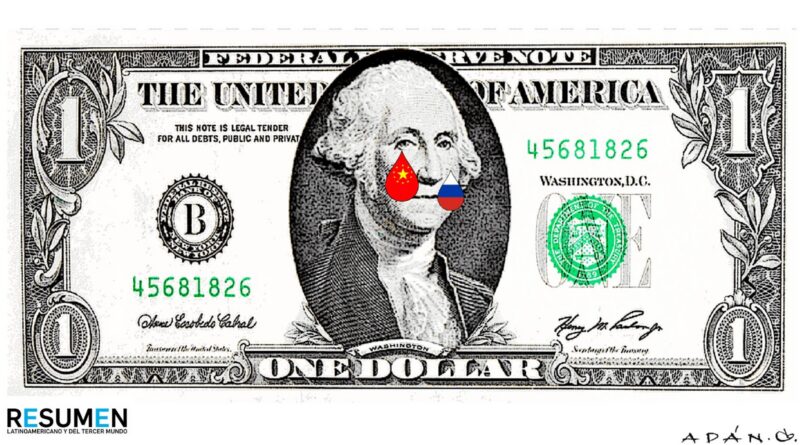
Two important actions taken independently by China and Russia are aimed at weakening the dollar’s position as the world’s leading reserve currency.
In this regard, the People’s Bank of China took a firm step in expanding its digital currency (e-CNY) by integrating an initial group of 26 financial institutions, both domestic and foreign, into its cross-border payments platform.
The information, provided by financial authorities to the South China Morning Post, indicates that the initiative seeks to “consolidate the payment infrastructure of the Chinese digital currency” and accelerate its global adoption, enabling greater connectivity in international financial markets.
According to authorities, the selected entities will participate directly in the e-CNY Cross-Border Transfer Services (CBETS), designed to operate 24/7, facilitating immediate connection with central banks and financial institutions worldwide.
One advantage is that by unifying various pre-existing service modules under the Digital Yuan International Operations Center, established in September 2025, China offers direct and far more efficient access to its payments network.
Analysts emphasize that this strategic advancement represents a crucial effort by Beijing to internationalize its currency and mitigate its vulnerability to the global financial system dominated by the US dollar.
This tactic aligns with China’s commitment to protecting its economic sovereignty amidst ongoing geopolitical and economic tensions with Washington, in a context marked by the growing push for dedollarization in dozens of countries.
Another significant development in this regard was the Russia-ASEAN Summit held in the Russian city of Kazan, where the host, President Vladimir Putin, urged the use of national currencies in the financial calculations of trade transactions, the elimination of remaining trade barriers, and the simplification of administrative procedures.
At the event, which marked the 35th anniversary of the establishment of relations between Moscow and the Association of Southeast Asian Nations (ASEAN), currently comprised of eleven developing countries, the Russian president emphasized that “all participants at the Summit have ample opportunity to do so.”
ASEAN currently comprises Indonesia, the Philippines, Malaysia, Singapore, Thailand, Vietnam, Brunei Darussalam, Cambodia, Laos, Timor-Leste, and Myanmar.
During the event, Russian Minister of Economic Development Maxim Reshetnikov reported that Russia’s trade volume with ASEAN had grown by 58% over the past 10 years, reaching $21 billion. Moscow proposed increasing exports of high value-added products such as fertilizers and pharmaceuticals to ASEAN countries and continuing to supply them with food and energy resources.
Analysts believe that eliminating the dollar as a currency of exchange between Russia and ASEAN will be a political decision, as it will establish direct channels by linking central banks without Western intermediaries.
The dollar’s hegemony in financial transactions is gradually diminishing in various parts of the world.
IMAGE CREDIT: Cover illustration: Adán Iglesias Toledo
(*) Hedelberto López Blanch is a renowned Cuban journalist. He writes for the newspaper Juventud Rebelde and the weekly Opciones. He is the author of “Cuban Emigration to the United States,” “Secret Stories of Cuban Doctors in Africa,” and “Miami, Dirty Money,” among others.
[ SOURCE: RESUMEN LATINOAMERICANO Y DEL TERCER MUNDO CUBA / EN RESUMEN ]
