

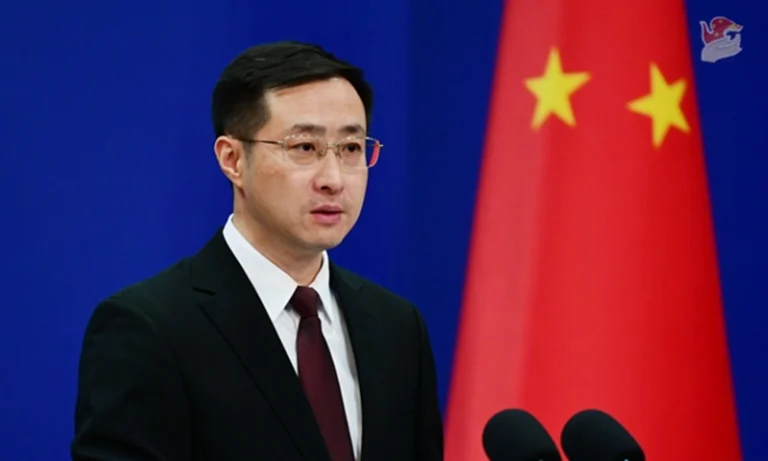
China defends its cooperation with Cuba as transparent and legitimate and rejects US accusations regarding its bilateral ties. The Chinese Foreign Ministry, through its spokesperson Lin Jian, stated this Wednesday that “making pretexts and spreading rumors to defame cannot serve as justification for the brutal blockade and illegal sanctions imposed by the United States against Cuba.”
The spokesperson added that Washington is seriously violating the rights of Cubans to survival and development, and contravening the basic norms of international relations with a tightened blockade of more than six decades, the damages of which exceed $170.677 billion. China will firmly support Cuba in defending its national sovereignty and security, and demands that the White House immediately end the economic war and sanctions, Lin Jian stressed.
Beijing’s response comes after statements by Secretary of State Marco Rubio, who asserted that Havana is allowing Washington’s adversaries to conduct intelligence activities near U.S. territory.
China will continue its “support and assistance” in the face of repeated U.S. threats, and condemned Washington’s pressure tactics that “compromise regional peace and stability.”
The Chinese Foreign Ministry reiterated its support for the island nation in the face of foreign interference and urged Washington to heed the voice of justice. Beijing is prepared to work with all parties to safeguard Cuba’s sovereignty and national security, as well as to oppose external interference.
These statements come amid broad international support for Cuba following the latest threats from the United States and President Donald Trump.
The US Senate voted Tuesday on a war powers resolution, sponsored by Democratic lawmakers, to prevent any unauthorized military action by the Trump Administration against Cuba. The unified vote of Republican lawmakers resulted in a 51-47 vote against, thus blocking their attempt to prevent a White House attack on the largest island of the Antilles.
According to press reports, Republicans Susan Collins of Maine and Rand Paul of Kentucky joined the Democratic initiative, introduced by Senators Tim Kaine, Adam Schiff, and Ruben Gallego, to block the use of U.S. forces in what they describe as “unauthorized hostilities.”
The U.S. blockade against Cuba intensified during Trump’s first term (2017-2021) with 243 measures of pressure, applied even during the Covid-19 pandemic. During that administration, the persecution of fuel imports by Cuba was intensified, with sanctions imposed on oil companies, shipping companies, insurers, and banks involved in operations to supply Cuba with hydrocarbons.
Last January, Trump signed an executive order declaring Cuba an unusual and extraordinary threat to U.S. national security, a pretext the administration used to threaten punitive tariffs on nations that sell oil to the Caribbean island. The decision condemns the small country to oil starvation and the paralysis of its economic and productive activity, which would trigger a humanitarian crisis.
Cuban authorities have emphasized that Cuba does not constitute a threat to the U.S., a country whose governments made state terrorism a policy to annihilate the Cuban Revolution. In addition to reaffirming the importance of respectful dialogue to resolve differences in the bilateral relationship, the revolutionary government has declared that, if attacked, Cuba will defend its sovereignty and independence.
IMAGE CREDIT: Beijing’s response comes after statements by Secretary of State Marco Rubio, who claimed that Havana allows Washington’s adversaries to conduct intelligence activities near US territory. Photo: Xinhua
[ SOURCE: PRENSA LATINA ]
