

The president of the National Assembly of People’s Power (ANPP) of Cuba, Esteban Lazo Hernández, warned international parliamentary leaders this Wednesday about the “real and dangerous threat” of direct US military aggression against the Caribbean nation, amid an escalation of tensions denounced by the Cuban government.
In an exercise of parliamentary diplomacy in defense of peace and sovereignty, Lazo Hernández—also a member of the Political Bureau of the Central Committee of the Communist Party of Cuba—sent an official communication to the heads of ten interparliamentary organizations, outlining Havana’s concerns regarding recent actions by Washington.
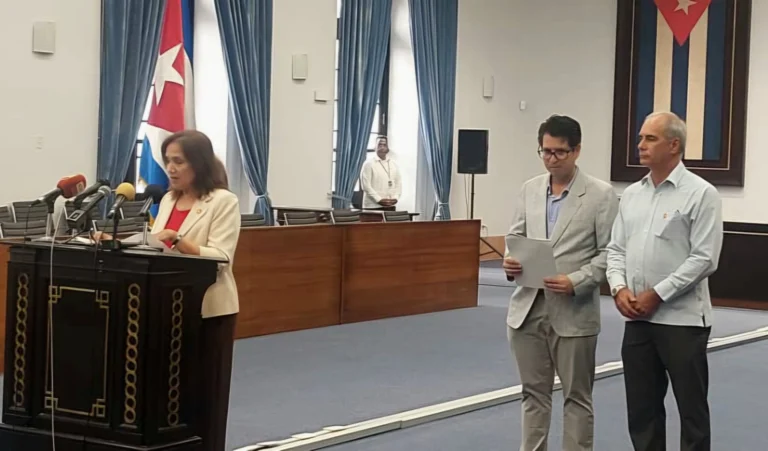
The statement was published on the National Assembly of People’s Power (ANPP) website and read by the Vice President of the legislative body, Ana María Mari Machado, to national and international media.
The letters were addressed to representatives of the Inter-Parliamentary Union (IPU), the Parliamentary Network of the Non-Aligned Movement, the BRICS Parliamentary Forum, the ASEAN Inter-Parliamentary Assembly (AIPA), the Pan-African Parliament, the Latin American and Caribbean Parliament (Parlatino), the Mercosur Parliament (Parlasur), the Andean Parliament (Parlandino), the Central American Parliament (Parlacen), and ParlAmericas.
In the statement, the head of the Cuban legislature reported on recent declarations by the Revolutionary Government and the Council of State, which indicate that Cuba currently faces a direct threat of military aggression from the United States government. According to the document, this situation is part of an “aggressive escalation” by the Donald Trump administration, accompanied by additional coercive measures.
Among these actions are executive orders that intensify the economic, commercial, and financial blockade, as well as an energy embargo that, according to the text, increases the impact on the Cuban population. The message warns that these policies contribute to “increasing the suffering of the people” and worsen living conditions on the island.
One of the elements highlighted in the statement is the announcement on May 20 by U.S. Acting Attorney General Todd Blanche regarding a criminal indictment against Army General Raúl Castro, 94, for an alleged conspiracy linked to the downing of Cuban aircraft in 1996. According to the U.S. Department of Justice, the Leader of the Revolution and other officials could face life imprisonment or the death penalty if found guilty.
In response, Lazo Hernández described the indictment as “infamous” and part of a political manipulation strategy, arguing that it distorts the events that occurred in Cuban airspace in February 1996, when aircraft belonging to the Miami-based organization Brothers to the Rescue were shot down.
For his part, Cuban President Miguel Díaz-Canel also reacted publicly, stating that the indictment lacks legal basis and could be used as a pretext to justify a potential military aggression against the island. Along the same lines, the document sent by the National Assembly of People’s Power (ANPP) maintains that these actions constitute illegitimate acts that violate international law and national sovereignty.
The text emphasizes that the measures adopted by Washington aim to intensify the blockade and the policy of pressure against Cuba, which—according to Cuban authorities—directly impacts the human rights of the population, especially the right to life. It also indicates that the current situation “exacerbates the collective suffering and the quality of life of the citizenry” due to the cumulative effects of the sanctions.
In this context, the official statement calls on parliaments and international organizations to mobilize and issue statements of support in defense of Cuban sovereignty, in order to prevent what it describes as a possible “military adventure” with regional and global consequences. The document warns that a conflict of this kind could generate a humanitarian catastrophe and destabilize Latin America and the Caribbean.
Likewise, the message reiterates that Cuba does not represent a threat to any country and that it maintains its commitment to regional peace, in accordance with the Proclamation of Latin America and the Caribbean as a Zone of Peace, signed in 2014 by the member states of the Community of Latin American and Caribbean States (CELAC).
Cuban authorities also expressed their willingness to engage in dialogue with the United States, provided that national sovereignty, the political system, and the right to self-determination are respected. According to the text, Havana aspires to maintain a “civilized, neighborly” relationship, despite existing differences.
In the final part of the communication, Lazo Hernández expressed gratitude for the expressions of solidarity received from various parliaments, emphasizing that “Cuba is not alone” on the international stage. He also stressed that his actions are in accordance with his position as the legitimate representative of the Cuban people.
The document also refers to the recent popular mobilization called “My Signature for the Homeland”, in which more than 6,230,973 citizens participated, reaffirming their support for national sovereignty and their commitment to the defense of the country.
IMAGE CREDIT: The National Assembly of People’s Power is promoting parliamentary diplomacy to denounce the threat of aggression against Cuba. Photo: @AsambleaCuba
[ SOURCE: teleSUR ]
