

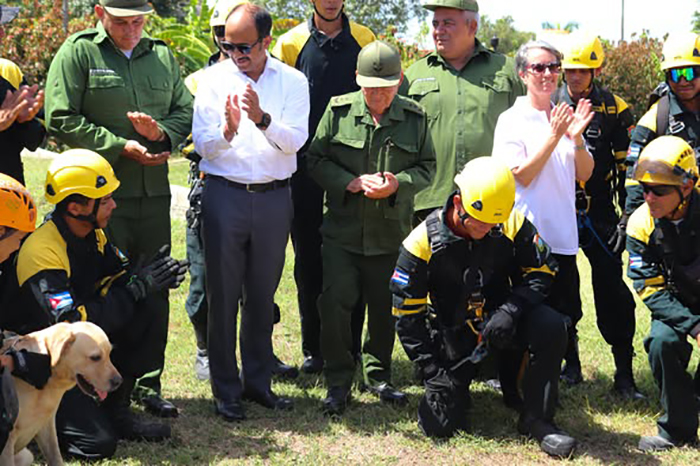
Kamal Kishore, Special Representative of the UN Secretary-General and head of the United Nations Office for Disaster Risk Reduction (UNDRR), learned this Wednesday in Havana about the actions of the Urban Resilience project, implemented by the United Nations Development Program (UNDP) and the Havana government, with support from the European Union’s Directorate-General for Civil Protection and Humanitarian Aid Operations and the National Civil Defense Staff.
According to the UNDP, as stated on its Facebook page, the exchange addressed topics related to risk management, urban planning, population protection, and territorial resilience. This was achieved through specialized training in rescue and salvage, the integration of a risk approach into urban planning instruments, community preparedness, and the strengthening of institutional capacities.
Kishore highlighted the value of the collaborative experience among communities, municipalities, and institutions, while firefighters conducted demonstration exercises.
The Urban Resilience project has focused its work on strengthening the preparedness capacities of the housing and urban planning sectors in Havana, Pinar del Río, and Artemisa, with the aim of contributing to a more efficient response to disasters and increasing the resilience of cities.
Participants in the meeting included Major General Ramón Pardo Guerra, Chief of the National Civil Defense Staff; and Denis Heidedroek, Regional Coordinator for the Caribbean in Disaster Preparedness. Nahuel Arena, head of the UNDRR Office for the Americas and the Caribbean; Gabriel Bottino, UNDP Deputy Resident Representative; city government officials; and members of the Cuban Fire Department.
Kishore was received this Wednesday at the Palace of the Revolution by the First Secretary of the Communist Party of Cuba and President of the Republic, Miguel Díaz-Canel Bermúdez, who thanked the UN for its support and emphasized the importance of the Sendai Framework as an international instrument for addressing disaster risks.
The president denounced the impact of the economic, commercial, and financial blockade imposed by the United States against Cuba on the country’s capacity to respond to disasters and reaffirmed Cuba’s commitment to multilateral cooperation in this area.
[ SOURCE: AGENCIA CUBANA DE NOTICIAS ]
