

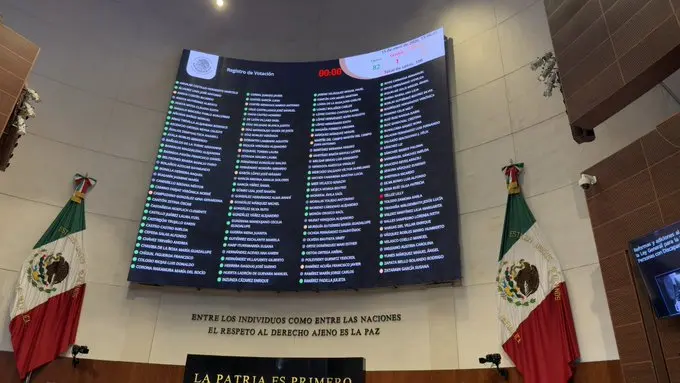
Senate passes Sheinbaum-backed film law with 87 votes in favor, 1 against and 18 abstentions, expanding rules for film and streaming
Mexico’s Senate has approved a new Federal Film and Audiovisual Law promoted by President Claudia Sheinbaum, designed to strengthen the production, promotion, exhibition and commercialization of Mexican cinema through fiscal incentives and regulatory measures.
The reform was approved with 87 votes in favor, one against and 18 abstentions, and has been sent to the executive branch for formal promulgation.
Senator José Antonio Álvarez Lima of Morena said the legislation reflects structural transformations in the audiovisual sector, particularly the expansion of digital platforms.
“The importance of this legislation lies in the fact that it ‘recognizes the major technological changes in the industry, so that it not only includes traditional films, but also audiovisual works that we see on our small screens and streaming or on-demand videos that we enjoy at home, from Netflix, Disney and others,’” he said.
Text Reads: Cinema is part of Mexico’s history and identity; with the aim of updating its legal framework, senators approved the creation of the Federal Film and Audiovisual Law. Learn more about this instrument that seeks to promote the national film industry.
He added that the law, which repeals the Federal Cinematography Law, maintains a requirement for commercial cinemas to allocate 10 percent of weekly screenings to Mexican films, while also obliging digital platforms to ensure visibility of national productions through fast-access formats.
This measure, he noted, ensures “the work of Mexican filmmakers, producers, directors, actors, actresses and industry technicians.”
Álvarez Lima also stated that the Mexican Cinematography Institute will be supported by an independent advisory committee intended to improve transparency in the allocation of public funding and avoid favoritism.
He added that the framework is guided by principles including cultural diversity, substantive equality, freedom of creation, inclusion, decentralization, and respect for Mexico’s multicultural composition, while also introducing accessibility measures such as inclusive dubbing and subtitling for people with disabilities.
Text Reads: With 82 votes in favor, 1 against, and 17 abstentions, the Senate approves the bill that enacts the Federal Film and Audiovisual Law and repeals the Federal Cinematography Law. It now goes to the Federal Executive Branch.
Beatriz Mojica Morga, president of the Senate Culture Commission, said the law strengthens Mexican cinema as both a cultural sector and an economic activity of public interest, emphasizing the state’s responsibility in supporting employment and development.
Morena senator Javier Corral said one of the main advances is the reinstatement of Article 35, which restores progressive public funding mechanisms for national cinema through trusts, funds and fiscal incentives.
“This includes a new fiscal incentive of up to 400 million pesos per year through 2030, which is added to an existing incentive under the Income Tax Law, with a cap of up to 750 million pesos and which credits up to 25 percent of projects submitted for national production,” he said.
The law now awaits presidential promulgation, after which it will enter into force.
[ SOURCE: teleSUR ]
