

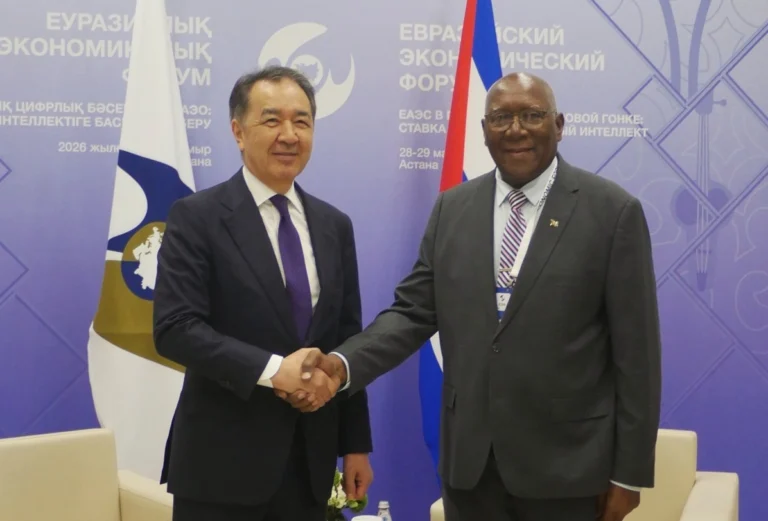
On Thursday, Cuban Vice President Salvador Valdés Mesa and the President of the Eurasian Economic Council Bakytzhan Sagintayev signed a Joint Action Plan for the period 2026-2030.
The document defines a multisectoral strategy to deepen cooperation between the Caribbean island and the Eurasian Economic Union. The agreement was signed within the framework of the 5th Eurasian Economic Forum, held in Astana.
RELATED:
Cuba Praises Role of Eurasian Economic Union in Global Cooperation
During their meeting in Kazakhastan, Valdés Mesa outlined Cuba’s potential for cooperation with the five nations of the bloc, highlighting sectors such as biotechnology, tourism, agriculture, the sugar industry, and the Mariel Special Development Zone.
They also discussed opportunities for exchange and joint ventures in these strategic areas. For his part, Bakytzhan Sagintayev expressed his gratitude for Cuba’s participation as an Observer State in the forum and acknowledged the esteem that Cuban President Miguel Díaz-Canel holds for the bloc.
The Eurasian leader emphasized that these exchanges have allowed for increased bilateral trade not only with Russia, but also with other members such as Armenia, at a complex time for the Caribbean nation.
During the talks, Valdés Mesa delved into the complex economic situation facing the island, a result of the tightening of the US embargo and threats of military aggression. The Cuban vice president also extended an invitation to the business community of the regional bloc to attend the Havana International Fair in November, a venue where new business deals could be finalized.
After the bilateral talks concluded, the officials toured the Astana Congress Center, the venue for the Eurasian Economic Forum. A Cuban business delegation representing the biotechnology, logistics, and trade sectors is participating in this event.
At the forum’s plenary session, Kazakhstan’s President Kassym-Jomart Tokayev opened the meeting, emphasizing that artificial intelligence and digital technologies are the new drivers of development and competitiveness for the Eurasian Economic Union.
For his part, Russian President Vladimir Putin focused his remarks on the large-scale deployment of AI and safeguarding the bloc’s technological and financial sovereignty against US sanctions.
Similarly, Belarusian leader Alexander Lukashenko stressed the urgent need to adapt the industrial sector to these emerging technologies.
