

By Migdalia Arcila
Raya Magazine / Opinion
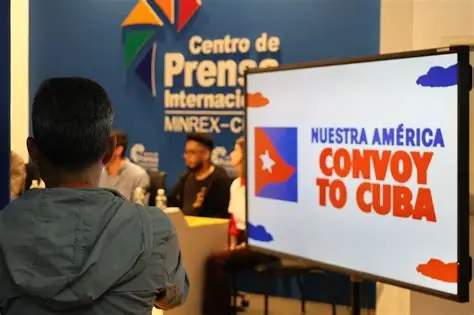
Despite the numerous threats of military intervention, despite the more than 45 bombings of civilian vessels in the Caribbean since September of last year, despite the numerous U.S. efforts to isolate and suffocate Cuba with an economic blockade that has now lasted over 60 years, the Our America Convoy arrived on the island on March 21.
More than 600 people from 32 different countries filled their luggage with medicine, school supplies, medical equipment, and all kinds of humanitarian aid they could fit on a commercial flight. Twenty-seven of us from Colombia, representing ten different social, academic, and labor organizations, departed. In just a couple of weeks, and with the support of hundreds of people, we managed to collect a ton of humanitarian aid. Among all of us who arrived by air in Havana from different corners of the world, we managed to deliver more than 20 tons of humanitarian aid, which is in addition to the 30 tons that arrived on a civilian vessel from Mexico this Tuesday, March 24.
While the United States has deliberately created a situation in which Cuba urgently needs this humanitarian aid, it is crucial to understand that the Convoy is not an act of charity; Cuba does not need anyone’s charity. Moreover, the Convoy is not simply an act of solidarity; it is, above all, an act of reciprocity. Since the triumph of the revolution, Cuba has achieved an understanding that in many countries of the Global South remains a pipe dream for a few: the understanding that every process of social justice and anti-imperialist liberation is, in essence, an internationalist process.
While lifting more than 700,000 people out of illiteracy and fighting against the U.S. invasion at Playa Girón, Cuba was simultaneously extending a helping hand to as many countries around the world as needed. In 1960, just one year after the triumph of the revolution, Cuba sent its first medical brigade to Chile to assist the victims of the great Valdivia earthquake, marking the beginning of the more than 57 medical brigades that currently serve patients around the world.
This “army of white coats” has responded to emergencies of such devastating magnitude as the cholera outbreak in Haiti, the Ebola epidemic in West Africa, and the Covid-19 pandemic. All of this has been done without neglecting its own population, who benefit from a universal, public, and free healthcare system, a maternal and child health program that women living in so-called “Western democracies” can only envy, and a range of social guarantees in education and housing that testify to a robust and successful humanist societal project.
It is precisely because the Cuban project works, because the principles of the revolution not only transformed Cuba from a haven for gringos and exploiters into a powerhouse in science, art and the humanities, but also brought care and hope to completely hopeless corners of the world that the United States has been trying, unsuccessfully, to suffocate for over 60 years.
The message of the Convoy and each of the delegations was very clear: the time has come to give back to Cuba a little of what they have given us. The Convoy is not a media gesture of depoliticized humanitarianism; it is a clear political act against the US blockade and the complicity of all those governments that, for more than 30 years, have voted in the United Nations General Assembly to “condemn” the blockade, but then stand idly by while the United States continues to oppress the Cuban people.
The economic blockade and constant threats to which Cuba has been subjected since 1959 have never prevented it from extending a helping hand to other nations. For example, in 2021, Cuba was once again included on the list of state sponsors of terrorism for its role as a guarantor in the peace negotiations between the Colombian government and some armed groups, forcing it to accept a series of sanctions and financial restrictions that added further hardship to more than 60 years of blockade. As if that weren’t enough, Cuba awarded 1,000 scholarships to signatories of the peace agreement between the Colombian government and the FARC so they could study medicine at ELAM (Latin American School of Medicine). These scholarships cover tuition, housing, food, transportation, and books. If you are Colombian, stop for a moment and carefully reread that last sentence.
While 480 signatories of the peace agreement have been murdered in our country, Cuba provides free education, housing, and food to a thousand of our compatriots. In other words, while our country, supposedly the most stable democracy in Latin America, long since surrendered to neoliberalism, has failed to guarantee the minimum conditions for survival for the signatories of the agreement—and for a large number of Colombians in general — Cuba offers opportunities for professional and personal flourishing to at least a thousand Colombians who today could be subject to persecution and violence in our country.
So, how can one leave the Our America Convoy without a profound sense of admiration and gratitude for Cuba? But above all, how can one leave the Convoy without the clear understanding that Cuban socialism is a project that works and has worked not only for Cubans but for many peoples around the world? What doesn’t work, what has Cuba in crisis, Gaza in ruins, and our countries on their knees in fear, is U.S. imperialism.
The same system that has brought us only devastation, dispossession, and humiliation, the same system that prefers to finance a genocide in Israel rather than provide social security and decent housing for its own population. This clarity is something they will not be able to take from us, something they have not been able to take from Cuba in more than six decades of implementing multiple maneuvers of suffocation, something they will not be able to take from the leaders of the Convoy who are being detained and interrogated today as they return from Havana to their countries.
The clarity that criticisms of Cuban socialism are completely empty as long as the blockade exists, as long as there is the possibility that a single country can decide at its convenience who has the right to live. We have found, then, a clarity that they will never be able to take from us, a clarity that, as the Our America Convoy demonstrates, is both mobilizing and internationalist.
[ SOURCE: www.cubainformacion.tv ]
