

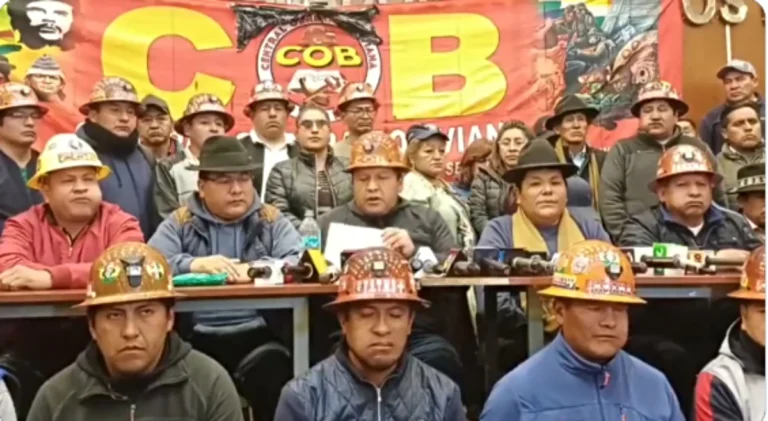
Bolivia’s main labor federation has submitted a proposal for immediate national pacification to President Rodrigo Paz after 47 consecutive days of social unrest, outlining a series of political, economic and institutional measures that it says are necessary to restore stability.
RELATED: Bolivia Rejects International Delegation of Human Rights Observers
The National Executive Committee of the Bolivian Workers’ Center (COB) delivered the document together with a formal ultimatum demanding an end to what it describes as the criminalization of social protest and calling for guarantees to restore institutional order.
The organization, which brings together trade unions, peasant organizations, Indigenous groups, neighborhood associations, miners, transport workers and other social sectors, said demonstrations and road blockades will continue across the country until the government issues an official response.
COB Executive Secretary Mario Argollo reiterated that the mobilizations remain indefinite and warned that pressure measures could intensify if authorities fail to respond. The resignation of President Rodrigo Paz continues to be a central demand among the organizations participating in the protests.
The proposal conditions any process of national pacification on compliance with an eight-point agenda focused on institutional reform, economic policy, labor rights and environmental protection.
Among its key demands, the COB calls for the repeal of anti-blockade legislation, an end to political, judicial and media persecution of social leaders, amnesty for those detained during the current conflict, and measures to eliminate discrimination and racism against Indigenous peoples.
The federation is also seeking legislative approval of a bill that would require elected officials, including the president, vice presidents, governors and mayors, to publicly account for their electoral commitments.
On economic policy, the proposal rejects any privatization, capitalization or concession of strategic state-owned companies to domestic or foreign private interests. It also opposes financing or policy conditions linked to the International Monetary Fund and calls for transparency regarding loans contracted with the World Bank and the Inter-American Development Bank.
The document further proposes a 50-50 fiscal-sharing arrangement between the central government and regional authorities to accelerate the distribution of public resources.
In the area of oversight and accountability, the COB is demanding the immediate removal of Argentine political consultant Fernando Cerimedo from any advisory role within the government and is calling for an investigation into alleged influence peddling related to public appointments and state contracts.
The proposal also seeks the creation of a special commission within the Plurinational Legislative Assembly to investigate the cases known as “narcomaderas” and “narcomaletas.”
Its energy-related demands include freezing domestic fuel prices and providing compensation to transport operators and vehicle owners affected by the distribution of destabilized gasoline or adulterated fuels, subject to an independent technical audit.
The labor platform calls for mandatory prior consultation before the approval of laws, supreme decrees or macroeconomic measures, including Supreme Decree 5515 and the government’s package of ten economic measures.
The proposal also advocates measures to curb speculation affecting the cost of basic goods and the creation of a sovereign fund to guarantee pensions equivalent to 100 percent of earned salaries for workers in sectors including mining, health care, manufacturing, agriculture, transport and commerce, as well as members of the Bolivian Police.
Environmental provisions include a ban on mining, oil extraction and other activities considered destructive within national parks and protected natural areas. The agenda concludes with a call for immediate dialogue tables to address pending demands from transport workers, peasant organizations, neighborhood federations and other affiliated sectors.
“A decision has been made, in consultation with all actors, to send the central government an ultimatum and proposal for the pacification and recovery of the country, which must be addressed immediately. The protest, the struggle and the mobilization continue throughout the country until we receive a response from the government,” Argollo said.
“Otherwise, we will expand actions on streets and highways to ensure compliance with what has been demanded today and remains at the center of the struggle, namely the resignation of the president. Just as a leader knows how to call for mobilization, he must also know how to call for peace,” he added.
Author: MK
Source: @FreddyteleSUR / agencies
Source: teleSUR English
